Home / Blog / Step The F*ck Up
STEP THE F*CK UP
Why Regret Hurts More Than Failure: The Compounding Problem
Part of the series Month Two: 28 Days of Dragging Fear Into the Light
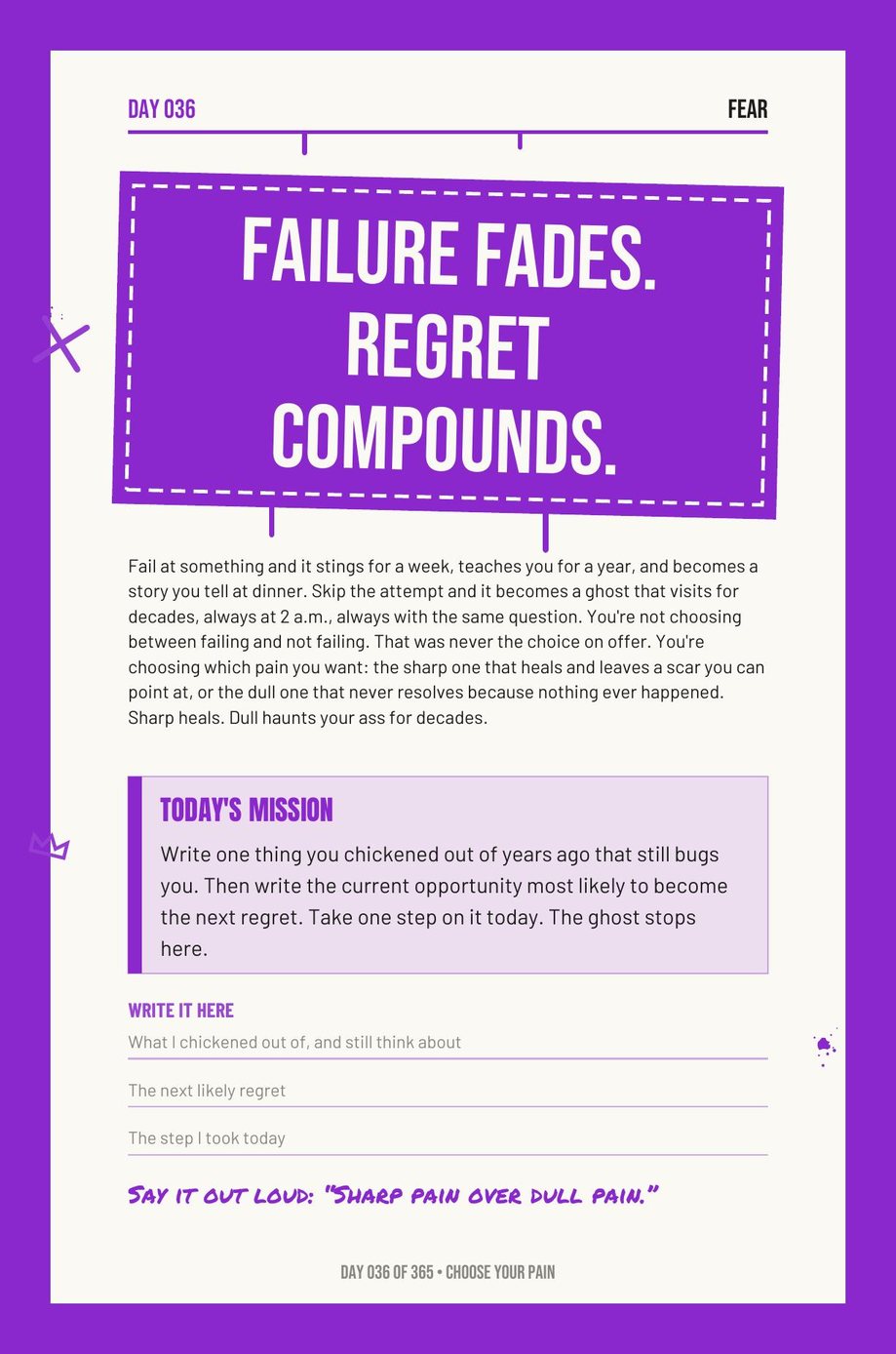
Failure and regret run on opposite financial models. Fail at something and it stings for a week, teaches you for a year, and then depreciates into an anecdote. Regret works the other way: it pays out no lesson, and it charges interest, quietly, for decades, because the untried thing never resolves. You cannot learn from a thing you never did, so the account never closes.
Failure is a cost. Regret is a debt.
A cost is paid once. The launch flops, the ask gets declined, the attempt is publicly mediocre: painful, finite, and convertible, because every failure carries data you can spend on the next attempt. A debt accrues. The business not started and the words not said generate no data at all, only the recurring question of what would have happened, which arrives at 2 a.m., on birthdays, and at other people's funerals, forever unanswerable by design.
Why your brain prices this backwards
In the moment, failure feels expensive because it is visible: people might see. Regret feels free because it is private: nobody watches you not try. So the instinct optimizes for the audience and books the invisible debt. The correction is noticing that the audience forgets your failures faster than you do, usually within days, while the debt has exactly one permanent witness, and you live with them.
The old-people evidence
Ask people at the far end of life what they would change and the answers cluster with almost boring consistency around omissions: the risk not taken, the truth not told, the person not called. Rarely the attempts that went badly. That is not sentimentality, it is the compounding math reported back from people who have run the full term of both instruments. The deathbed test is the daily tool built on exactly this reporting.
What to do with the asymmetry
Not recklessness; accounting. When avoiding something, name both prices honestly: the one-week sting of a bad attempt against the open-ended interest of never knowing. Then act on the arithmetic instead of the feeling, one small scary move at a time, which is the entire fear month of a certain daily book, and the reason bouncing back from failure is a learnable skill while there is no such page for bouncing back from regret. There cannot be. That is the point.
Step The F*ck Up
365 days of no-bullsh*t motivation. One page, one mission, two minutes. Miss never twice.
Why does regret feel worse than failure?
Because failure resolves and regret cannot. A failed attempt produces pain plus data, then fades. An untried thing produces no data, so the question of what would have happened stays open and accrues for decades.
Is it better to fail than to regret?
Financially, yes: failure is a one-time cost that pays a lesson; regret is an interest-bearing debt that pays nothing. The exception is genuine recklessness, where the failure cost is catastrophic rather than embarrassing.
More on Step The F*ck Up
- Your Eulogy Is Being Written Now, in Ordinary Hours
- Why You Self-Sabotage Right Before It Works
- Why Strength Is a Life Skill, Not Vanity
- Why Sleep Comes Before Everything: Sleep Is a Performance Drug
- Why Everything Feels Worse at Night (3 A.M. Is a Liar)
The method behind every book
- Which 365-Day Book Should I Start With? A One-Minute Guide
- What Is a No Zero Day? The Rule That Saves a Bad Week
- What Is a Realistic Morning Routine? Two Minutes, Not Two Hours
All articles about Step The F*ck Up → · The book page → · All the books →
written by the author, at the kitchen table, after work.