Home / Blog / Step The F*ck Up
STEP THE F*CK UP
Why Everything Feels Worse at Night (3 A.M. Is a Liar)
Part of the series Month Three: 31 Days of Teaching the Voice in Your Head Who It Works For
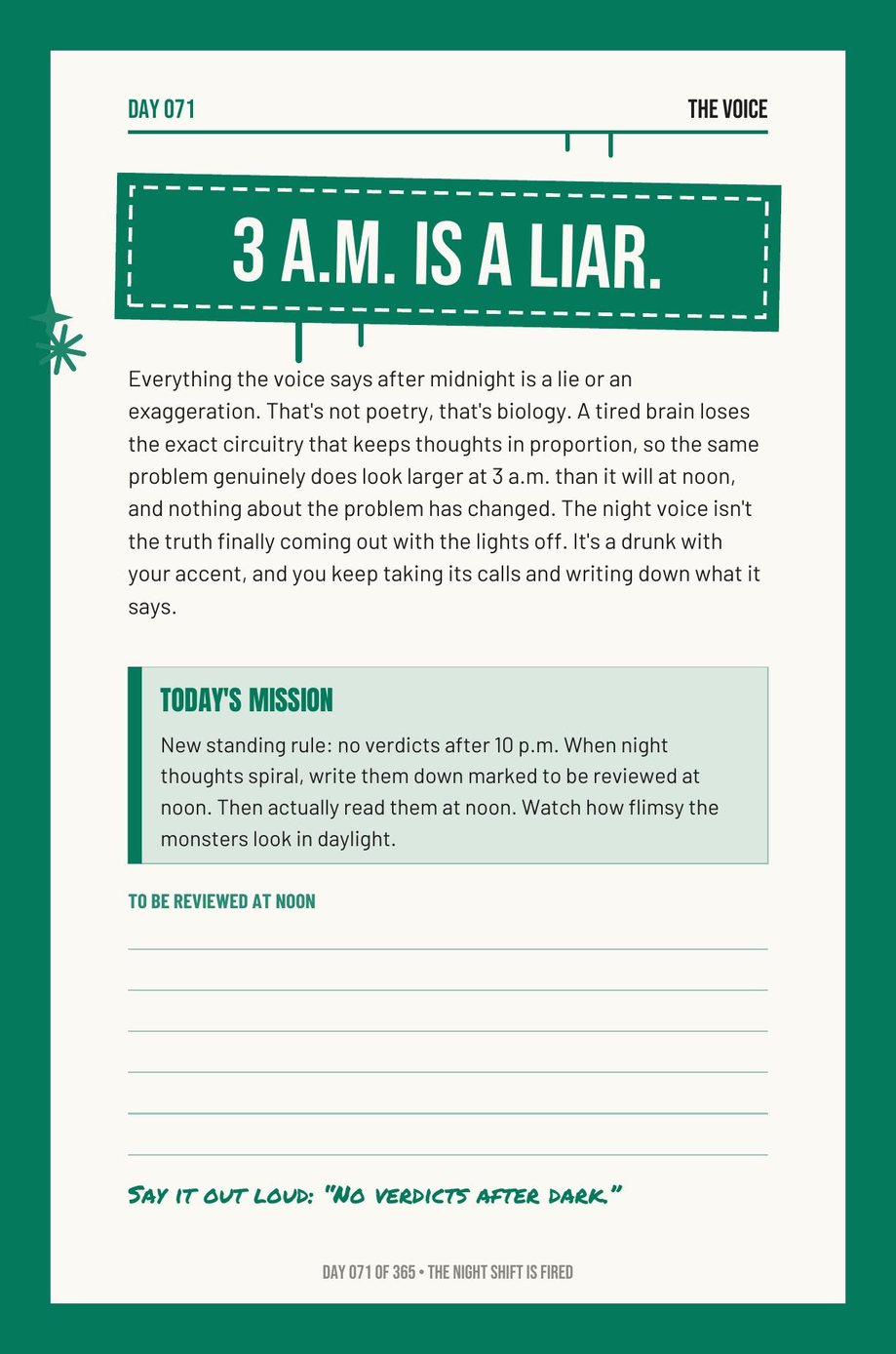
Everything the voice says after midnight is a lie or an exaggeration, and the book's Day 71 page insists that is not poetry, it is biology. A tired brain loses the exact circuitry that keeps thoughts in proportion, so the same problem genuinely does look larger at 3 a.m. than it will at noon, and nothing about the problem has changed. The night voice is not the truth finally coming out with the lights off. It is, in the book's phrase, a drunk with your accent, and you keep taking its calls and writing down what it says.
What is actually happening at 3 a.m.
Sleep loss and the small hours degrade the parts of the brain that regulate emotion and put things in scale, while leaving the parts that generate threat fully staffed. So the mind runs the same problem through a machine with the proportion module switched off, and produces a verdict: it is hopeless, you have ruined it, everyone knows. The verdict feels more true than the daytime version precisely because it is unopposed. There is nobody in the booth to argue. That is not insight. It is a missing referee.
The rule: no verdicts after 10 p.m.
The mission is a standing rule, not a technique for the moment: no verdicts after ten. When night thoughts spiral, write them down, marked to be reviewed at noon, and then actually review them at noon. The writing is the trick, because it satisfies the mind's demand to deal with the thing without letting the 3 a.m. version make any decisions. And the noon review is where the education happens: read in daylight, the night verdict is nearly always either wrong or smaller than it was, and after a few weeks of this the night voice loses its credentials, because you have a file of its predictions and their results.
Why this is a discipline problem too
The 3 a.m. voice is loudest in people who are chronically short of sleep, which is most people, which is why the book returns to the body in Month Six and puts sleep first. A tired brain is a brain that has handed the voice a microphone. The Health rubric in a scored life treats seven hours as the floor for exactly this reason. Fix the sleep and the night voice does not go away, but it gets quieter and later, and the noon review has less to review.
Where this sits
Day 71 of Month Three, The Voice, the night shift, after the statistics and before the tax. Stopping negative self-talk is the daytime method; the Health rubric explains why sleep is the floor; fear holding you back is what the night voice is usually working with. One written thought, one noon review, and a certain book's rule about who gets to issue verdicts after dark.
Step The F*ck Up
365 days of no-bullsh*t motivation. One page, one mission, two minutes. Miss never twice.
Why do my problems feel bigger at night?
Because a tired brain loses the circuitry that keeps thoughts in proportion while the threat-generating parts stay fully staffed. The problem has not changed; the referee has gone home. The night verdict is unopposed, not true.
What should you do about anxious thoughts at 3 a.m.?
Write them down, marked for review at noon, and issue no verdicts after 10 p.m. Review them in daylight; after a few weeks you have a file showing the night voice's predictions and their results.
More on Step The F*ck Up
- Your Eulogy Is Being Written Now, in Ordinary Hours
- Why You Self-Sabotage Right Before It Works
- Why Strength Is a Life Skill, Not Vanity
- Why Sleep Comes Before Everything: Sleep Is a Performance Drug
- Why Regret Hurts More Than Failure: The Compounding Problem
The method behind every book
- Which 365-Day Book Should I Start With? A One-Minute Guide
- What Is a No Zero Day? The Rule That Saves a Bad Week
- What Is a Realistic Morning Routine? Two Minutes, Not Two Hours
All articles about Step The F*ck Up → · The book page → · All the books →
written by the author, at the kitchen table, after work.