Home / Blog / Step The F*ck Up
STEP THE F*CK UP
How to Stop Calling Yourself Stupid: The Self-Insult Tax
Part of the series Month Three: 31 Days of Teaching the Voice in Your Head Who It Works For
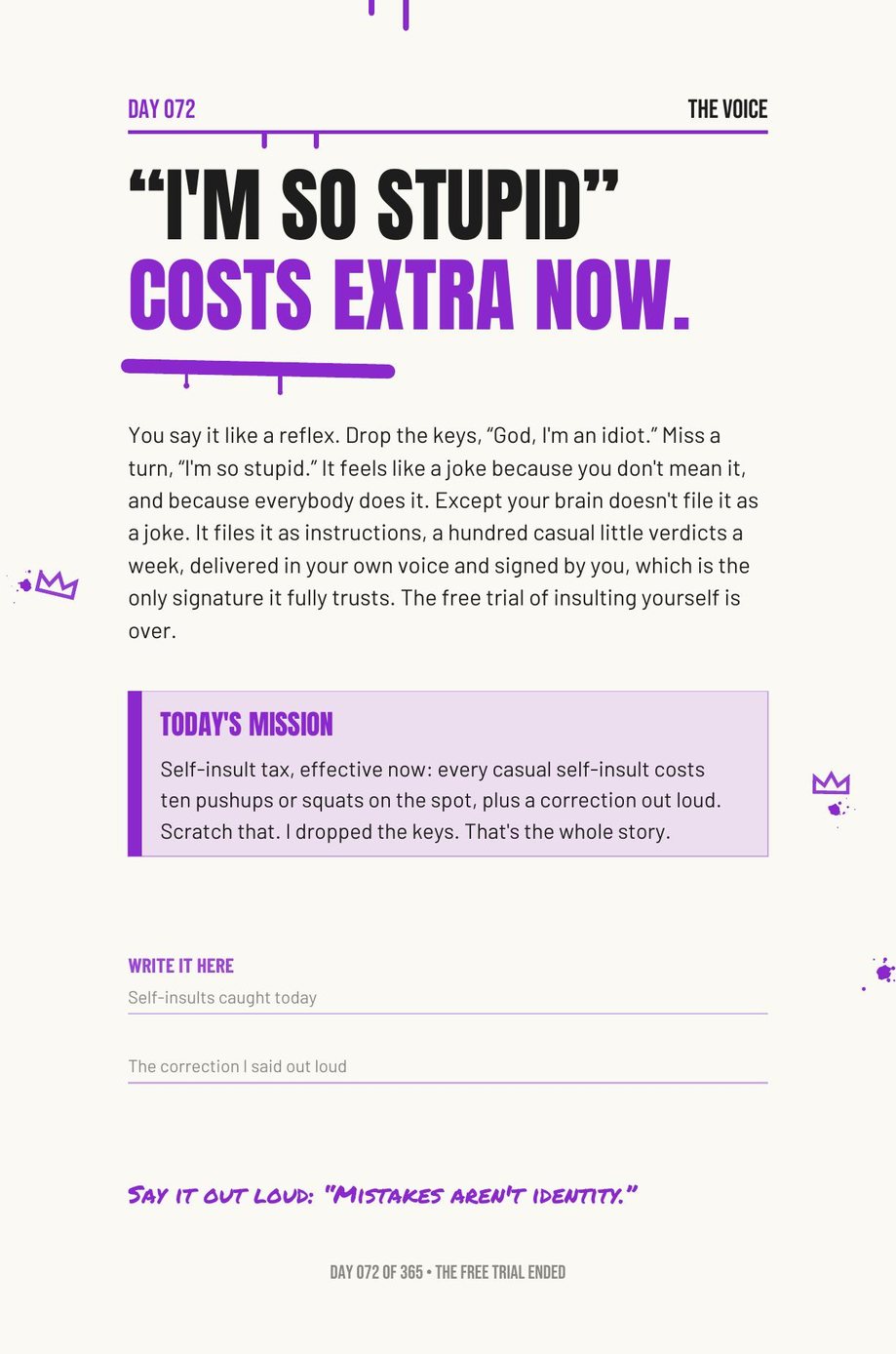
You say it like a reflex. Drop the keys, God, I'm an idiot. Miss a turn, I'm so stupid. It feels like a joke because you do not mean it and because everybody does it. The book's Day 72 page says your brain does not file it as a joke. It files it as instructions, a hundred casual little verdicts a week, delivered in your own voice and signed by you, which is the only signature it fully trusts. The free trial of insulting yourself is over, and the replacement is a tax.
Why casual matters more than serious
The dramatic self-attack after a real failure is rare and gets noticed and argued with. The casual one is constant, unnoticed, and unopposed, and volume is what the brain believes. A hundred small idiots a week, over twenty years, is a hundred thousand signed instructions, and the person who wonders why they do not trust themselves with anything important has been telling themselves, hourly, in their own voice, that they cannot be trusted with keys. The reflex is not harmless because it is small. It is harmful because it is small enough to run all day.
The tax, exactly as the book runs it
Effective immediately: every casual self-insult costs ten pushups or squats on the spot, plus a correction out loud. Scratch that; I dropped the keys. The physical cost makes the reflex expensive enough to notice, which is the first requirement, since you cannot stop what you cannot hear. The correction out loud does the second job: it replaces the instruction with an accurate one, in the same voice, with the same signature. I dropped the keys is true. I'm an idiot is a verdict, and verdicts, the month has established, are the voice's business, not yours.
What a week of the tax does
The first two days are humbling, because the count is higher than anyone expects; people report twenty or thirty pushups before lunch. By day four the reflex has learned that it costs, and the pause appears between the dropped keys and the sentence. By the end of the week the sentence has mostly changed to the accurate version, and the brain is receiving, for the first time in decades, a hundred true small instructions instead of a hundred false ones. The book's next page, the voice has a DJ, is about what it plays when the insults stop.
Where this sits
Day 72 of Month Three, The Voice, the day after the 3 a.m. rule, in the block where the voice's habits get expensive. Stopping negative self-talk is the cross-examination; the inner critic is the longer companion; the can't rewrite is the same principle, that your words are instructions, from Month One. Ten pushups and a corrected sentence, in a certain book that charges for self-insult.
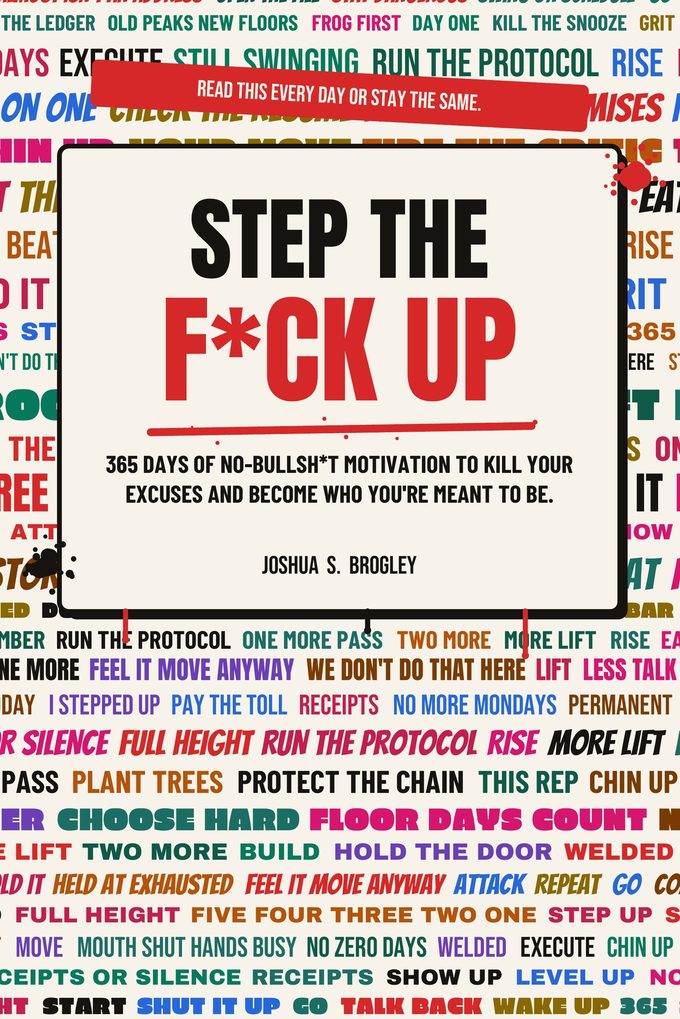
Step The F*ck Up
365 days of no-bullsh*t motivation. One page, one mission, two minutes. Miss never twice.
How do you stop putting yourself down?
Make it cost: ten pushups or squats on the spot for every casual self-insult, plus a correction said out loud, I dropped the keys instead of I'm an idiot. The cost makes the reflex audible; the correction replaces the instruction.
Does calling yourself stupid as a joke matter?
Yes. The brain files it as an instruction signed by you, and it happens a hundred times a week. Volume is what the brain believes, and the casual insult runs all day unopposed.
More on Step The F*ck Up
- Your Eulogy Is Being Written Now, in Ordinary Hours
- Why You Self-Sabotage Right Before It Works
- Why Strength Is a Life Skill, Not Vanity
- Why Sleep Comes Before Everything: Sleep Is a Performance Drug
- Why Regret Hurts More Than Failure: The Compounding Problem
The method behind every book
- Which 365-Day Book Should I Start With? A One-Minute Guide
- What Is a No Zero Day? The Rule That Saves a Bad Week
- What Is a Realistic Morning Routine? Two Minutes, Not Two Hours
All articles about Step The F*ck Up → · The book page → · All the books →
written by the author, at the kitchen table, after work.