Home / Blog / Step The F*ck Up
STEP THE F*CK UP
How to Stop Saying I Can't (Most Can'ts Are Won'ts in Disguise)
Part of the series Month One: 31 Days of Hunting Down Every Excuse You Have Ever Made
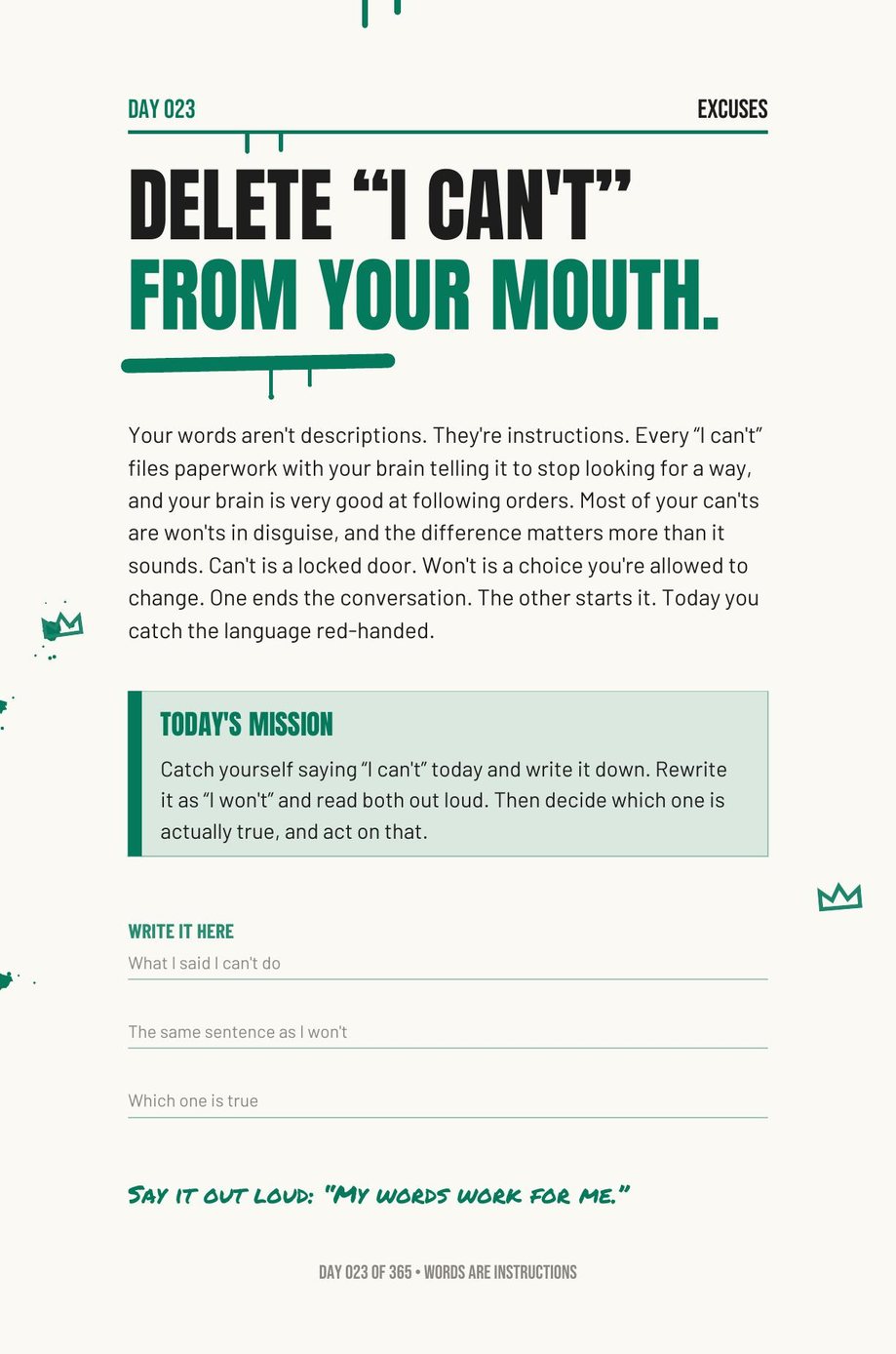
Your words are not descriptions. They are instructions. Every I can't files paperwork with your brain telling it to stop looking for a way, and your brain is very good at following orders. That is the book's Day 23 page, and its central claim is uncomfortable and checkable: most of your can'ts are won'ts in disguise. Can't is a locked door. Won't is a choice you are allowed to change. One ends the conversation. The other starts it. The method is to catch the language red-handed, once a day, in writing.
Why the word matters more than it sounds
Can't sounds like a fact about the world; won't is a fact about you. The reason people prefer can't is that it removes them from the sentence: I can't afford it, I can't get up that early, I can't talk to him. Each one, rewritten, becomes I won't prioritize it, I won't go to bed earlier, I won't have that conversation, and every one of those is true and every one of those is fixable, which is precisely why the mouth avoids them. The rewrite is not a trick of positive thinking. It is an accuracy correction, and the brain, which takes instructions, gets a different instruction.
The rewrite, exactly as the book runs it
Catch yourself saying I can't today. Write it down. Rewrite it as I won't, and read both out loud. Then decide which one is actually true. Sometimes it is can't: you cannot bench three hundred today, you cannot make the deadline that passed. Fine; those are constraints, and constraints get planned around. But the majority turn out to be won'ts, and a won't read aloud in your own voice is hard to keep saying, because it is embarrassing in a useful way. The embarrassment is the mechanism.
What happens after a week of it
The word thins out. Not because you police it, but because you can hear it now, the way you can hear a verbal tic once someone points it out. What replaces it is mostly two things: the honest won't, which leads to a decision, and the honest can't yet, which leads to a plan. Both are better than the locked door. The book pairs this page with the one on tomorrow and the one on shrinking goals, because can't is usually the door, tomorrow is the excuse for not opening it, and too big is what you find behind it.
Where this sits
Day 23 of Month One, Excuses, late in the month, after the easier excuses have been buried and the language is the last place they hide. Shrinking the goal is what to do once can't becomes can't yet; the inner critic is where the word comes from; what fear is is usually what the door is locked with. One rewrite a day, in ink, is the size of the whole practice in a certain book that treats your sentences as instructions.
Step The F*ck Up
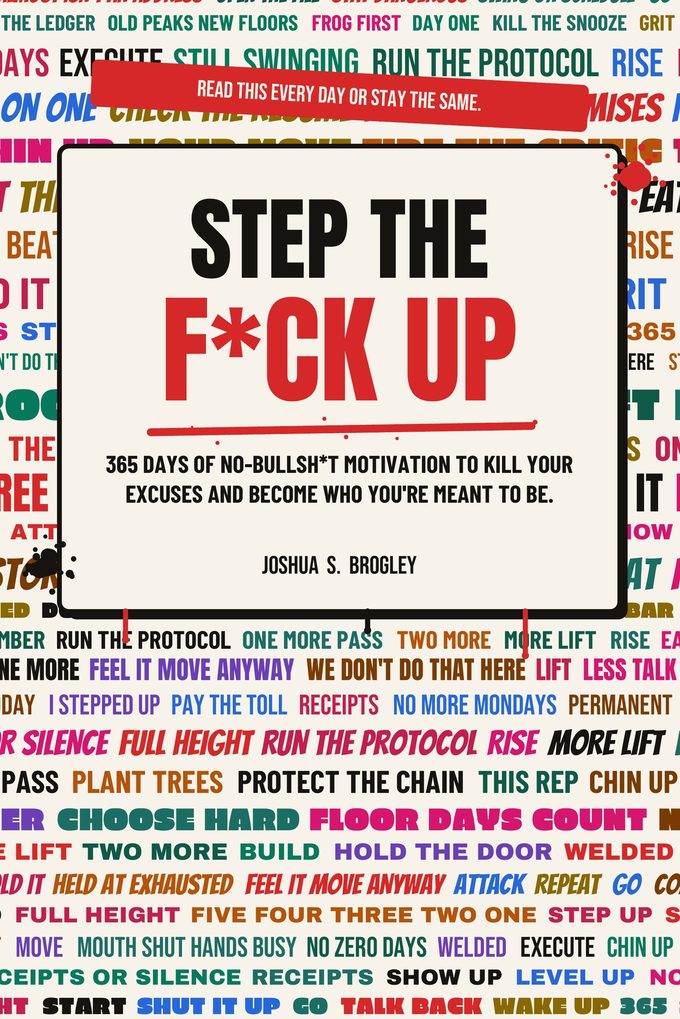
365 days of no-bullsh*t motivation. One page, one mission, two minutes. Miss never twice.
Why should you stop saying I can't?
Because words are instructions to the brain, and I can't tells it to stop looking for a way. Most can'ts are won'ts in disguise: can't is a locked door, won't is a choice you can change.
How do you reframe I can't?
Write the sentence down when you catch it, rewrite it as I won't, read both aloud, and decide which is true. Real can'ts become constraints to plan around; the rest become decisions.
More on Step The F*ck Up
- Your Eulogy Is Being Written Now, in Ordinary Hours
- Why You Self-Sabotage Right Before It Works
- Why Strength Is a Life Skill, Not Vanity
- Why Sleep Comes Before Everything: Sleep Is a Performance Drug
- Why Regret Hurts More Than Failure: The Compounding Problem
The method behind every book
- Which 365-Day Book Should I Start With? A One-Minute Guide
- What Is a No Zero Day? The Rule That Saves a Bad Week
- What Is a Realistic Morning Routine? Two Minutes, Not Two Hours
All articles about Step The F*ck Up → · The book page → · All the books →
written by the author, at the kitchen table, after work.