Home / Blog / Step The F*ck Up
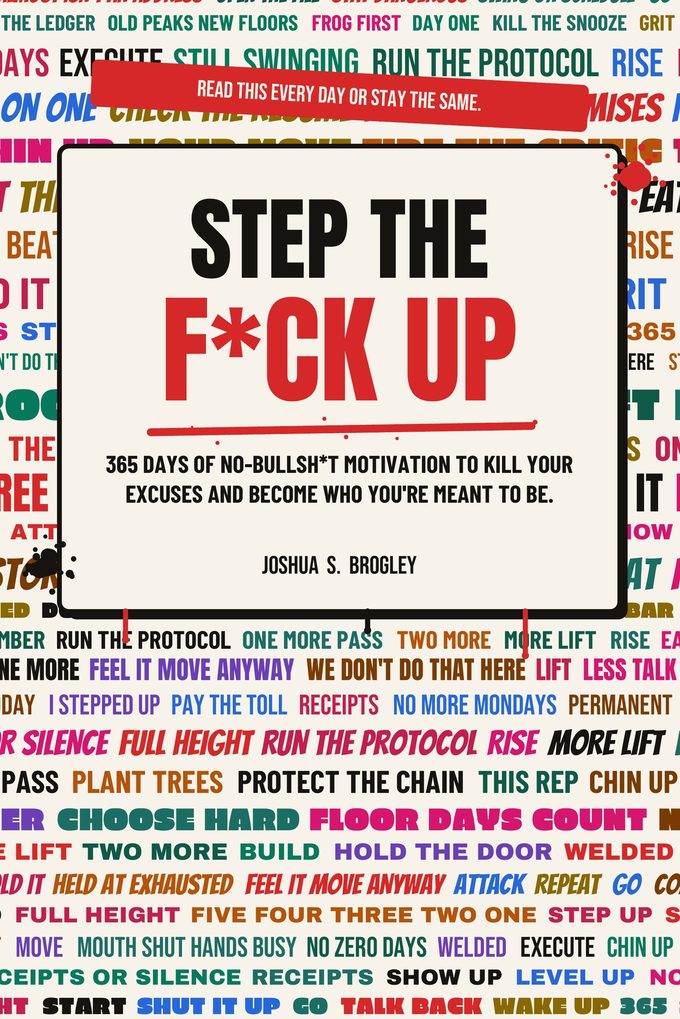
STEP THE F*CK UP
Month One: 31 Days of Hunting Down Every Excuse You Have Ever Made
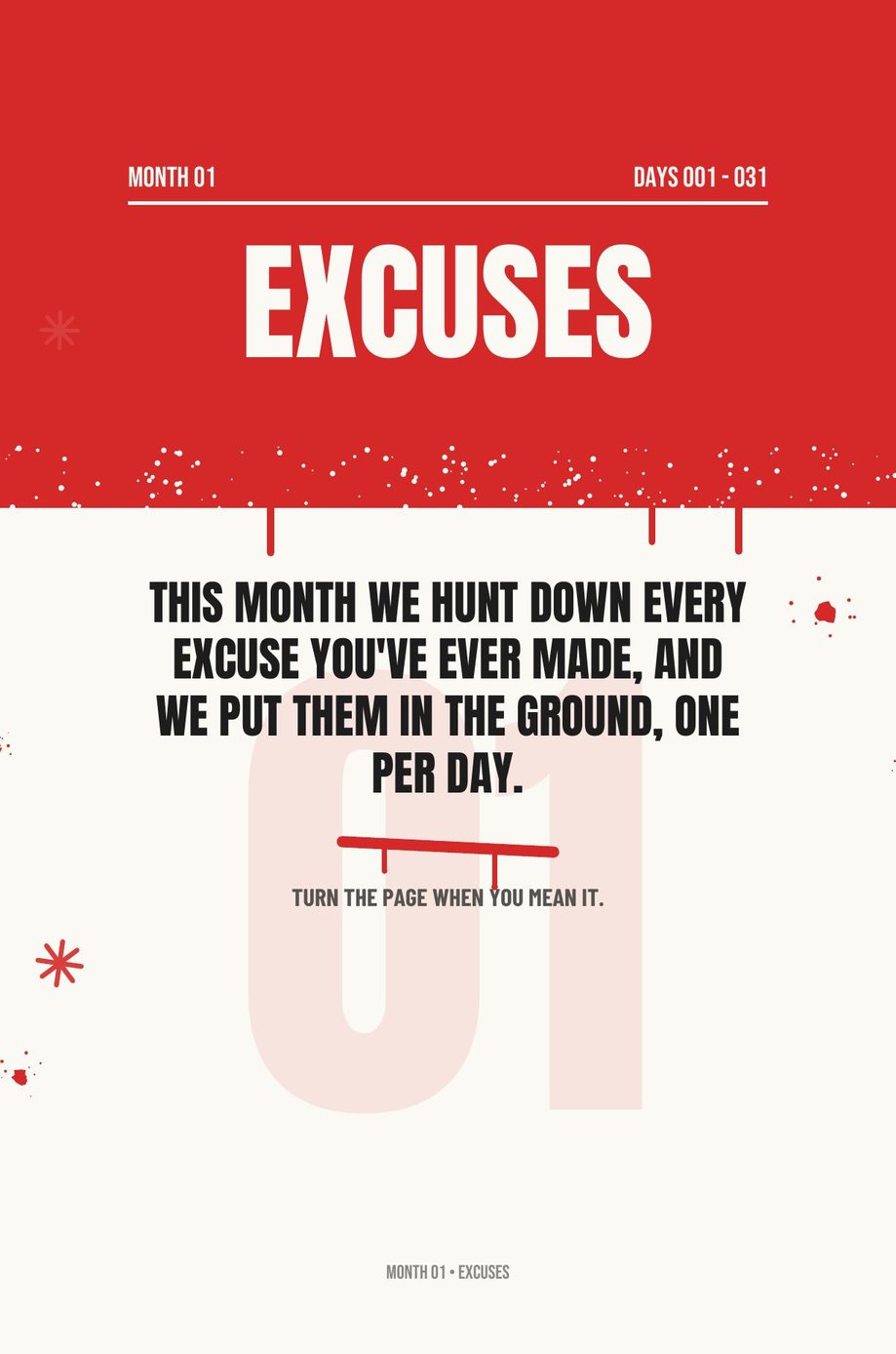
Month One is Excuses, days one to thirty-one, and the opener states the job without decoration: this month we hunt down every excuse you have ever made, and we put them in the ground, one per day. It comes first because everything else in the year is built on top of it. You cannot train discipline, face fear or own outcomes while a working excuse is still available, because the excuse will be used, every time, right at the moment the work gets hard. So the book spends a month taking them away one at a time, in daylight, with a mission attached to each.
What the month attacks, day by day
Day one names the pattern: every excuse is a check your future self has to cash, and the time has never been right for anybody. Then the roll call, one per page. I don't have time, dismantled by a screen-time report. The right time, which was never scheduled. Nobody knew, tomorrow, too late. Too old and too young, which the book calls the same bottle. Broke. Somebody had it worse. I can't, which is usually won't in disguise. Too big, which is a math error. The checkpoint on day sixteen asks whether you are still here; the month gate on day thirty-one prints the count, thirty-one excuses hunted down, and points at what was hiding behind them: fear.
Why excuses come before everything else
Motivation books start with vision; this one starts with the thing that kills vision on a Tuesday. The book's argument is that a person is not behind because life is unfair, since life is unfair for everyone; they are behind because they keep negotiating with the weakest version of themselves as if it deserved a seat at the table. The month removes the seat. Each day catches one specific negotiation in the act, names it, and hands you a mission small enough to do before you close the book. By day thirty-one the excuses are not gone, but they are recognizable, which is the only state in which they can be refused.
The daily mechanics
One page. A headline that names the excuse. A short paragraph that takes it apart without mercy. A mission with a box to write in: the screen-time number, the person who started later than you, the goal cut into three and then three again, the can't rewritten as won't and read aloud. Two minutes, in ink, then the day. The mechanics are the point: an excuse survives as a feeling and dies as a sentence on a page with a date next to it. The one-page-a-day format explains the format; how to stop making excuses and the most common excuses are the month's two anchor posts.
Go deeper into the month
Why you make excuses for everything, and what the reflex is protecting. I don't have time is a lie, with the report that proves it. How to stop saying I can't, the won't rewrite. Too big? Shrink it, the cut-into-three method. Plus the older posts the month feeds: procrastination, I always quit everything, and why you quit right before it works. Then Month Two, Fear, because that is what was behind every one of them.
Step The F*ck Up
365 days of no-bullsh*t motivation. One page, one mission, two minutes. Miss never twice.
What is the first month of Step The F*ck Up about?
Excuses. Thirty-one days, one excuse per day, each named, dismantled and given a two-minute mission: no time, wrong time, too old, too broke, too big, I can't. The month ends by pointing at what hid behind them, fear.
Why start with excuses instead of goals?
Because a working excuse is used at the exact moment any goal gets hard. The book removes them first so that discipline, fear and ownership can be trained on ground that does not give way.
More on Step The F*ck Up
- Your Eulogy Is Being Written Now, in Ordinary Hours
- Why You Self-Sabotage Right Before It Works
- Why Strength Is a Life Skill, Not Vanity
- Why Sleep Comes Before Everything: Sleep Is a Performance Drug
- Why Regret Hurts More Than Failure: The Compounding Problem
The method behind every book
- Which 365-Day Book Should I Start With? A One-Minute Guide
- What Is a No Zero Day? The Rule That Saves a Bad Week
- What Is a Realistic Morning Routine? Two Minutes, Not Two Hours
All articles about Step The F*ck Up → · The book page → · All the books →
written by the author, at the kitchen table, after work.