Home / Blog / Step The F*ck Up
STEP THE F*CK UP
How to Set Boundaries Without Pushing People Away: Instructions, Not Walls
Part of the series Month Eight: 31 Days of Auditing Who Sharpens You, Who Drains You, Who Stays
You think boundaries push people away. The book's Day 216 page says it is backwards, and the backwardness is costing you. A boundary is an instruction manual: here is how this works with me, here is what does not. People without boundaries do not end up with more friends; they end up with more resentment, delivered late and sideways after years of silent tolerating that nobody knew was happening. Clear instructions are a gift to everybody who actually wants to stay.
Why the wall model is wrong
A wall says stay out. An instruction says here is how to come in. The person who avoids boundaries to keep people close is running the wall model in reverse: no instructions, so people trip over invisible lines, so resentment builds on one side and confusion on the other, so the relationship degrades for reasons neither party can name. The book's ownership month already covered the mechanism, what you tolerate you teach; this page is the fix, and the fix is a sentence.
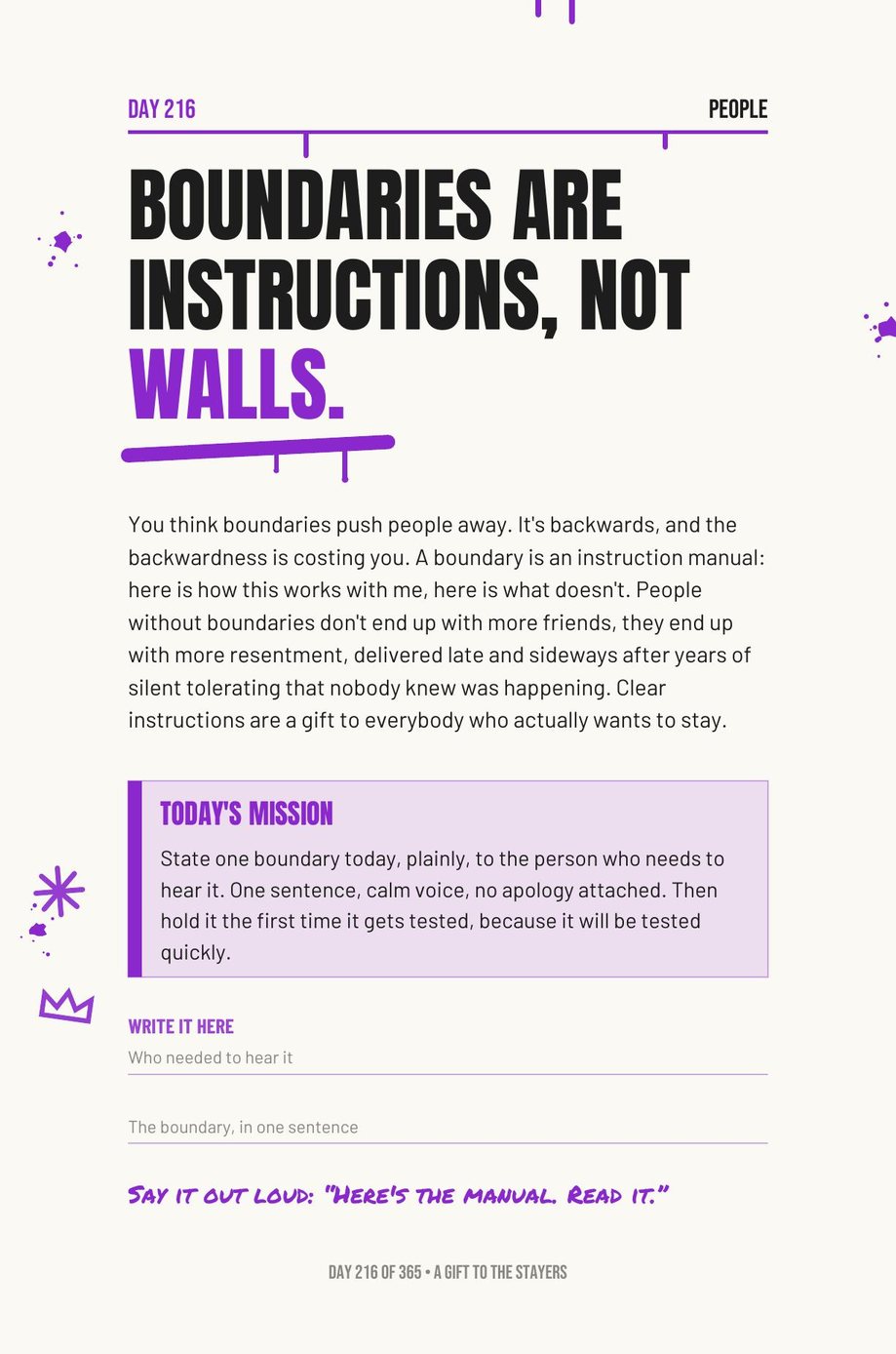
The mission: one boundary, plainly, to the person
State one boundary today, plainly, to the person who needs to hear it. Not a speech, not a text essay, not a hint. I don't take calls after nine. I'm not going to discuss her with you. If you're late again I'll start without you. The plainness is the whole technique; boundaries fail when they are wrapped in so much apology that the instruction is lost, and they fail when they are delivered as verdicts on the other person's character. An instruction is neither. It is information about you, offered so the other person can use it.
What happens next, usually
Relief, on both sides, more often than conflict. Most people who have been tripping the invisible line had no idea it was there and would rather know. The small number who react badly to a plain instruction were, the book suggests, relying on the absence of instructions, and their reaction is itself an audit result. The Circle Standards on Day 220 formalize this: the seats closest to you have entry requirements, written and signed, and a boundary stated out loud is the first one anyone gets to read.
Where this sits
Day 216 of Month Eight, People, the action page after the drainers have been identified. Spotting the drainers is who the sentence is usually for; the circle audit is the context; the Family rubric in the slow book asks whether conflicts get addressed before they harden, which is what a boundary does. One plain sentence, to one person, today, in a certain book that treats boundaries as a manual.
Step The F*ck Up
365 days of no-bullsh*t motivation. One page, one mission, two minutes. Miss never twice.
How do you set boundaries without hurting people?
Treat the boundary as an instruction, not a wall: one plain sentence about how things work with you, said to the person who needs to hear it, without apology and without a verdict on their character. Most people are relieved to know where the line is.
Why do people without boundaries lose friends?
Because tolerated resentment gets delivered late and sideways after years of silence nobody knew was happening. Clear instructions are a gift to everyone who actually wants to stay.
More on Step The F*ck Up
- Your Eulogy Is Being Written Now, in Ordinary Hours
- Why You Self-Sabotage Right Before It Works
- Why Strength Is a Life Skill, Not Vanity
- Why Sleep Comes Before Everything: Sleep Is a Performance Drug
- Why Regret Hurts More Than Failure: The Compounding Problem
The method behind every book
- Which 365-Day Book Should I Start With? A One-Minute Guide
- What Is a No Zero Day? The Rule That Saves a Bad Week
- What Is a Realistic Morning Routine? Two Minutes, Not Two Hours
All articles about Step The F*ck Up → · The book page → · All the books →
written by the author, at the kitchen table, after work.