Home / Blog / Lifetime Blueprint
LIFETIME BLUEPRINT
How to Score Your Family Life From 0 to 10, Whatever Its Shape
Part of the series The Eight Domains of Life, Scored: The Complete Guide
Family means the bonds you are born to, the bonds you build, and sometimes the bonds you have chosen to leave behind. For some readers the domain is a household of partner and children; for others parents and siblings; for others the chosen family of close friends; for others a more solitary configuration. The score is not about how many people you have. It is about the honesty and quality of the relationships that exist, and your peace with their shape. A reader at peace with a small or non-traditional family can score high. A reader with a large family on autopilot can score low.
The six bands
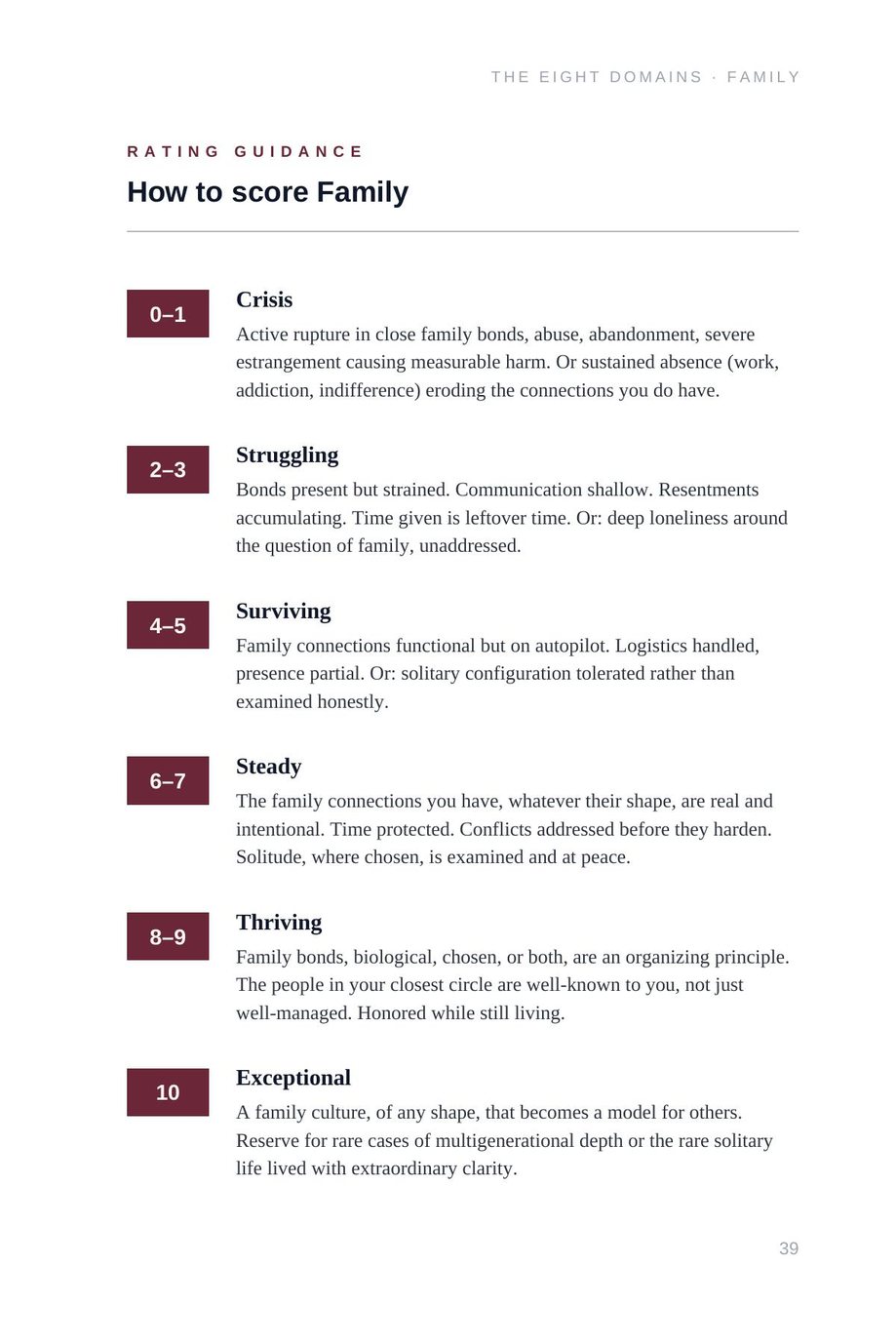
Crisis, 0 to 1: active rupture in close bonds, abuse, abandonment, severe estrangement causing measurable harm; or sustained absence, through work, addiction or indifference, eroding the connections that exist. Struggling, 2 to 3: bonds present but strained, communication shallow, resentments accumulating, time given is leftover time; or deep loneliness around the question of family, unaddressed. Surviving, 4 to 5: connections functional but on autopilot, logistics handled, presence partial; or a solitary configuration tolerated rather than examined. Steady, 6 to 7: the connections you have, whatever their shape, are real and intentional, time protected, conflicts addressed before they harden, and chosen solitude examined and at peace. Thriving, 8 to 9: family bonds, biological or chosen, are an organizing principle; the people in your closest circle are well-known to you, not just well-managed; honored while still living. Exceptional, 10: a family culture of any shape that becomes a model for others, reserved for multigenerational depth or the rare solitary life lived with extraordinary clarity.
Well-managed is not well-known
The single most useful phrase in the rubric sits in the Thriving band: well-known to you, not just well-managed. A great many busy households score themselves a 7 because the logistics run, the calendar is full, everyone is fed and delivered and nobody is fighting, and the rubric calls that Surviving, because presence is partial. The test is uncomfortable and quick: what is your teenager currently worried about, what did your partner most want this year, what does your father think about at night. If the answers are guesses, the score is a 5 with excellent administration. The band above it costs time, not competence, and the book's whole design pushes toward it by pairing this domain with the people inventory.
Leftover time is the diagnosis, and it is fixable
The Struggling band's line, time given is leftover time, describes the most common shape of family decline in working adults: nothing is wrong, and the family gets what remains after the calendar has taken everything else. The move from Struggling to Steady is one word, protected: time that cannot be taken by work, blocked in advance, and defended against the meeting. Readers who dislike the vagueness of relationship advice tend to like this domain, because it is the one where a calendar audit is the score. Being present while working full-time is the daily version; the remaining-visits math is the version that makes it urgent.
Scoring the solitary and the estranged honestly
The rubric refuses to punish people for the shape of their family. Chosen solitude, examined and at peace, is a 6 or 7. Solitude tolerated but never examined is a 4. Estrangement chosen deliberately and honestly, with the bonds left behind named rather than avoided, can be Steady; estrangement that is still an open wound is Struggling regardless of whose fault it was. The domain scores the relationship you have with the shape of your family, not the shape. That is what lets it be scored across a lifetime in which the shape will change several times. The eight domains holds the system; connecting with your kids and questions for your parents are two of the most direct ways up a band.
Lifetime Blueprint
The hardcover built to be inherited: eight life domains scored across decades, thirty life-event templates, and letters written forward, ending in a Final Letter.
How do you know if your family relationships are healthy?
By presence, repair and intention rather than headcount: time protected rather than leftover, conflicts addressed before they harden, and the people closest to you well-known rather than well-managed. A full household on autopilot scores lower than a small, intentional one.
Can you score family highly if you live alone?
Yes. Chosen solitude that has been examined honestly and is at peace scores Steady, 6 to 7. The domain measures your relationship with the shape of your family, not the shape itself.
More on Lifetime Blueprint
- Your Twenties: The Decade of Compounding Choices
- Your Thirties: The Building Decade, When Time Starts to Feel Finite
- Your Forties Are a Recalibration, Not a Crisis
- Your Fifties: The Distillation Decade, Subtraction Over Addition
- Why Most People Will Never Write Their Life Down
The method behind every book
- Which 365-Day Book Should I Start With? A One-Minute Guide
- What Is a No Zero Day? The Rule That Saves a Bad Week
- What Is a Realistic Morning Routine? Two Minutes, Not Two Hours
All articles about Lifetime Blueprint → · The book page → · All the books →
written by the author, at the kitchen table, after work.