Home / Blog / Lifetime Blueprint
LIFETIME BLUEPRINT
How to Score Your Mind: The Inner Life, Observed From 0 to 10
Part of the series The Eight Domains of Life, Scored: The Complete Guide
Mind is the inner landscape: emotional baseline, stress response, mental clarity, and the quality of your relationship with your own thoughts. It is the domain easiest to lie about, because the only witness is the person doing the lying. The score is not about whether you are smart. It is about whether your inner life is being lived consciously or simply happening to you, and the rubric draws that line in a place most people have never looked at: whether quiet moments are comfortable, and whether stress arrives as a signal or as a wave.
The six bands
Crisis, 0 to 1: an active mental health emergency, suicidal ideation, severe depression or anxiety preventing daily function; professional help is the immediate need, and nothing in a journal substitutes for it. Struggling, 2 to 3: persistent anxiety or depression, racing thoughts, inability to be present, frequent emotional dysregulation; functioning but barely. Surviving, 4 to 5: baseline managed but reactive; stress drives most decisions, quiet moments are uncomfortable, no regular practice for observing the inner life. Steady, 6 to 7: a stable baseline, stress recognized as it arises and managed with real tools, and some regular practice, meditation, journaling, prayer, therapy. Thriving, 8 to 9: active emotional intelligence, stress used as signal rather than overwhelm, the inner life observed in real time, difficult emotions metabolized rather than suppressed. Exceptional, 10: sustained equanimity under severe difficulty, reserved for those whose inner life is a model others actively study.
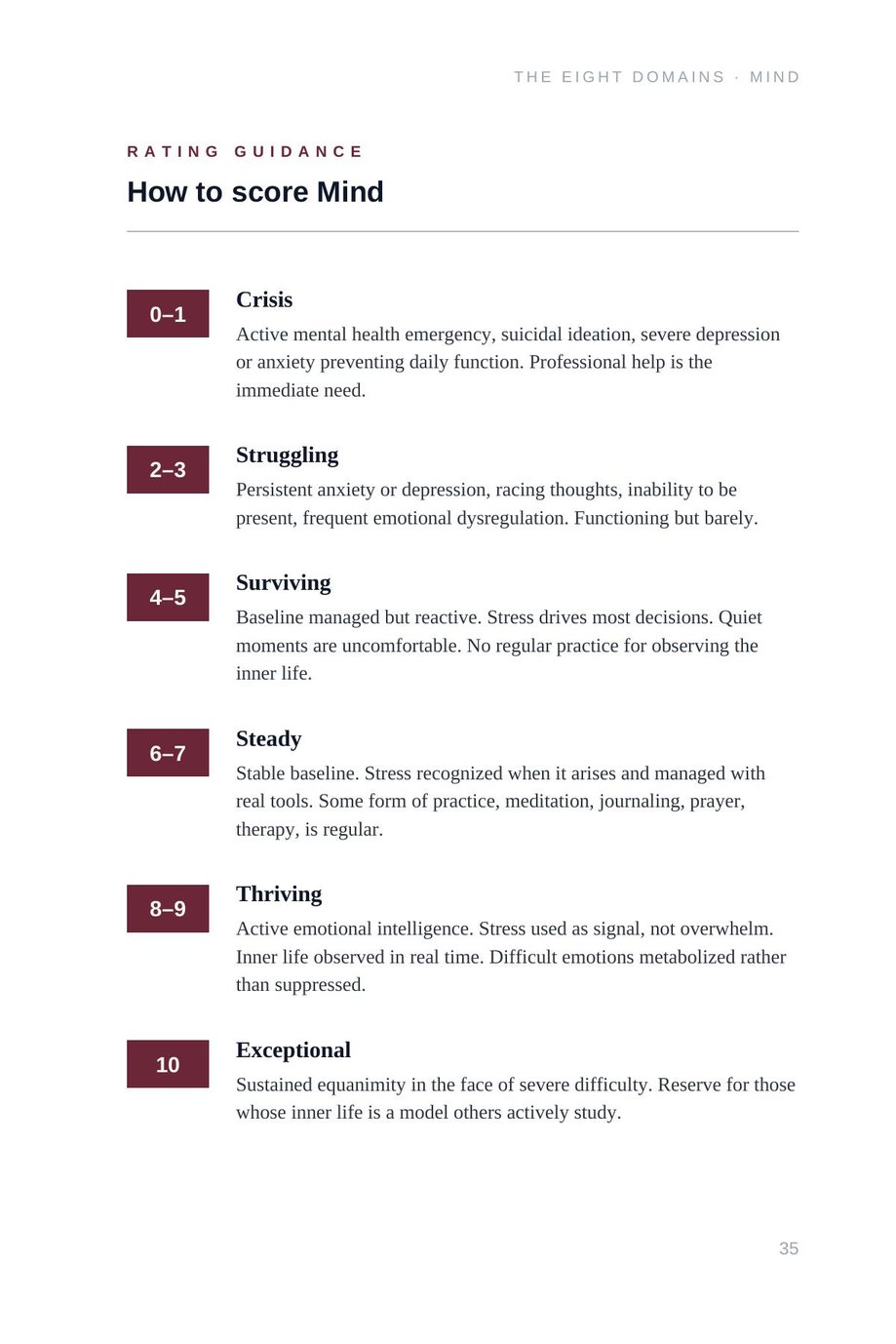
The line between 5 and 6 is a practice, not a personality
Read the bands again and the jump from Surviving to Steady contains exactly one new ingredient: a regular practice for observing the inner life. Not a calmer temperament, not fewer problems, a practice. The book is deliberately agnostic about which one, because meditation, journaling, prayer and therapy all do the same structural job: they install a small gap between a feeling arriving and a decision being made in its grip. Readers who score themselves a 4 and cannot see why usually have a decent baseline and no gap. The gap is learnable in weeks. That is the most encouraging fact in this domain.
Why this one gets inflated
Because the dinner-party self is fine, and the score gets taken from that self. The rubric's tell is quiet moments: if silence in a car without a podcast is uncomfortable, if the phone comes out in every queue, the honest score is Surviving no matter how composed the presentation is. The second tell is decision quality under stress, which colleagues and partners can see and you cannot, which is why the witness question, would the person who lives with me agree with this number, revises Mind scores more often than any other domain. The Feynman rule is the discipline; quieting the inner critic is one of the practices.
What a year of one practice does to the number
Not a transformation; a band. Ten minutes a day of any observing practice, held for a year, reliably moves a 4 or 5 to a 6, and the evidence is specific: stress noticed before it drives a decision, difficult conversations survived without a week of replay, the quiet becoming tolerable and then preferred. The next band, Thriving, is stress genuinely used as information, and it takes years, not months, and it is also where the inner life stops being a private project and starts being visible to the people you love. Score it, date it, name the practice in the habits-to-build line, and compare in five years. The eight domains holds the system; the life audit is the single-session version.
Lifetime Blueprint
The hardcover built to be inherited: eight life domains scored across decades, thirty life-event templates, and letters written forward, ending in a Final Letter.
How do you measure mental well-being for yourself?
Against observable criteria: whether stress drives decisions or arrives as a signal, whether quiet moments are comfortable, and whether a regular practice for observing the inner life exists. The score is about consciousness, not intelligence or mood.
What is a good mental health score?
Steady, 6 to 7: a stable baseline, stress recognized and managed with real tools, and a regular practice such as meditation, journaling, prayer or therapy. The single ingredient separating it from Surviving is the practice.
More on Lifetime Blueprint
- Your Twenties: The Decade of Compounding Choices
- Your Thirties: The Building Decade, When Time Starts to Feel Finite
- Your Forties Are a Recalibration, Not a Crisis
- Your Fifties: The Distillation Decade, Subtraction Over Addition
- Why Most People Will Never Write Their Life Down
The method behind every book
- Which 365-Day Book Should I Start With? A One-Minute Guide
- What Is a No Zero Day? The Rule That Saves a Bad Week
- What Is a Realistic Morning Routine? Two Minutes, Not Two Hours
All articles about Lifetime Blueprint → · The book page → · All the books →
written by the author, at the kitchen table, after work.