Home / Blog / Lifetime Blueprint
LIFETIME BLUEPRINT
A Wheel of Life Alternative: Score Your Life Against a Rubric, Not a Mood
Part of the series The Eight Domains of Life, Scored: The Complete Guide
The wheel of life is the most common life-assessment exercise in coaching: draw a circle, cut it into slices, shade each one from 1 to 10 by how satisfied you feel. It is quick and it is better than nothing. It also has a flaw you can feel the moment you try it twice: the score is a mood. On a good week Health is a 7; after a bad night it is a 4, and nothing about your body changed. The alternative is not a different shape. It is a different ruler.
Quick answer: Score each life area against a written description of what each level looks like in real life, not against how you feel. Use one fixed scale (Crisis, Struggling, Surviving, Steady, Thriving, Exceptional), score the last 90 days, use whole numbers, and keep the scores dated so you can compare them years apart. The free life scoring tool runs this on eight domains in about ten minutes.
The problem with satisfaction scores
A satisfaction score measures the distance between your life and your expectations, and expectations move. A man who just got promoted rates Work a 9 in March and a 6 in September with the same job, because the new normal arrived. A woman who compares herself to her friends rates Money by their houses. Neither number tells you what is actually happening, and neither can be compared to the same number five years later, which is the only comparison that reveals a direction. That is why most people who do a wheel of life once never do it again: the second wheel cannot be read against the first.

A rubric is a fixed ruler
The Lifetime Blueprint scores eight domains, Health, Mind, Faith, Family, Relationships, Work, Money and Growth, against a written scoring guide for each. Every guide uses the same six levels: 0 to 1 Crisis, 2 to 3 Struggling, 4 to 5 Surviving, 6 to 7 Steady, 8 to 9 Thriving, 10 Exceptional. What changes per domain is the description. A Steady Health is consistent sleep of seven hours or more, regular movement three or more times a week, thoughtful eating and preventive care. A Steady Money is six months or more of emergency savings, retirement on track, no high-interest debt, and some giving. A Steady Relationships is two to five real friendships kept up on purpose. You cannot feel your way to a 7 when the guide says what a 7 is. The one-page Quick Reference in the book, shown here, compresses all eight into what a 3, a 7 and a 10 look like.
Four rules that make the number honest
The book prints four rules for every score, and each one closes a leak the wheel of life leaves open. Score the last 90 days, not the next 90, so the number is not an intention. Use whole numbers and use the guide, not your peers, so the number is not a comparison. Remember that a 10 is rare and most honest scores land between 3 and 8, so the scale has room to move. And if you cannot answer honestly today, leave it blank and come back, because a blank is information and a guess is noise. Then run the test: would someone who has watched you closely this past year agree with this number? Being honest with yourself covers the three common lies the test catches.
Why eight domains, and why these
A wheel usually has whatever slices the coach chose: fun and recreation, physical environment, romance. The Blueprint uses eight, chosen so that fewer would leave real parts of a life unmeasured and more would turn the measurement into noise. Two of them surprise people. Faith is there for secular readers too, because it asks whether your engagement with what is larger than yourself is conscious or unexamined, and a thoughtful atheist can score as high as a monk. Money is there for readers who feel above it, because it asks whether you understand what you earn, spend and save, not what you have. If a domain feels awkward, the book says, it is usually the one most worth measuring. The eight domains, scored has a post per domain.
Run it once, then run it again
A single assessment is a photograph. The value is in the second and third. The Blueprint's first measurement scores every domain three times, Past, Present and Ideal, so even the first sitting has a direction in it, and then twelve later snapshots are spaced across the rest of your life. If you want to try the scale before buying anything, the free life scoring tool asks five questions per domain, maps them to the six levels, draws a radar chart and tells you which domain to fix first. No signup, nothing stored. Then put the numbers somewhere dated, because the comparison is the point.
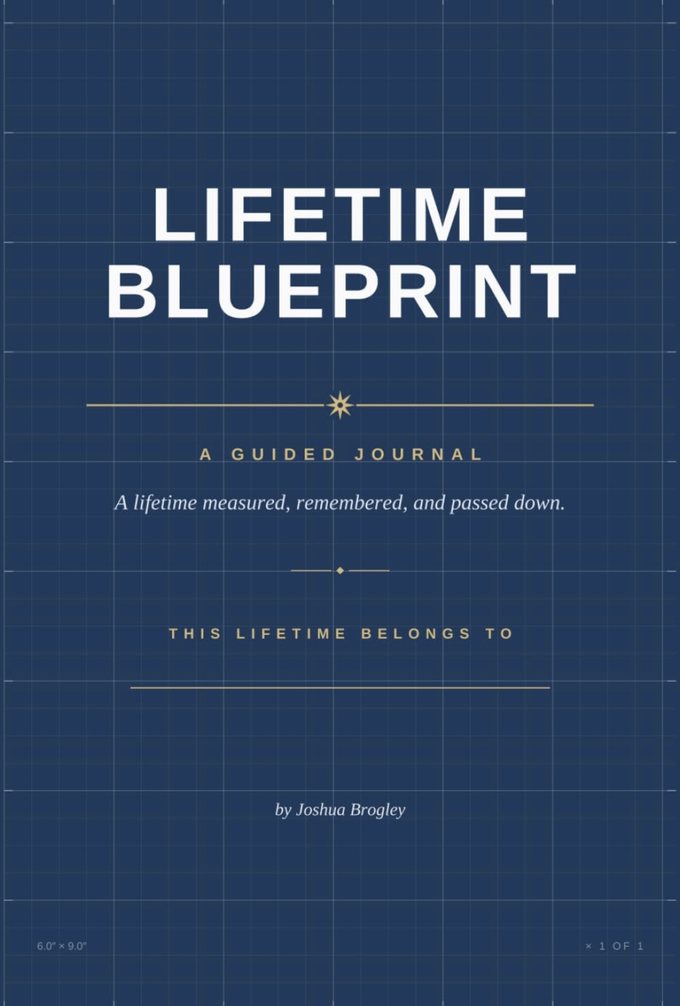
Lifetime Blueprint
The hardcover built to be inherited: eight life domains scored across decades, thirty life-event templates, and letters written forward, ending in a Final Letter.
What is the difference between a wheel of life and a life rubric?
A wheel of life scores how satisfied you feel in each area. A rubric scores what is true against a written description of each level, so the same life gets the same number on a good day and a bad one, and scores from different years can be compared.
What are the eight areas of life to score?
The Lifetime Blueprint uses Health, Mind, Faith, Family, Relationships, Work, Money and Growth, each scored 0 to 10 against its own scoring guide with six levels from Crisis to Exceptional.
How often should you score your life areas?
Score once to get a baseline, then again at a fixed interval. The Blueprint suggests dividing the years you expect ahead by twelve, so roughly every five years at 20, three at 40, two at 60 and yearly at 70.
More on Lifetime Blueprint
- Why Most People Will Never Write Their Life Down
- Your Fifties: The Distillation Decade, Subtraction Over Addition
- Your Forties Are a Recalibration, Not a Crisis
- Your Thirties: The Building Decade, When Time Starts to Feel Finite
- Your Twenties: The Decade of Compounding Choices
The method behind every book
- Which 365-Day Book Should I Start With? A One-Minute Guide
- What Is a No Zero Day? The Rule That Saves a Bad Week
- What Is a Realistic Morning Routine? Two Minutes, Not Two Hours
All articles about Lifetime Blueprint → · The book page → · Group and bulk orders →
written by the author, at the kitchen table, after work.