Home / Blog / Lifetime Blueprint
LIFETIME BLUEPRINT
How Often Should You Review Your Life? Choose an Interval by Your Age
Most advice on reviewing your life says do it every year, usually in the last week of December. A yearly review is fine for goals. It is too close to see the shape of a life, because a single year is mostly noise: one injury, one bad quarter, one good summer. Wait a decade and the opposite happens, the review is honest but too late to change anything. The useful interval is in between, and it depends on how old you are.
Quick answer: Estimate the years you reasonably expect ahead and divide by twelve. That gives about every five years at 20, four at 30, three at 40, two to three at 50, two at 60, every year at 70 and every six to twelve months past 80. Never leave more than five years between reviews.
The rule: years ahead, divided by twelve
The Lifetime Blueprint gives you twelve Lifetime Snapshots after your first measurement, and asks you to spread them across the life you have left so the finished book holds a complete line from the beginning to the end. The interval is how far apart you take them, and the simplest way to choose it is printed as a table: estimate the years you reasonably expect ahead, and divide by twelve. At 20, about sixty years ahead, a snapshot about every five years. At 30, every four. At 40, every three. At 50, every two to three. At 60, every two. At 70, every year. At 80 and over, every six to twelve months.

Why five years is the ceiling
The table is rounded averages, not predictions about anyone, and the book adds one hard limit: five years is the longest gap to leave. Any longer and you lose the texture between measurements, the job change and the illness and the move that happened in between and that you will misremember by the time you score again. If you reach your twelfth snapshot with life still ahead, the book calls that good news: revisit your ideal and keep the line going in a new volume.
Why age changes the interval
At twenty, most of what moves a life moves slowly: a career compounds, a marriage forms, a body is still forgiving. Five years is short enough to catch the drift. At seventy, a year can hold a diagnosis, a death, a move to be closer to the grandchildren, and the scores you care about can shift in months. The same principle, enough measurements to draw a line across the whole remaining life, gives a different interval at every age. That is the honest version of how often should I review my life: as often as it takes to see your line bend before it is too late to bend it back.
Pick an anchor date, and score before you look back
The second decision is the date. Take every snapshot on the same anchor, a birthday, New Year's, the anniversary of your first measurement, so the comparison is clean. Then follow the order the book prints: score all eight domains first, from where you are today, and only then compare with earlier scores. Scoring before looking back protects you from scoring who you wanted to become. Block a real hour, because the work is in the reflection, not the numbers. Then read two old pages: the small moves you committed to last time, and your plan for the people who matter, and mark what you did.
What the reviews add up to
After your first measurement and two snapshots, you have a line. After four, you have momentum: you can see whether the slope is speeding up, holding or bending. A domain steady across three snapshots rarely changes without deliberate effort. A domain rising consistently is compounding. A domain that has fallen twice in a row is asking a question. The book plots every total on one chart, the Lifetime Line, with your ideal drawn as a dashed line straight across, and the space between them is your life's work, made visible. Measuring personal growth over years covers how to read it; how often to journal covers the smaller returns in between.
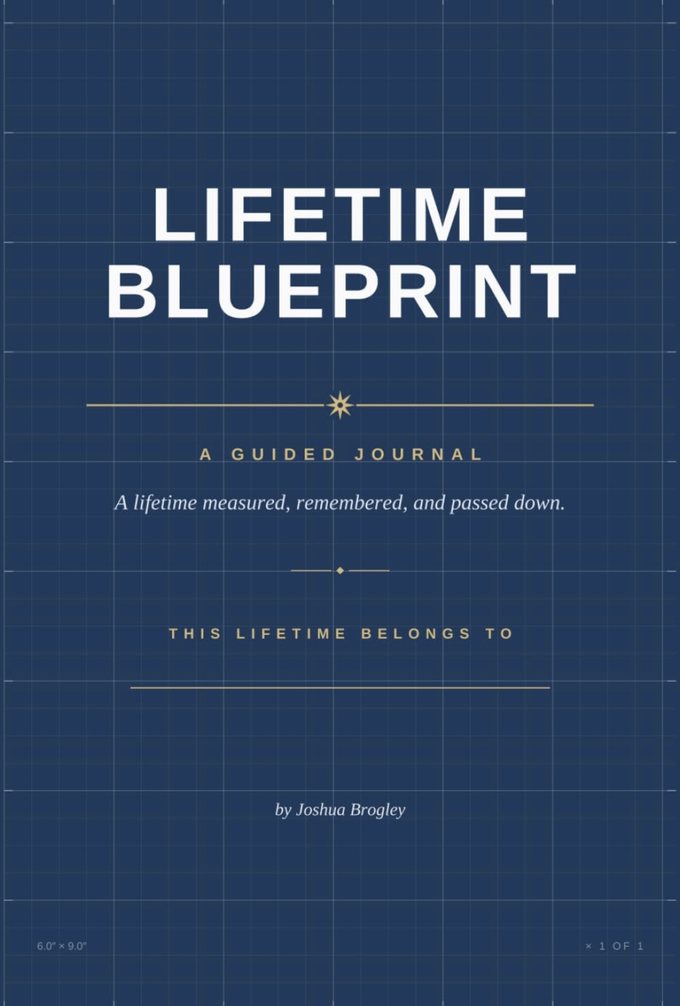
Lifetime Blueprint
The hardcover built to be inherited: eight life domains scored across decades, thirty life-event templates, and letters written forward, ending in a Final Letter.
How often should you do a life review?
Divide the years you reasonably expect ahead by twelve: roughly every five years at 20, three at 40, two at 60, yearly at 70 and every six to twelve months past 80. Never leave more than five years between reviews.
Is a yearly life review enough?
A yearly review is good for goals but mostly measures noise at the scale of a whole life. Pair it with a deeper scored review at an interval set by your age, so you can see a direction rather than a mood.
When is the best time to review your life?
On a fixed anchor date you will remember, such as your birthday or New Year's, so every review is comparable. Score first, then compare with earlier scores.
More on Lifetime Blueprint
- Why Most People Will Never Write Their Life Down
- Your Fifties: The Distillation Decade, Subtraction Over Addition
- Your Forties Are a Recalibration, Not a Crisis
- Your Thirties: The Building Decade, When Time Starts to Feel Finite
- Your Twenties: The Decade of Compounding Choices
The method behind every book
- Which 365-Day Book Should I Start With? A One-Minute Guide
- What Is a No Zero Day? The Rule That Saves a Bad Week
- What Is a Realistic Morning Routine? Two Minutes, Not Two Hours
All articles about Lifetime Blueprint → · The book page → · Group and bulk orders →
written by the author, at the kitchen table, after work.