Home / Blog / Lifetime Blueprint
LIFETIME BLUEPRINT
Your Thirties: The Building Decade, When Time Starts to Feel Finite
Part of the series How to Reflect on Your Life by Decade: The Complete Method
The thirties are the building decade. The careers begun in the twenties either take shape or stall. Households form, or the decision not to form them solidifies. The people who raised you, if living, begin in many cases to need help rather than to give it. The metabolism slows; the bank account, with luck, grows. And it is the first decade in which time begins to feel finite, not as an abstract fact but as a felt sense. The right response to that feeling is not a panicked acceleration. It is a deliberate selection of what will be built and what will not.
What to focus on
Naming what you are actually building, household, vocation, body, community, and assessing honestly whether it is what you intended or what accumulated. Recognizing the gap between your public competence and your private uncertainty, which widens in this decade and which nobody talks about. Identifying the practices that need to become non-negotiable now in order to compound over the next thirty years, because the thirties are the last decade where starting them is cheap. And examining how you handle conflict, ambition and disappointment now that there is a track record to compare against.
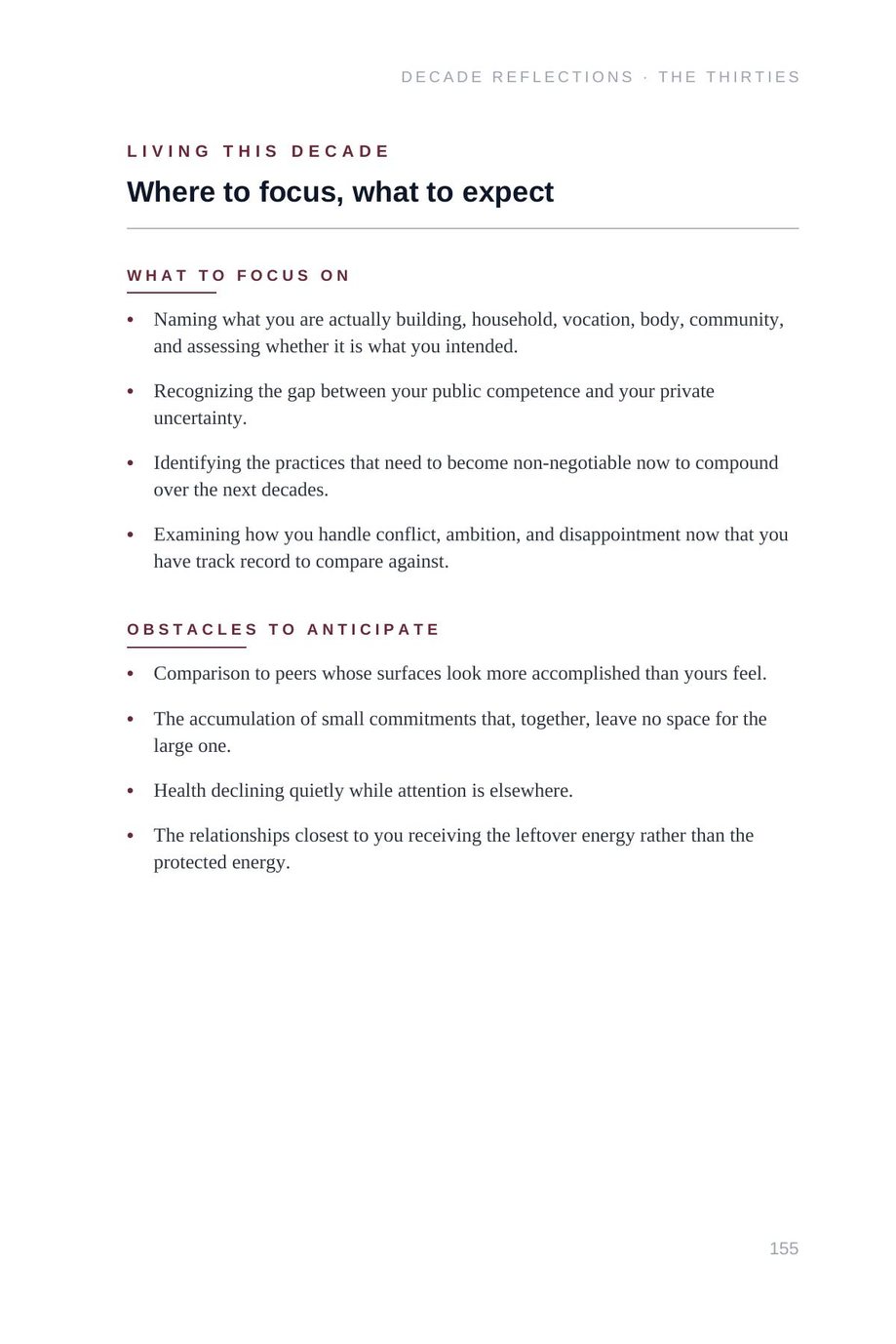
The obstacles
Comparison to peers whose surfaces look more accomplished than yours feel; the surfaces are the only part visible and the only part being compared. The accumulation of small commitments that together leave no space for the large one, which is how good people spend a decade busy and build nothing. Health declining quietly while attention is elsewhere, the beginning of a thirty-year bill. And the relationships closest to you receiving the leftover energy rather than the protected energy, which is the thirties' signature failure and entirely a scheduling decision.
What is coming, and the four tips
The people who raised you may begin to need you. Children, your own, your siblings', your friends', may need significant attention. What you build in this decade will be visible in your forties, and so will what you neglect. And the body that recovered overnight at twenty will increasingly need explicit care. The tips: protect time with the people closest to you, because they will not always be there to receive it; build yearly health checks even when you feel fine; choose priorities deliberately, since you can have many of the things you want but not all at once; and begin saying no to good things so you can say yes to the right ones.
Scoring the building decade
The book's own worked example scores a reader's thirties in Health: three steady years, a back injury and two years of Struggling, two years rebuilding, three steady years to close. The weighted During comes out at 5; the At the End is a 7; the gap of two is the recovery they earned, and the single average would have hidden it entirely. That is the thirties in miniature: a hard middle and an earned close, in one domain or several. The worked examples show the arithmetic; the forties are where what was built here becomes visible; the full method holds the chapter; and the felt sense of finite time is exactly what a certain hardcover was built to answer, not with acceleration but with selection.
Lifetime Blueprint
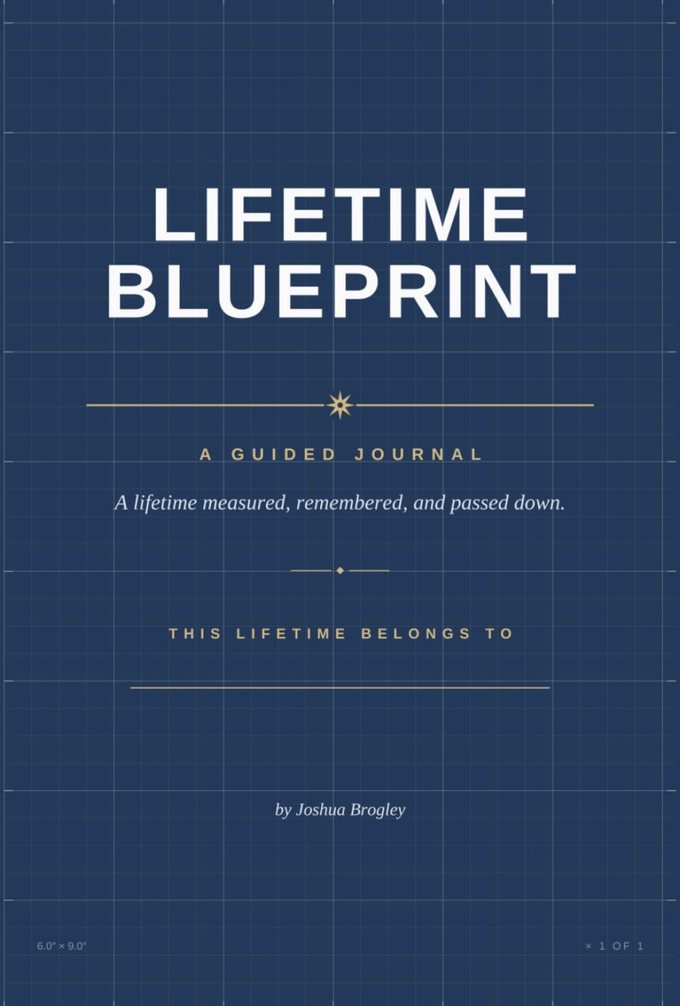
The hardcover built to be inherited: eight life domains scored across decades, thirty life-event templates, and letters written forward, ending in a Final Letter.
What should you focus on in your thirties?
Naming what you are actually building and whether it is intended, making the compounding practices non-negotiable now, protecting time with the closest people rather than giving them leftovers, and yearly health checks even when you feel fine.
Why do the thirties feel so short?
Because it is the first decade in which time becomes finite as a felt sense rather than a fact. The right response is deliberate selection of what to build and what to release, not acceleration.
More on Lifetime Blueprint
- Your Twenties: The Decade of Compounding Choices
- Your Forties Are a Recalibration, Not a Crisis
- Your Fifties: The Distillation Decade, Subtraction Over Addition
- Why Most People Will Never Write Their Life Down
- Who the Lifetime Blueprint Is For: Five Readers, Five Reasons
The method behind every book
- Which 365-Day Book Should I Start With? A One-Minute Guide
- What Is a No Zero Day? The Rule That Saves a Bad Week
- What Is a Realistic Morning Routine? Two Minutes, Not Two Hours
All articles about Lifetime Blueprint → · The book page → · All the books →
written by the author, at the kitchen table, after work.