Home / Blog / Lifetime Blueprint
LIFETIME BLUEPRINT
How to Score a Decade: Worked Examples From Real Life Shapes
Part of the series How to Reflect on Your Life by Decade: The Complete Method
A decade gets two scores in this method, and the book's own worked example shows why. A reader at forty-five scores their thirties in Health as four phases: three steady years at 6.5, two years of back injury and surgery at 2.5, two years rebuilding at 4.5, three steady years at 6.5 to close. Weighted by duration and divided by ten, the During comes out at 5.3, written as 5. The last phase closed at 6.5, rounded to 7, so At the End is 7. The decade was hard, and the reader closed it stronger than the average: the gap of two is the recovery they earned. A different reader with a 7 During and a 5 At the End has the opposite story, a steady decade that ended in decline, from an identical average. Here are four shapes, worked.
Shape one: injury and recovery (the book's example)
Phases: 30 to 33 Steady, 6.5, three years. 33 to 35 Struggling, 2.5, two years. 35 to 37 Surviving, 4.5, two years. 37 to 40 Steady, 6.5, three years. Arithmetic: 19.5 plus 5 plus 9 plus 19.5 equals 53, over ten years, 5.3. During: 5. Closing band Steady at 6.5: At the End 7. Reading: a dip earned back. The pair says this reader knows how to rebuild, which is worth more at forty-five than a flat 7 would have been, and which a single average of 5 would have reported as mediocrity.
Shape two: the steady decline
Say Relationships across the thirties: 30 to 34 Steady, 7, four years; 34 to 38 Surviving, 4.5, four years; 38 to 40 Struggling, 3, two years. Arithmetic: 28 plus 18 plus 6 equals 52, over ten, 5.2. During: 5. At the End: 3. Same During as shape one, opposite direction. This is the shape people most need to see written down, because it is the drift shape: nothing dramatic, four good years, then friendships thinning by inattention until the decade closes lonely. The pair catches what the average hides, and it is the pair that makes the next decade's correction obvious.
Shape three: the late bloom, and shape four: the flat line
Late bloom, Work in the twenties: 20 to 26 Surviving, 4.5, six years; 26 to 30 Thriving, 8.5, four years. Arithmetic 27 plus 34 equals 61, over ten, 6.1. During: 6. At the End: 9. A decade that reads as ordinary on average and was actually a launch. Flat line, Faith across the forties: ten years Surviving at 4.5. During: 5. At the End: 5. The flat pair is its own message: a domain that was never in crisis and never examined, which the book's rating guidance calls nominal rather than active, and which a reader usually only notices when the pair is written beside the other seven.
How to run it on your own decade
Pick one domain. Divide the decade into phases by feel first, then check them against evidence, the job change, the diagnosis, the move. Assign each phase a band midpoint, 0.5, 2.5, 4.5, 6.5, 8.5, and count its years. Multiply, sum, divide by ten: that is During, rounded. Take the last phase's midpoint, rounded: that is At the End. Write both, then one sentence on what the pair means. Then the next domain, until eight pairs sit on the page, and the decade has a shape rather than an adjective. The method page and the worked example are printed in the same hardcover the seven decade chapters live in, so the arithmetic is never more than a page away from the entry it scores. The full decade method; hindsight's distortions; the eight domains and their band midpoints.
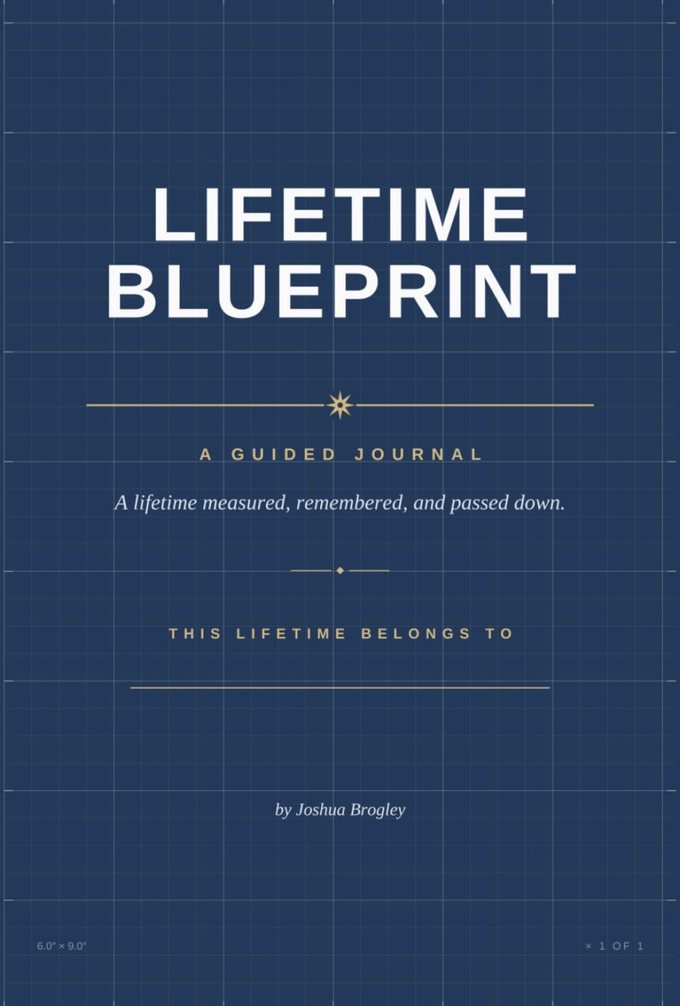
Lifetime Blueprint
The hardcover built to be inherited: eight life domains scored across decades, thirty life-event templates, and letters written forward, ending in a Final Letter.
How do you score a decade of your life?
Twice. During: break the decade into phases, give each a band midpoint, weight by years, sum and divide by ten. At the End: the band the decade closed in. A 5 and a 7 is a hard decade closed strong; a 7 and a 5 is a steady decade that ended in decline.
Why score a decade with two numbers instead of one?
Because a single average cannot show direction. Two decades with the same average can be a recovery and a decline; the During and At the End pair distinguishes them and points at the correction the next decade needs.
More on Lifetime Blueprint
- Your Twenties: The Decade of Compounding Choices
- Your Thirties: The Building Decade, When Time Starts to Feel Finite
- Your Forties Are a Recalibration, Not a Crisis
- Your Fifties: The Distillation Decade, Subtraction Over Addition
- Why Most People Will Never Write Their Life Down
The method behind every book
- Which 365-Day Book Should I Start With? A One-Minute Guide
- What Is a No Zero Day? The Rule That Saves a Bad Week
- What Is a Realistic Morning Routine? Two Minutes, Not Two Hours
All articles about Lifetime Blueprint → · The book page → · All the books →
written by the author, at the kitchen table, after work.