Home / Blog / Lifetime Blueprint
LIFETIME BLUEPRINT
How to Write About Your Childhood Honestly (The Unauthored Decade)
Part of the series How to Reflect on Your Life by Decade: The Complete Method
Childhood is the decade you did not author. You were placed into circumstances, given a family or its absence, a culture, a country. The choices that shaped those years were not yours, but the residue of them is in everything you became afterward. To write about it honestly is to do one specific piece of work: separate the inheritance from the interpretation. What actually happened, and what story have you been telling yourself about what happened? The two are rarely the same, and distinguishing them takes years of returning to the same pages.
What to focus on
Four things. The people who shaped the decade, for good or for harm, and what each one gave you, named plainly. The unspoken rules of the early household, and which of them you still live by without ever having chosen to. The person you were before the world began correcting you, which is the memory most adults have lost and most want back. And the moments that taught you what to expect from love, from authority, from safety, because those expectations are still running, decades on, in every relationship you have.
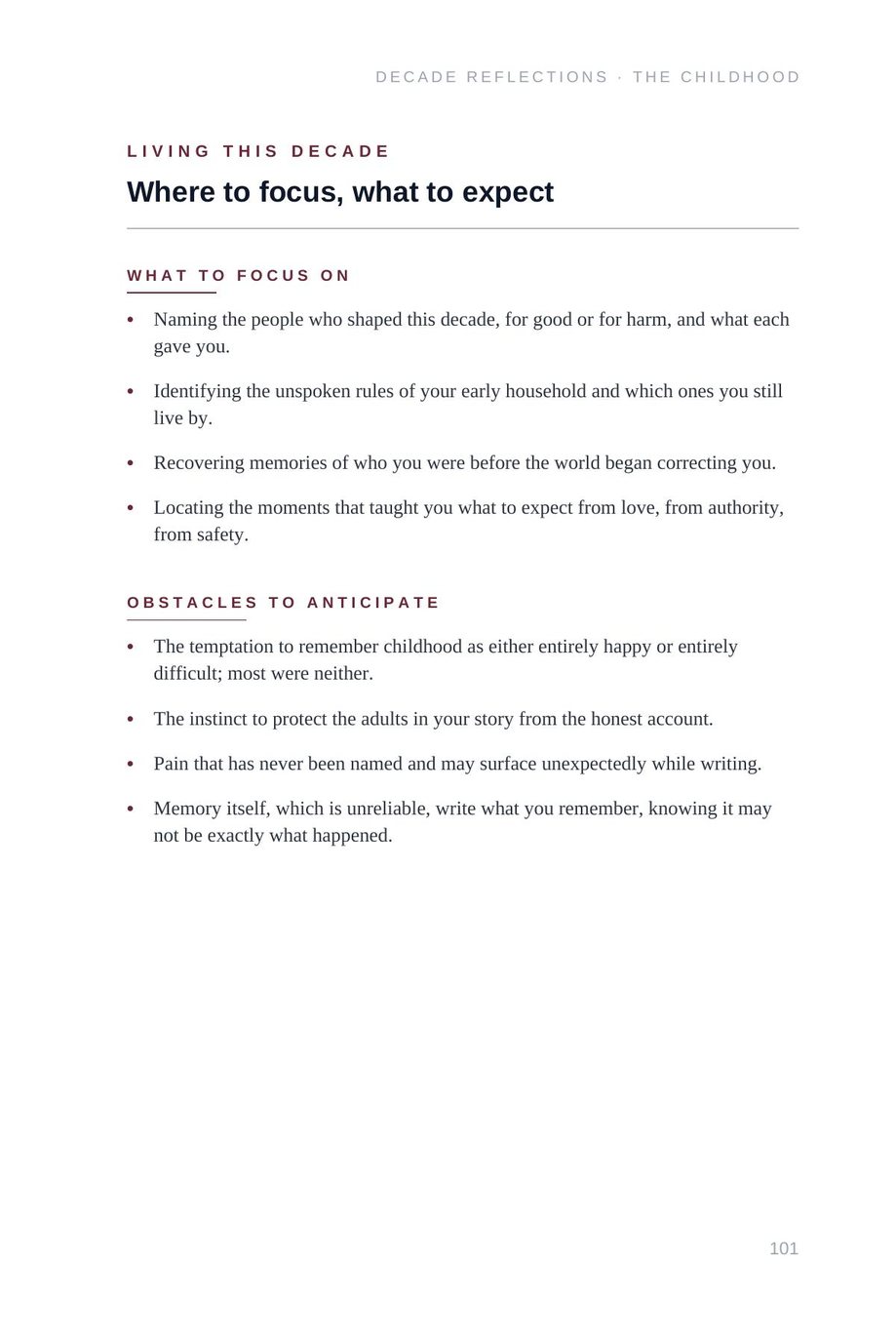
The obstacles, which are the same for almost everyone
The temptation to remember childhood as entirely happy or entirely difficult; most were neither, and the honest account is usually mixed in ways that are harder to write than either extreme. The instinct to protect the adults in the story from the truth, which produces a version suitable for family gatherings and useless for a record. Pain that has never been named and may surface unexpectedly at the desk. And memory itself, which is unreliable: write what you remember, knowing it may not be exactly what happened, and say so on the page. Skipping what you cannot yet face applies here more than anywhere.
How to write it: the trusted-friend version
Write the version of the story you would tell a trusted friend, not the one you tell at family gatherings. That single instruction fixes most childhood writing, because the family-gathering version has been edited for forty years and the trusted-friend version has not. If you remember almost nothing, that is information: write about the absence itself, what it might mean, and what it costs. Pair the entry with photographs if you have them, or with a single object that survived from the time; objects unlock memory that questions cannot. And be patient. Some childhoods take years to write honestly, and the chapter's log is built to record the layers.
Why this is the chapter to write last, and why it matters most
The book suggests writing the decade that pulls hardest first, and for most people that is not childhood; it is the decade where they made choices. Childhood reads differently once those are on the page, because the patterns visible in the twenties and thirties turn out to have been laid down here, and the adolescence chapter will ask you to interpret them. It is also the decade a future reader has no other source for: the grandchild who finds the book cannot ask your parents. The full decade method holds the chapter's place; the family history is the practice that reaches further back still.
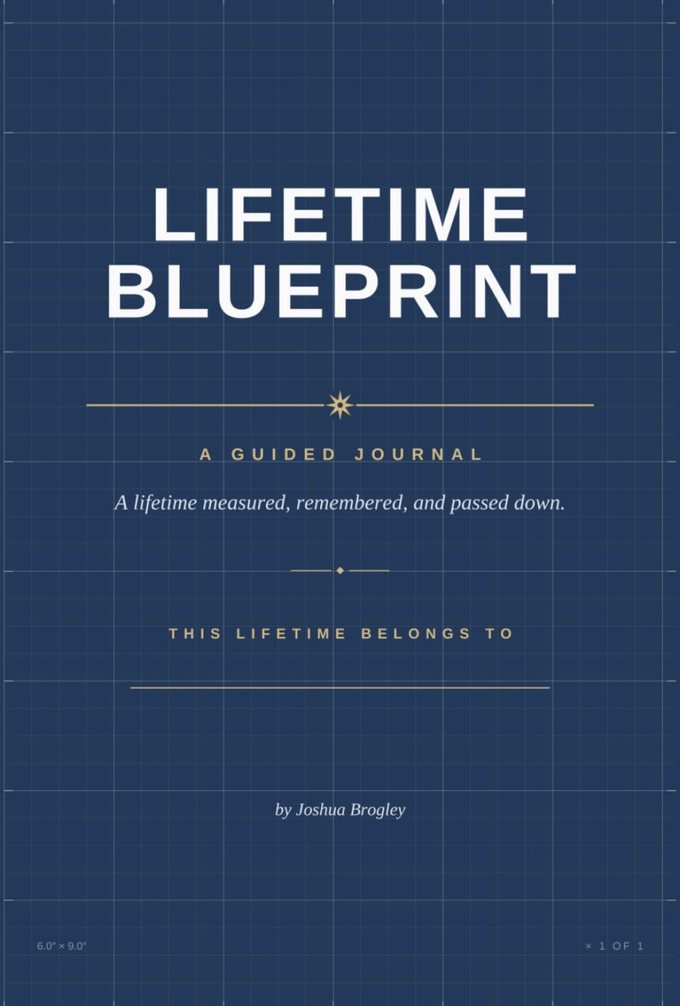
Lifetime Blueprint
The hardcover built to be inherited: eight life domains scored across decades, thirty life-event templates, and letters written forward, ending in a Final Letter.
How do you write about your childhood?
Separate what actually happened from the story you tell about it. Name the people who shaped you and what each gave you, the household's unspoken rules, who you were before correction, and the moments that taught you what to expect from love and safety. Write the trusted-friend version, not the family-gathering one.
What if I do not remember my childhood?
Write about the absence itself; not remembering is information. Pair the attempt with a photograph or a single surviving object, and return across years. Some childhoods take a long time to write honestly, and that is expected.
More on Lifetime Blueprint
- Your Twenties: The Decade of Compounding Choices
- Your Thirties: The Building Decade, When Time Starts to Feel Finite
- Your Forties Are a Recalibration, Not a Crisis
- Your Fifties: The Distillation Decade, Subtraction Over Addition
- Why Most People Will Never Write Their Life Down
The method behind every book
- Which 365-Day Book Should I Start With? A One-Minute Guide
- What Is a No Zero Day? The Rule That Saves a Bad Week
- What Is a Realistic Morning Routine? Two Minutes, Not Two Hours
All articles about Lifetime Blueprint → · The book page → · All the books →
written by the author, at the kitchen table, after work.