Home / Blog / Lifetime Blueprint
LIFETIME BLUEPRINT
Skip What You Cannot Face Yet: The Pages Will Wait
Part of the series Where to Begin a Lifetime Journal: Five Ways In, and Who Each Is For
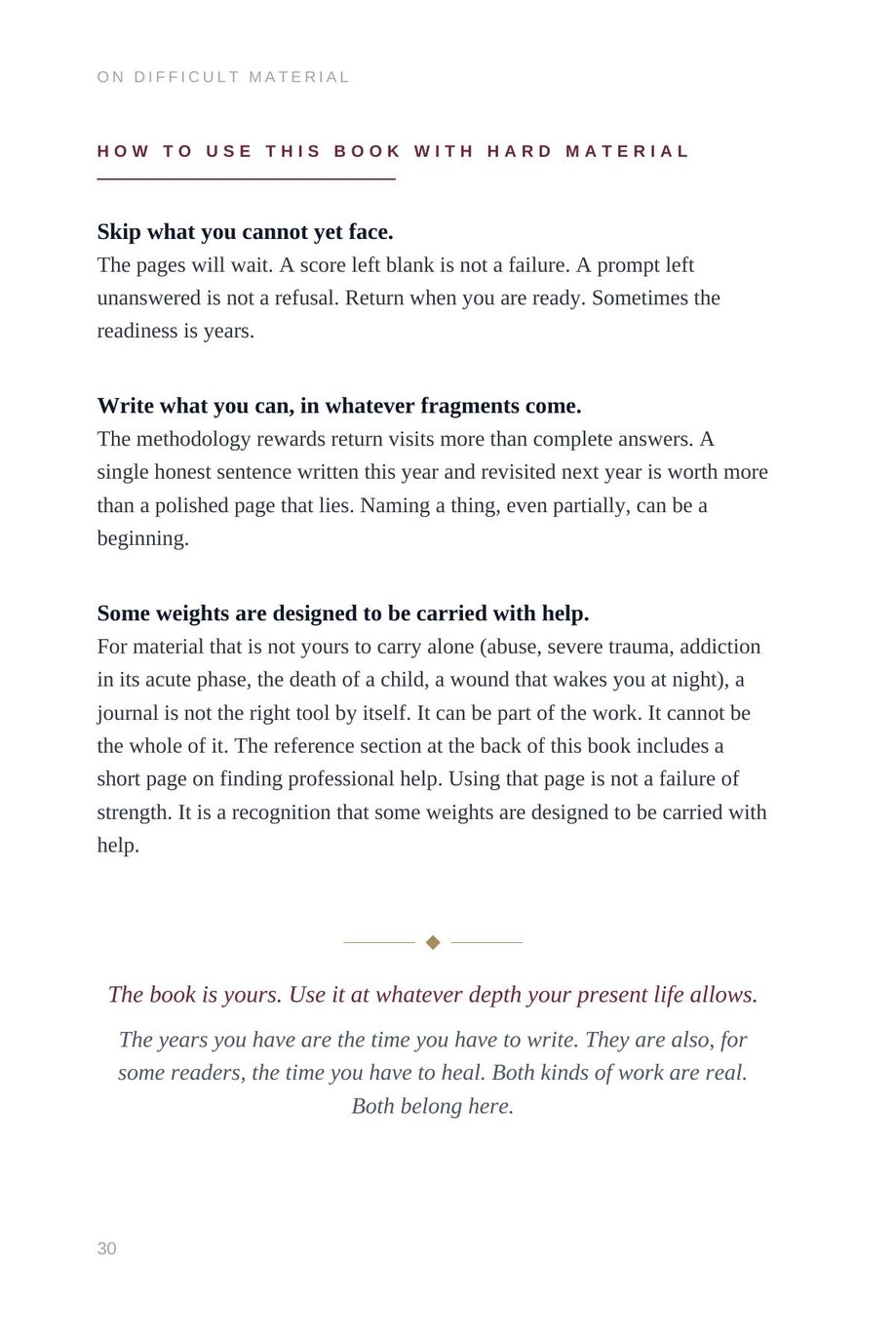
You will not fill in every prompt, and the book says so on its twentieth page. Some prompts will not apply to your life. Some you will not yet have the words for. Some you will not be ready to face. All of it is expected: skip what you cannot yet answer, the pages will wait, return when you are ready, and sometimes the readiness is years. A score left blank is not a failure and a prompt left unanswered is not a refusal. It is a placeholder for a person who does not exist yet, and the book is patient with that person.
The three kinds of blank
They deserve different treatment. Does not apply: cross it out lightly and move on, the prompt was written for a life shaped differently from yours, and the book's own language rules say answer for the closest match or skip. No words yet: date the blank; write nothing but the date, so the future reader and future you can see that the question was seen and set down. Not ready to face: leave it entirely, no date, no mark, and let it become invisible until the day it is not. The third kind is the one people feel guilty about, and it is the one the book most explicitly protects.
Hard material has a method, not just permission
An honest life contains hard material, and the book's short reflection on it gives more than a pass: skip what you cannot yet face; do not score a domain while inside its crisis, score it later from the far side; write facts before feelings, because facts consent to being recorded while feelings are still weather; and if a page consistently makes things worse, put the book down without apology, and if the material is the kind that people carry alone, carry it to a person or a professional as well. The pages will wait either way. Nothing in them is owed to the book. Writing about a loss applies the method to the hardest template.
How to return, and how to know it is time
Readiness is not a mood; it is usually an event. A death, an anniversary, a diagnosis, a child reaching the age you were: something in life reopens the question, and the blank becomes answerable, often suddenly. Two signals to trust: you catch yourself thinking about the page unprompted, or you have told someone the story out loud for the first time. When you do return, date the new entry and write under the blank rather than pretending it was never blank; the gap between the date the question was seen and the date it was answered is itself part of the record, sometimes the truest part.
Why a slow book can afford this
A daily journal cannot tolerate skipped days; its whole mechanism is the streak. A lifetime book runs on a different clock, decades, and it can afford to leave a page empty for eight years because eight years is nothing on that clock. This is the deep reason the two kinds of journal should never be confused: the daily kind builds the person, the slow kind records what the person was for, and the slow kind is built to wait. How often to journal covers the cadence; any age covers the language and the skipping rules together; where to begin is the map for the pages you are ready for.
Lifetime Blueprint
The hardcover built to be inherited: eight life domains scored across decades, thirty life-event templates, and letters written forward, ending in a Final Letter.
Is it OK to skip prompts in a journal?
Yes, and in a lifetime journal it is designed in. Prompts that do not apply get crossed lightly, prompts you lack words for get a date and nothing else, and prompts you cannot yet face are left blank until an event reopens them, sometimes years later.
How do I write about something painful in a journal?
Facts before feelings, score the domain later from the far side of the crisis rather than inside it, and put the book down without apology if a page makes things worse. Hard material is carried to people as well as pages.
More on Lifetime Blueprint
- Your Twenties: The Decade of Compounding Choices
- Your Thirties: The Building Decade, When Time Starts to Feel Finite
- Your Forties Are a Recalibration, Not a Crisis
- Your Fifties: The Distillation Decade, Subtraction Over Addition
- Why Most People Will Never Write Their Life Down
The method behind every book
- Which 365-Day Book Should I Start With? A One-Minute Guide
- What Is a No Zero Day? The Rule That Saves a Bad Week
- What Is a Realistic Morning Routine? Two Minutes, Not Two Hours
All articles about Lifetime Blueprint → · The book page → · All the books →
written by the author, at the kitchen table, after work.