Home / Blog / Lifetime Blueprint
LIFETIME BLUEPRINT
Where to Begin a Lifetime Journal: The First Six Sittings, in Order
A lifetime journal is joined, not started: wherever you are in life is where you come in. The book prints the order on one page, Your First Sittings: six steps, each with the time it takes and the page it starts on. Follow it for the first few sittings, then open the book freely. Read Part One. Take your Origin Snapshot. Name the people who matter. Backfill one decade. Record one event you have already lived. Write one letter, when you are ready. Then live, and return. Below is each step, why it sits where it does, and who might reasonably change the order.
Quick answer: Read the eight domains first (about 30 minutes), then take the Origin Snapshot in one sitting (one to two hours). After that: the people who matter (30 minutes), one decade (an evening), one event, one letter. Then come back only when life gives you a reason.
Step one: read Part One, about thirty minutes
The revised edition puts a step in front of the snapshot that the first printing left implicit: before you score anything, skim the eight domains and how they are scored. Thirty minutes is enough to read On Drift, the table of what each domain measures, the scale from Crisis to Exceptional and the four rules for every score (the last 90 days, whole numbers, a 10 is rare, a blank beats a guess). Readers who skip this step score on mood and then distrust their own numbers. The eight domains, scored is the long version.

Step two: the Origin Snapshot, one to two hours, one sitting
Score all eight domains three times: Past (three to five years ago, anchored to a specific season), Present (the last 90 days) and Ideal (the future you actually want). Then read your trajectory and name your gap. It has to be one sitting because the three scores only mean something next to each other, and memory reorders them if they are spread over weeks. Three worked examples, a seventeen-year-old, a thirty-four-year-old and a sixty-three-year-old, sit right before the Ideal so you can see what honest numbers look like. Every later measurement in the book compares against this one. What the Origin Snapshot is walks the sitting; the exercise, worked through shows a full set of numbers.
Step three: name the people who matter, about thirty minutes
The people whose time with you is limited, and one action for each. Some readers swap steps two and three, and that is reasonable: if a parent is eighty-two, the arithmetic of visits left is louder than any score. The page draws it plainly, a parent of 75 seen twice a year as about twenty-five circles. Doing that math is where many people first understand what the whole book is for, and the six-month plan is what to do next.
Step four: backfill one decade, an evening
Start with the most recent decade you have completed, not the one that hurts most and not childhood. The most recent completed decade is close enough to remember and far enough to see whole, and it teaches the two-score method, During and At the End, on material you can check. Readers with a lot of road behind them will do more, but one decade is the step. Backfilling the decades covers the order and the traps.
Step five: record one event you have already lived
A birth, a move, a loss, a turning point. Any one will do. The point of doing it early is to learn the template, six prompts and three pages, before the week you need it in a hurry. If something is happening right now, that is the event: starting with what just happened is the version for a reader mid-event.
Step six: one letter, when you are ready, then live and return
To your future self, a child, or whoever reads this after you. No required date; some people cannot score anything until they have written to someone, and the first letter unlocks the rest. After that the book waits. You come back when life gives you a reason: something significant happens, your snapshot interval arrives, a milestone birthday, someone who matters is aging or drifting, a letter is ready. How often to come back covers the rhythm. Age changes the mix, not the method: seventeen and sixty run the same procedure with different amounts of backfill, and sixty is nowhere near too late. Nobody fills every prompt: skipping and returning is designed in.
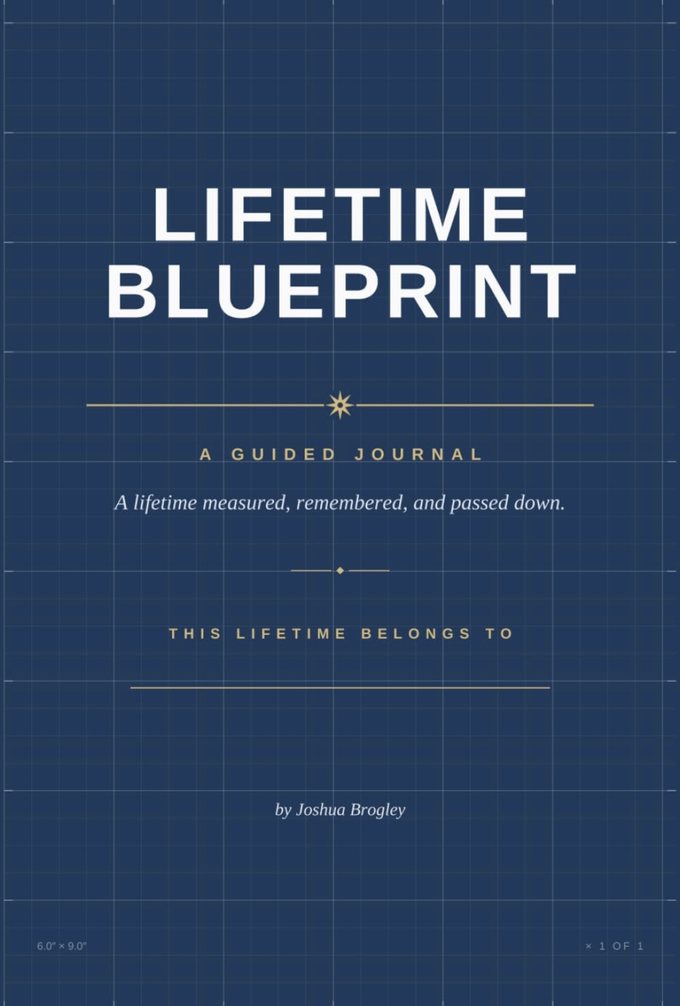
Lifetime Blueprint
The hardcover built to be inherited: eight life domains scored across decades, thirty life-event templates, and letters written forward, ending in a Final Letter.
What should I write first in a lifetime journal?
Read the eight domains first, about thirty minutes, then take the Origin Snapshot: eight life domains scored for past, present and ideal in one sitting of one to two hours. It is the measurement every later entry compares against.
Do I have to fill in a lifetime journal in order?
Only for the first few sittings: read Part One, take the Origin Snapshot, name the people who matter, backfill one decade, record one event, write one letter. After that the book is opened freely, when something happens or a snapshot interval arrives.
More on Lifetime Blueprint
- Your Twenties: The Decade of Compounding Choices
- Your Thirties: The Building Decade, When Time Starts to Feel Finite
- Your Forties Are a Recalibration, Not a Crisis
- Your Fifties: The Distillation Decade, Subtraction Over Addition
- Why Most People Will Never Write Their Life Down
The method behind every book
- Which 365-Day Book Should I Start With? A One-Minute Guide
- What Is a No Zero Day? The Rule That Saves a Bad Week
- What Is a Realistic Morning Routine? Two Minutes, Not Two Hours
All articles about Lifetime Blueprint → · The book page → · All the books →
written by the author, at the kitchen table, after work.