Home / Blog / Lifetime Blueprint
LIFETIME BLUEPRINT
Is It Too Late to Write Your Life Down? Not at 60, 70 or 80
Part of the series Where to Begin a Lifetime Journal: Five Ways In, and Who Each Is For
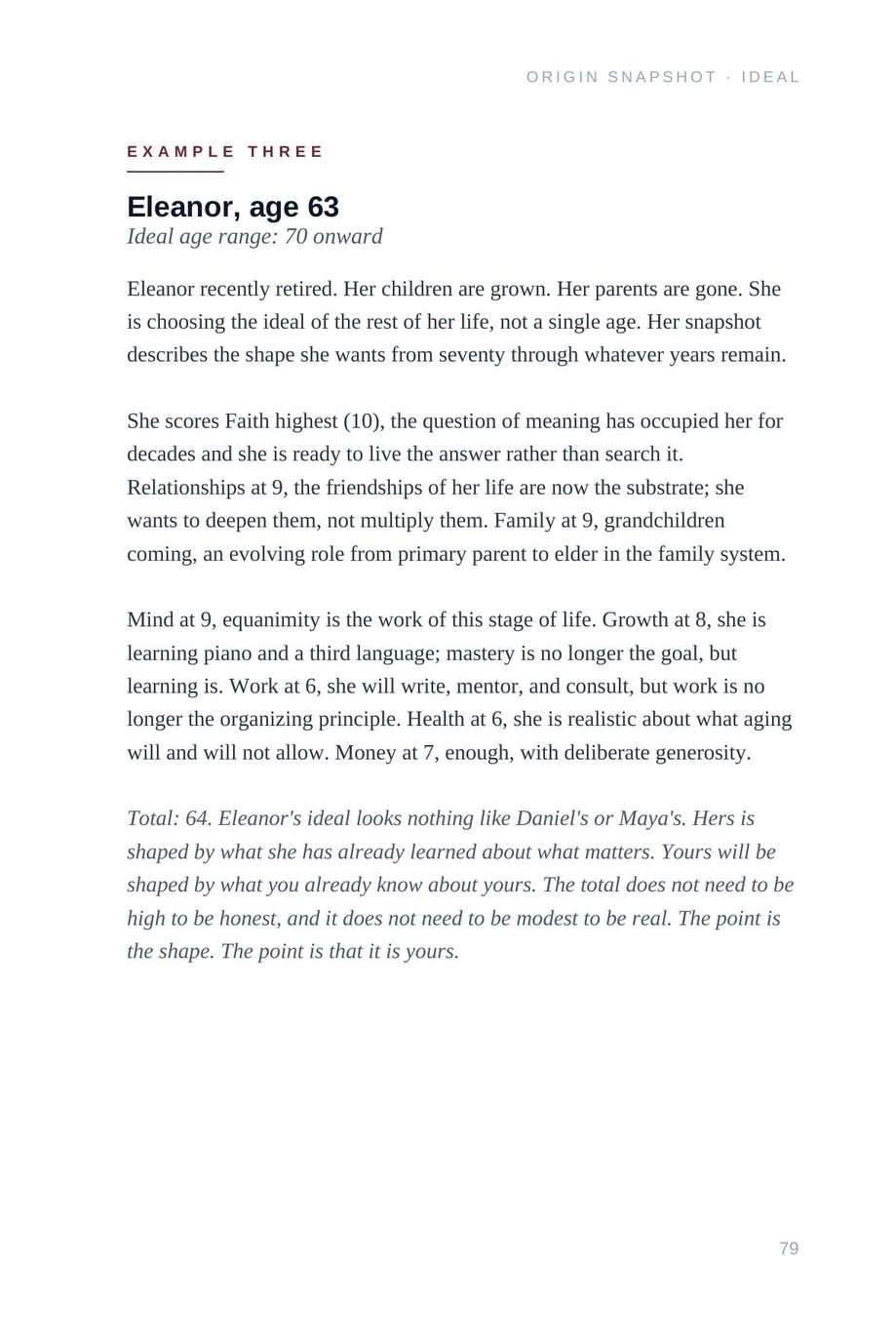
No. The reader who starts at sixty-three, retired, children grown, parents gone, is one of the three worked examples printed in the book, and not as an edge case: she is the reader with the most material, the most witnesses already lost, and the clearest view of what a decade actually costs. Too late is arithmetic done without checking it. The thing that is genuinely late is not the writing. It is the waiting, because the details a family will most want are the ones that leave first.
What the older reader has that nobody else does
Six or seven decades of backfill, most of it lived before anyone was recording anything, which makes the record irreplaceable in a way a thirty-year-old's cannot be. The stories only you still carry about parents now gone. The prices, the jobs, the kitchens, the ordinary Tuesdays of a world that no longer exists, which are precisely the details a grandchild will skip the sermons to find. And a scoring view of the decades that the young cannot have: you already know which choices compounded, and you can write what you did not know then with the authority of someone who found out.
Do not attempt the whole thing; log the layers
The late starter's failure mode is scale: seventy years, one notebook, one heroic winter. The book is designed against that. Each decade chapter has a log for the date of every entry, so backfill is built in fifteen-minute layers across months, and the decade that pulls hardest goes first, not the earliest. Ten dated paragraphs across a year beats the complete memoir that was never begun, and the log itself becomes part of the record: future readers can see that the thirties were written at seventy-one, which is its own kind of honesty. Backfilling the decades has the full method.
Score an ideal for the rest of your life, not a year
Measurement does not retire. The worked example at sixty-three chooses an ideal age range, seventy onward, rather than a single year, and scores eight domains for that whole stretch: what Health looks like if the remaining years are used well, what Family and Faith and Growth look like at eighty. The gap between that ideal and today is then named as habits to stop, habits to build, relationships to grow or find. Readers describe this as the page that changed what their sixties were spent on. The Origin Snapshot explains the three points; here the third point simply reaches further.
The letters stop being practice
At this age the letters forward are the reason the book exists. The letter to a grandchild who may not yet be born. The letter to whoever reads this after you, found in a drawer in thirty years. The inside-cover inscription to the person who finds the book, and the chosen next reader, named now rather than left to chance. And the Final Letter, to the people you most loved, to be opened after you are gone, written while it can be written well. That letter has its own method; any age covers how the mix shifts across a life, and where to begin is the same first sitting at seventy as at twenty.
Lifetime Blueprint
The hardcover built to be inherited: eight life domains scored across decades, thirty life-event templates, and letters written forward, ending in a Final Letter.
Is 70 too old to start a journal?
No. The seventy-year-old holds decades of irreplaceable material, the stories about people now gone, and the clearest view of what choices compounded. Build it in dated fifteen-minute layers rather than one heroic effort.
What should an older person write in a lifetime journal first?
The decade that pulls hardest, then the letters that count: to a grandchild, to whoever finds the book, and the final letter to the people most loved. An ideal snapshot for the rest of life, not a single year, decides what the remaining decades are spent on.
More on Lifetime Blueprint
- Your Twenties: The Decade of Compounding Choices
- Your Thirties: The Building Decade, When Time Starts to Feel Finite
- Your Forties Are a Recalibration, Not a Crisis
- Your Fifties: The Distillation Decade, Subtraction Over Addition
- Why Most People Will Never Write Their Life Down
The method behind every book
- Which 365-Day Book Should I Start With? A One-Minute Guide
- What Is a No Zero Day? The Rule That Saves a Bad Week
- What Is a Realistic Morning Routine? Two Minutes, Not Two Hours
All articles about Lifetime Blueprint → · The book page → · All the books →
written by the author, at the kitchen table, after work.