Home / Blog / Lifetime Blueprint
LIFETIME BLUEPRINT
Past, Present and Ideal: A Self-Reflection Exercise With Three Scores
Part of the series Where to Begin a Lifetime Journal: The First Six Sittings, in Order
Most self-reflection exercises ask one question about one moment: how are you doing? You get a feeling, and a feeling has no direction. Ask the question three times, about three moments, and you get a line. That is the whole idea behind the Origin Snapshot in the Lifetime Blueprint, and it works as a stand-alone exercise for anyone willing to give it an honest hour.
Quick answer: Score eight life areas from 0 to 10 three times: Past (three to five years ago), Present (the last 90 days) and Ideal (the future you actually want). Trajectory is Present minus Past. Gap is Ideal minus Present. Then pick the two or three areas where the work is most urgent and write one small, dated move for each.
Three points, one trajectory
One score gives you a feeling. Two scores make a line, but a line between two points cannot tell you whether you are speeding up, slowing down or holding steady. Three points can. The three are not alike, and each does different work. Past is the calibration: a specific season three to five years back, scored without the flattering round-off memory adds. Present is the hardest: the last 90 days, where the pull to inflate is strongest because the score is about who you are now. Ideal is the destination: the future you actually want, scored without shrinking it to feel achievable.

Run it in one sitting
Block one to two hours, no phone, no audience. Score Past first, then Present, then Ideal, using the same scoring guide for all three, so a 6 means the same thing in every column. Anchor each one in a line at the top of the page: what defined that time. Do not spread it across a week; the three numbers only mean something next to each other, and memory reorders them if you give it time. The free life scoring tool covers the Present in about ten minutes if you want a head start.
A worked example: one reader at 38
The book prints a fully worked example, shown here, so you can see what finished numbers look like. A hypothetical reader, 38. Past total 32 of 80, Present 53, Ideal 68. That is a trajectory of plus 21, a strong upward arc, with Mind gaining the most ground at plus 4. The overall gap is 15, and the reading notes that this Ideal mixes strong and maximum scores; another reader might score all tens, and there is no ceiling. Then six readings, each one a sentence. Largest gap: Health, 6 to 9, the only domain with a gap of three, so that is where the next few years belong. Slowest mover: Relationships, plus 1, the quietest signal on the page, because whatever has been done there is not changing it. Lowest score today: Faith at 5, climbing from the lowest start. Already strong: Family and Work at 8. Hold steady; push elsewhere.
Read it as a picture
The next page in the book draws the same numbers as eight small slope charts: a solid line from Past to Present, where you have been heading, and a dashed line from Present to Ideal, where you want to go. Health has the longest dashed line still ahead. Relationships has the flattest solid one. Drawn, the reading takes five seconds and is hard to argue with. Then the totals go on one chart out of 80, and the shape tells you something too: a steep climb means your recent choices are working, so protect them; a flat line means life has held steady, so ask whether that is peace or drift; a drop is not a verdict but the first honest measurement of a hard stretch. The four patterns turns this into a two-by-two.
Then do something small
The exercise ends with a decision, not an insight. Pick the two or three domains where the work is most urgent and let the others hold steady, because pushing all eight at once usually moves none of them. Name the gap: habits to stop, habits to build, relationships to grow or find. Then write one move per domain for the next six months, small enough to actually do, dated when you write it and dated again when it is done. What to do after a life audit covers that page. The Origin Snapshot is the full method, with three more worked examples at 17, 34 and 63.
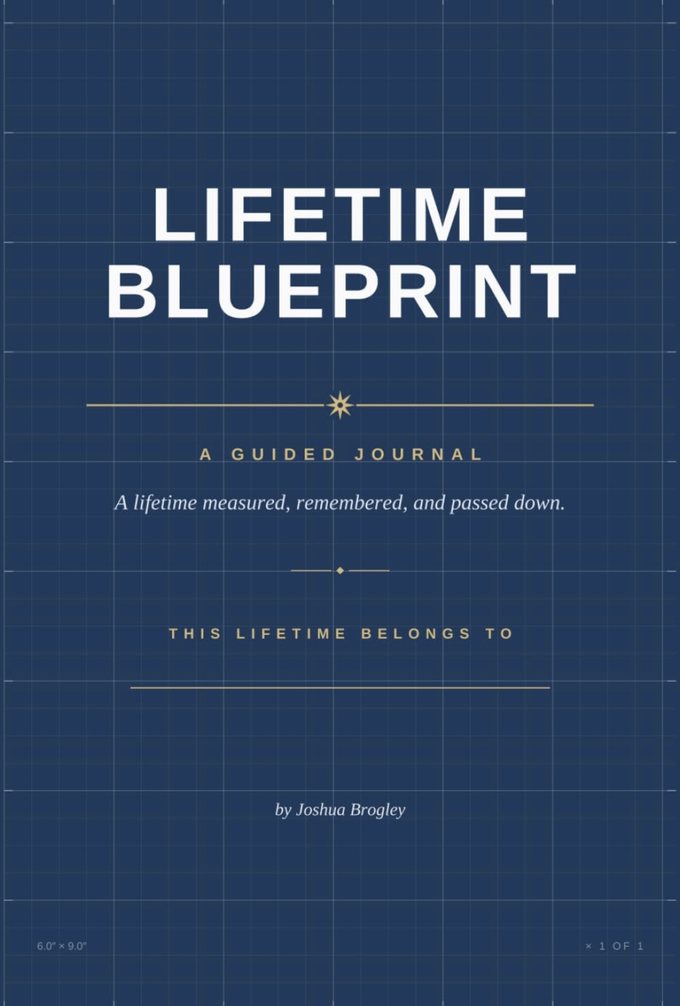
Lifetime Blueprint
The hardcover built to be inherited: eight life domains scored across decades, thirty life-event templates, and letters written forward, ending in a Final Letter.
What is the past, present and future self-reflection exercise?
Score each area of your life three times: where you were three to five years ago, where you are over the last 90 days, and where you want to be. The difference between Present and Past is your trajectory; the difference between Ideal and Present is your gap.
How far back should the past score go?
Three to five years, anchored to a specific season or chapter you can actually remember, not a vague sense of before.
Should my ideal scores be realistic?
No. Score the future you actually want without shrinking it. The book's worked example mixes strong and maximum scores, and notes another reader might score all tens.
More on Lifetime Blueprint
- Why Most People Will Never Write Their Life Down
- Your Fifties: The Distillation Decade, Subtraction Over Addition
- Your Forties Are a Recalibration, Not a Crisis
- Your Thirties: The Building Decade, When Time Starts to Feel Finite
- Your Twenties: The Decade of Compounding Choices
The method behind every book
- Which 365-Day Book Should I Start With? A One-Minute Guide
- What Is a No Zero Day? The Rule That Saves a Bad Week
- What Is a Realistic Morning Routine? Two Minutes, Not Two Hours
All articles about Lifetime Blueprint → · The book page → · Group and bulk orders →
written by the author, at the kitchen table, after work.