Home / Blog / Lifetime Blueprint
LIFETIME BLUEPRINT
Journal vs Planner: One Looks Forward a Week, One Holds a Life
Part of the series Where to Begin a Lifetime Journal: Five Ways In, and Who Each Is For
The difference between a journal and a planner is not format, it is the direction and length of the gaze. A planner looks forward one week and tracks what you will do; it assumes you already know who you are trying to become and just need the logistics managed. A journal looks backward and inward across years and records what happened and what it meant. The planner executes a life. The journal is where you find out which life is worth executing.
What the planner quietly assumes
Every planner ships with an invisible premise: the destination is settled, so optimize the route. For weeks and projects the premise is fine. Adopted as a life philosophy, it produces the familiar modern specimen: superbly organized motion toward a destination chosen by default, reviewed never. The planner cannot catch this, structurally, because no Tuesday grid contains the question is this the right direction. That question needs an instrument with a longer gaze, which is what reflection is for, and why values work always feels out of place in a scheduling tool.
What the journal does that scheduling cannot
Three jobs, roughly. Measuring honestly: where the domains of life actually stand, on record, against last year's answer. Remembering accurately: the events and turnings written while true, before memory revises. And transmitting: the record a family keeps of itself, which no planner has ever produced, because planners are consumed and discarded while a real journal is the only book in the house that appreciates. The gaze is backward but the function is forward: you cannot correct a course you never measured.
You need both; you replace neither
This is not planner-bashing: a life with only reflection and no execution is a well-documented drift. The working system is a cheap, disposable planner for the week, any format, it genuinely does not matter, plus a permanent journal on the slow clock for the life: snapshots yearly, events as they land, decades scored at their close. One is a tool, bought again every January. The other is a single volume, because its cadence is measured in years and its entries must land next to each other to compound.
The tell, and the fix
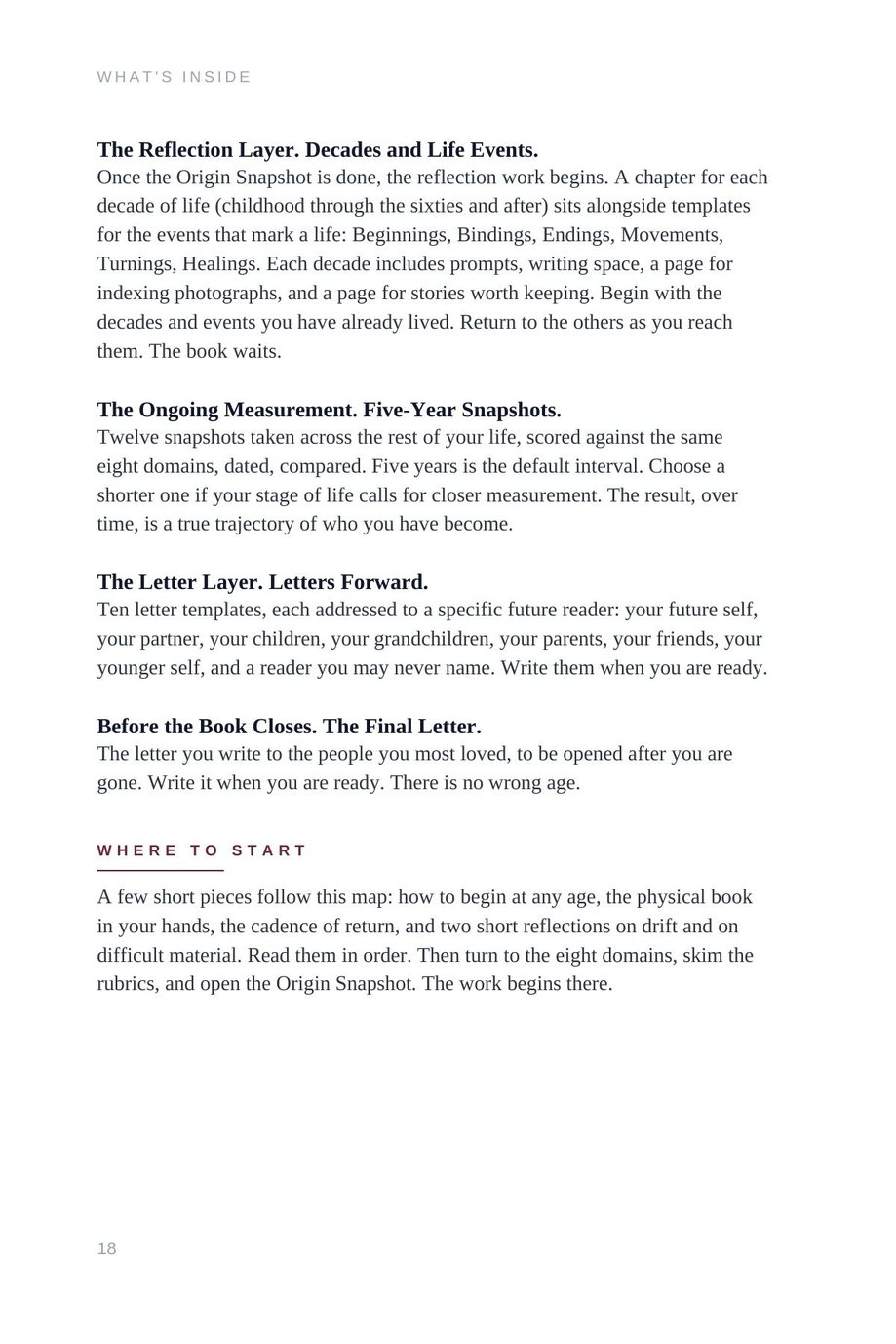
Here is the tell that the balance has tipped: you can say what you are doing next week in detail and cannot say what last year was about in one sentence. Extremely common, entirely fixable, and the fix costs one evening: a first honest snapshot in a book built for the long gaze, eight domains, dated, with the explicit design goal of being the volume your family keeps. That book states its own scope on an early page, three things it is for, measuring honestly, remembering accurately, handing on, and a planner is deliberately none of them. What a lifetime journal is covers the category; documenting a life covers the practice.
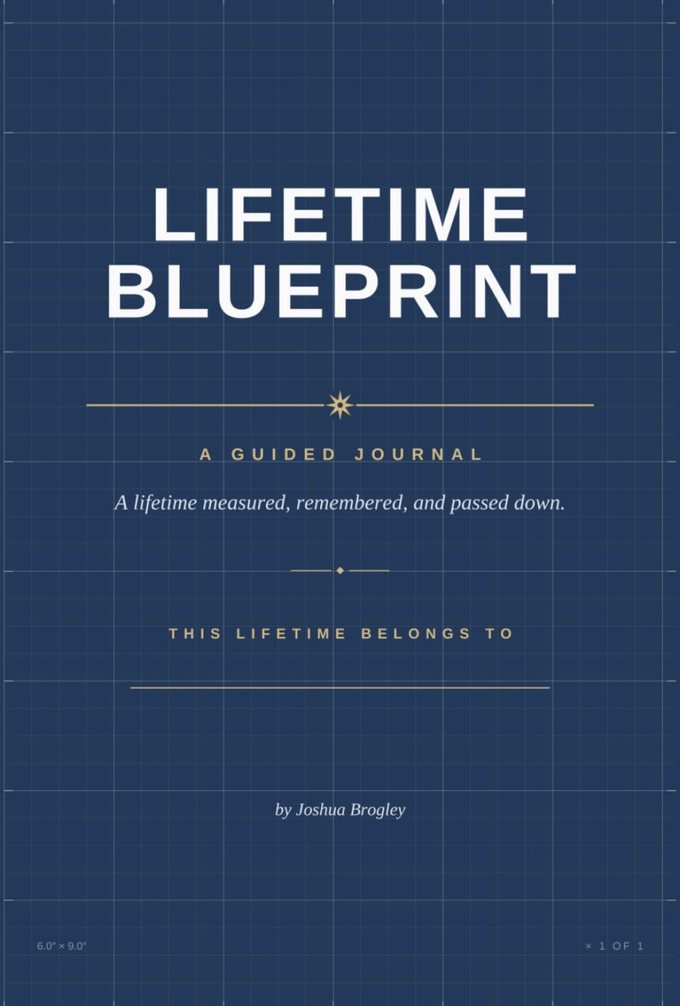
Lifetime Blueprint
The hardcover built to be inherited: eight life domains scored across decades, thirty life-event templates, and letters written forward, ending in a Final Letter.
What is the difference between a journal and a planner?
Direction and horizon: a planner looks forward a week and manages what you will do; a journal looks across years and records what happened and what it meant. One executes a life, the other measures whether it is the right one.
Do I need a journal if I already use a planner?
If you can detail next week but cannot summarize last year in a sentence, yes. Keep the disposable planner for execution and add a permanent, slow-cadence journal for measurement; they do different jobs and replace each other badly.
More on Lifetime Blueprint
- Your Twenties: The Decade of Compounding Choices
- Your Thirties: The Building Decade, When Time Starts to Feel Finite
- Your Forties Are a Recalibration, Not a Crisis
- Your Fifties: The Distillation Decade, Subtraction Over Addition
- Why Most People Will Never Write Their Life Down
The method behind every book
- Which 365-Day Book Should I Start With? A One-Minute Guide
- What Is a No Zero Day? The Rule That Saves a Bad Week
- What Is a Realistic Morning Routine? Two Minutes, Not Two Hours
All articles about Lifetime Blueprint → · The book page → · All the books →
written by the author, at the kitchen table, after work.