Home / Blog / Lifetime Blueprint
LIFETIME BLUEPRINT
Start With What Just Happened: Journaling Mid-Event
Part of the series Where to Begin a Lifetime Journal: Five Ways In, and Who Each Is For
Some people open a lifetime journal for the first time in the week something happened: the baby arrived, the parent died, the boxes are still packed, the diagnosis is three days old. The right door for that reader is not the Origin Snapshot and its two-hour sitting. It is the event template, opened now, written badly, dated, and returned to. The recording matters more than the order, because events are the entries memory revises fastest, and a first attempt made while it is still true is worth more than a polished one made after the sanding.
Why events cannot wait for the proper sequence
Decades can be backfilled for years with acceptable losses; an event loses its detail in weeks. What was actually said in the hospital corridor, what the house smelled like on the last night, the sentence the surgeon used, the particular feeling in the car afterward: these are the parts a reader thirty years on will value most, and they are the first to go. Sequence is a convenience. The event page is a perishable, and perishables get handled first.
Write facts, refuse meaning, date it
The mid-event protocol is the same one used for grief and for turning points, because it works: record what observably happened, what was said, who was there, what you notice yourself doing, and explicitly decline the question of what it means. Meaning assigned in the week is usually wrong in an unfixable way, because the theory overwrites the observations. The template splits its prompts between what happened then and what you know now precisely so the second half can be written a year or five later, under the first, rather than instead of it. Writing about losing someone is the hardest version of this; recognizing a turning point is the quietest.
Find the right template, then trust the category
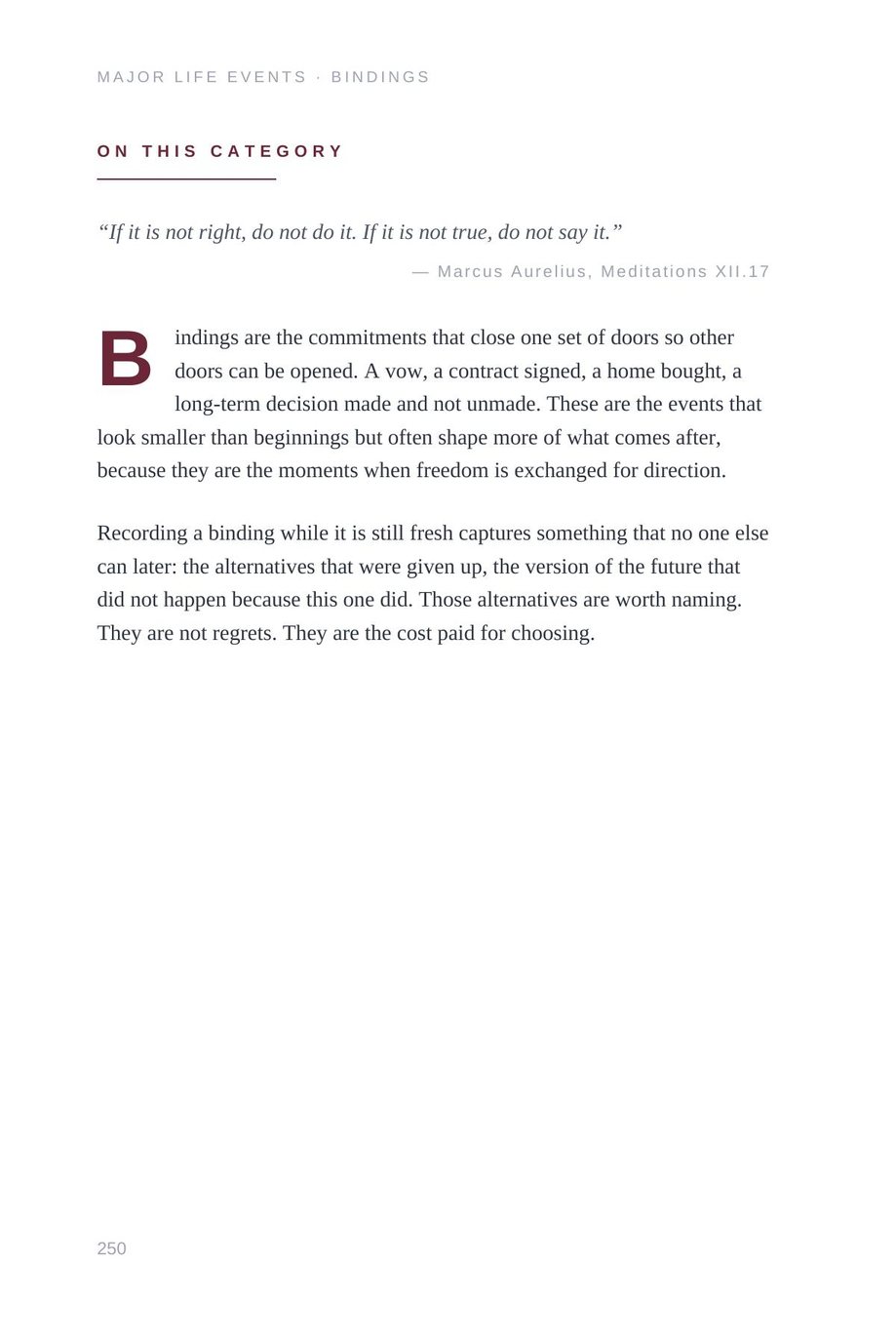
The thirty templates sit in six categories: Beginnings, Bindings, Endings, Movements, Turnings, Healings. A birth is a Beginning, a wedding a Binding, a death an Ending, a move a Movement, the decision that changed the decade a Turning, and the recovery, written much later, a Healing. Choosing the category is itself clarifying, because it tells you what kind of thing you are inside: people mid-Movement often discover they are also mid-Turning, and the second template gets opened the same week. The six kinds explains each with examples.
Then, when the dust settles, go back to the front
Starting mid-event does not cancel the recommended order; it defers it. Once the first weeks pass, the Origin Snapshot gets its sitting, and it will be a more honest snapshot for having been taken by someone who just wrote an event page, because the event has already broken the dinner-party version of the present. The people inventory usually follows immediately, since events tend to reorder who matters. Where to begin holds the full sequence for when you are ready to run it.
Lifetime Blueprint
The hardcover built to be inherited: eight life domains scored across decades, thirty life-event templates, and letters written forward, ending in a Final Letter.
Should I start a journal during a major life event?
Yes, at the event page rather than the front of the book. Events lose their detail in weeks; write the facts now, dated, refuse the meaning question, and return later to interpret. The rest of the recommended order can follow once the dust settles.
What do I write about an event I am still in the middle of?
What observably happened, what was said, who was there, and what you notice yourself doing. Leave what it means for a later dated entry under the first; meaning assigned mid-event tends to overwrite the evidence.
More on Lifetime Blueprint
- Your Twenties: The Decade of Compounding Choices
- Your Thirties: The Building Decade, When Time Starts to Feel Finite
- Your Forties Are a Recalibration, Not a Crisis
- Your Fifties: The Distillation Decade, Subtraction Over Addition
- Why Most People Will Never Write Their Life Down
The method behind every book
- Which 365-Day Book Should I Start With? A One-Minute Guide
- What Is a No Zero Day? The Rule That Saves a Bad Week
- What Is a Realistic Morning Routine? Two Minutes, Not Two Hours
All articles about Lifetime Blueprint → · The book page → · All the books →
written by the author, at the kitchen table, after work.