Home / Blog / Lifetime Blueprint
LIFETIME BLUEPRINT
How to Recognize a Turning Point While You're Inside One
Part of the series The Six Kinds of Life Events Worth Writing Down
Turning points almost never announce themselves. The wedding has a date and a photographer; the conversation that made you quit the safe job looked like Tuesday lunch. Most turnings are only visible in the rearview mirror, and that is mostly fine, except that the details evaporate before the significance arrives. So the skill is not prediction. It is noticing three live signals, and running a simple protocol when they fire: record now, interpret later.
Signal one: the map resizes
The clearest live marker of a turning is that options change size. Doors you were not looking at swing open; doors you assumed were permanent close without ceremony. A city becomes possible, a career stops being imaginable, a person's opinion suddenly weighs double or nothing. When you catch yourself recalculating what is possible, not what to do, but what could be done, something upstream has moved. That recalculation is worth a dated paragraph even when you cannot yet say why.
Signals two and three: the disproportionate moment, and the quiet after
Second signal: an event's emotional size wildly exceeds its calendar size, a twenty-minute conversation you keep replaying for a month, a small rejection that will not settle, a stranger's sentence that lodged. Replay is the mind flagging significance it cannot yet name. Third, stranger signal: an unfamiliar quiet around a decision that should feel enormous, the calm of a question that has, somewhere below deliberation, already been answered. People consistently report that the biggest turnings felt less dramatic than the medium ones. The drama happens at the surface. Turnings happen below it.
Record now, interpret later, on purpose
The protocol when a signal fires: write what is observably happening, dated, and explicitly refuse the meaning question for now. What was said, what changed, what you notice yourself doing, one honest page. Interpretation is scheduled for later, a year, sometimes five, when the consequences have declared themselves, added under the original entry rather than replacing it. This split matters because meaning assigned in the moment is usually wrong in an unfixable way: the original observations get overwritten by the theory. Facts first age well. Verdicts first destroy the evidence.
Give turnings a category and they multiply
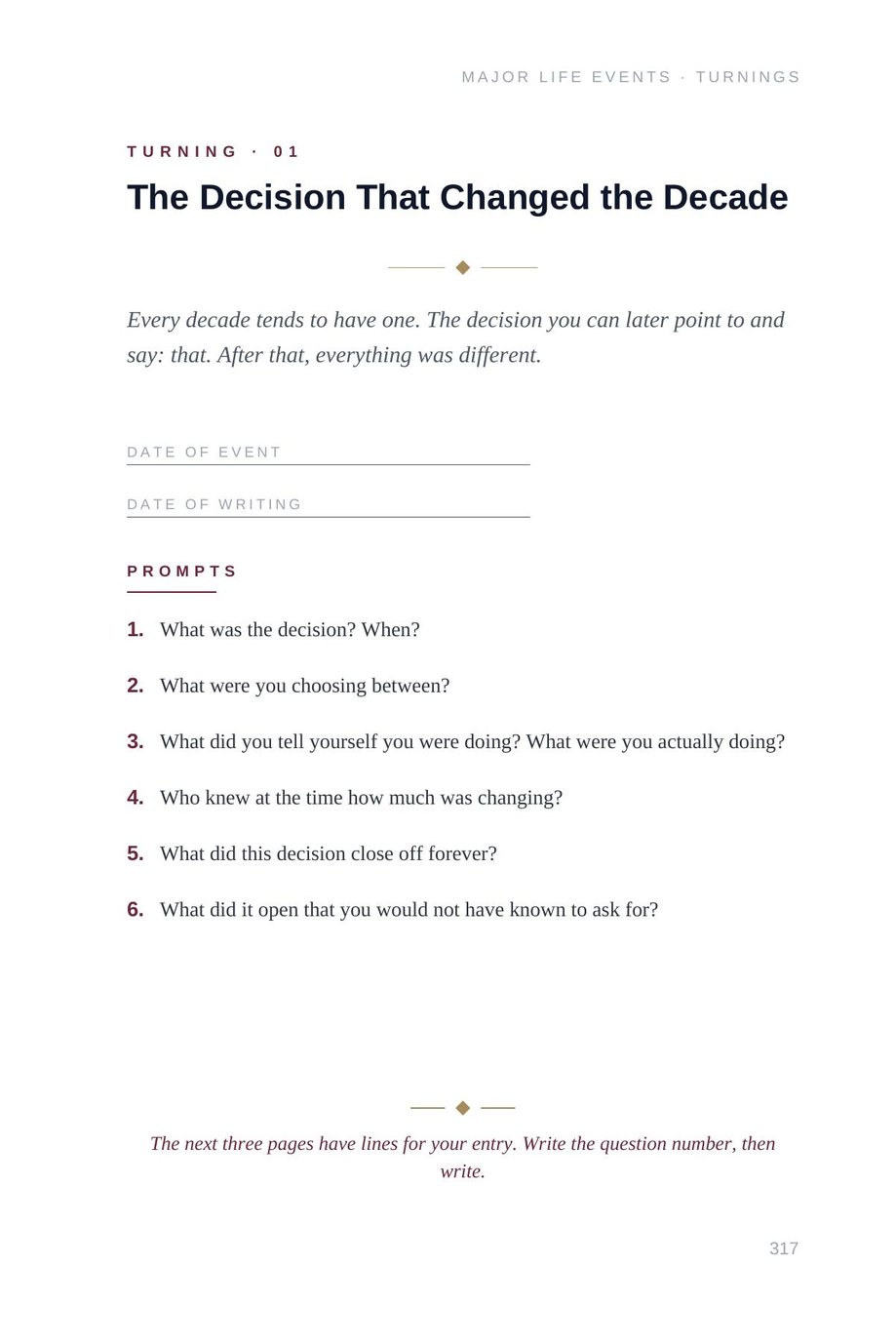
The reason most people can name only two or three turning points in a whole life is not that only three occurred; it is that nothing in their record-keeping had a slot for them, so the quiet ones filed themselves under ordinary time and dissolved. Turnings are one of the six kinds of life events, with their own templates in a certain hardcover, the first of which is titled, exactly, The Decision That Changed the Decade, with the prompts split between what happened then and what you know now. People who keep the category report finding a turning roughly every eighteen months. The frequency was always there. The slot was not. Recording the big events is the wider practice; the decade reflection is where the interpretations finally get written.
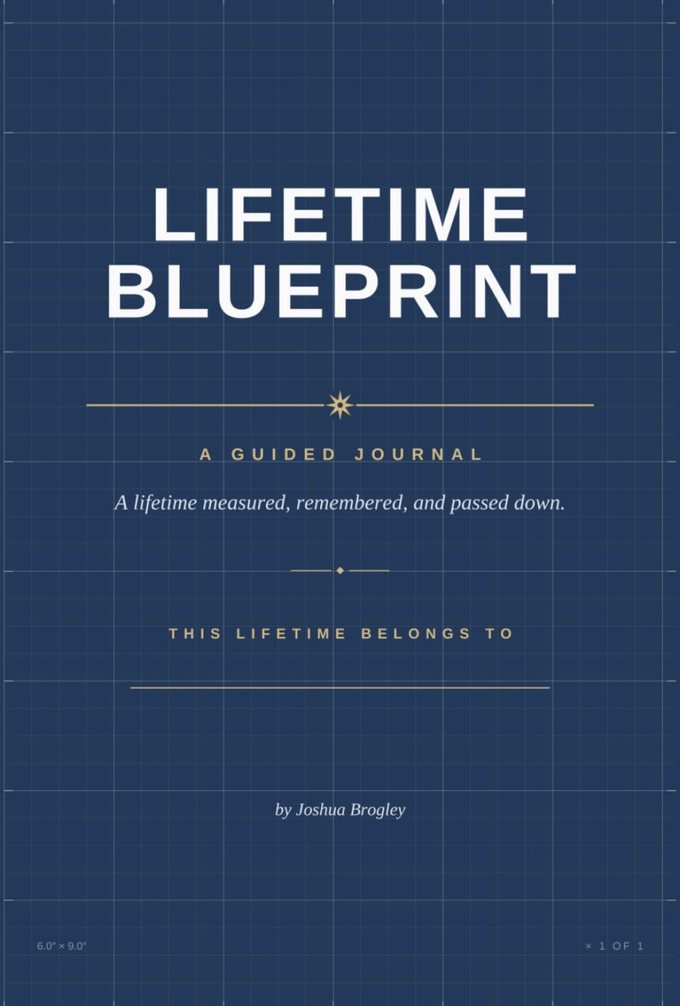
Lifetime Blueprint
The hardcover built to be inherited: eight life domains scored across decades, thirty life-event templates, and letters written forward, ending in a Final Letter.
How do you know if something is a turning point in your life?
Three live signals: your sense of what is possible resizes, an event's emotional weight wildly exceeds its size, or an unfamiliar calm settles around a decision that should feel enormous. Any of the three earns a dated entry.
Should I make big decisions during a turning point?
Record first, decide on your normal timeline, and interpret much later. The protocol is facts now, meaning in a year: verdicts written in the moment tend to be wrong and to overwrite the evidence.
More on Lifetime Blueprint
- Your Twenties: The Decade of Compounding Choices
- Your Thirties: The Building Decade, When Time Starts to Feel Finite
- Your Forties Are a Recalibration, Not a Crisis
- Your Fifties: The Distillation Decade, Subtraction Over Addition
- Why Most People Will Never Write Their Life Down
The method behind every book
- Which 365-Day Book Should I Start With? A One-Minute Guide
- What Is a No Zero Day? The Rule That Saves a Bad Week
- What Is a Realistic Morning Routine? Two Minutes, Not Two Hours
All articles about Lifetime Blueprint → · The book page → · All the books →
written by the author, at the kitchen table, after work.