Home / Blog / Lifetime Blueprint
LIFETIME BLUEPRINT
Movements: Writing the Leaving and the Arriving
Part of the series The Six Kinds of Life Events Worth Writing Down
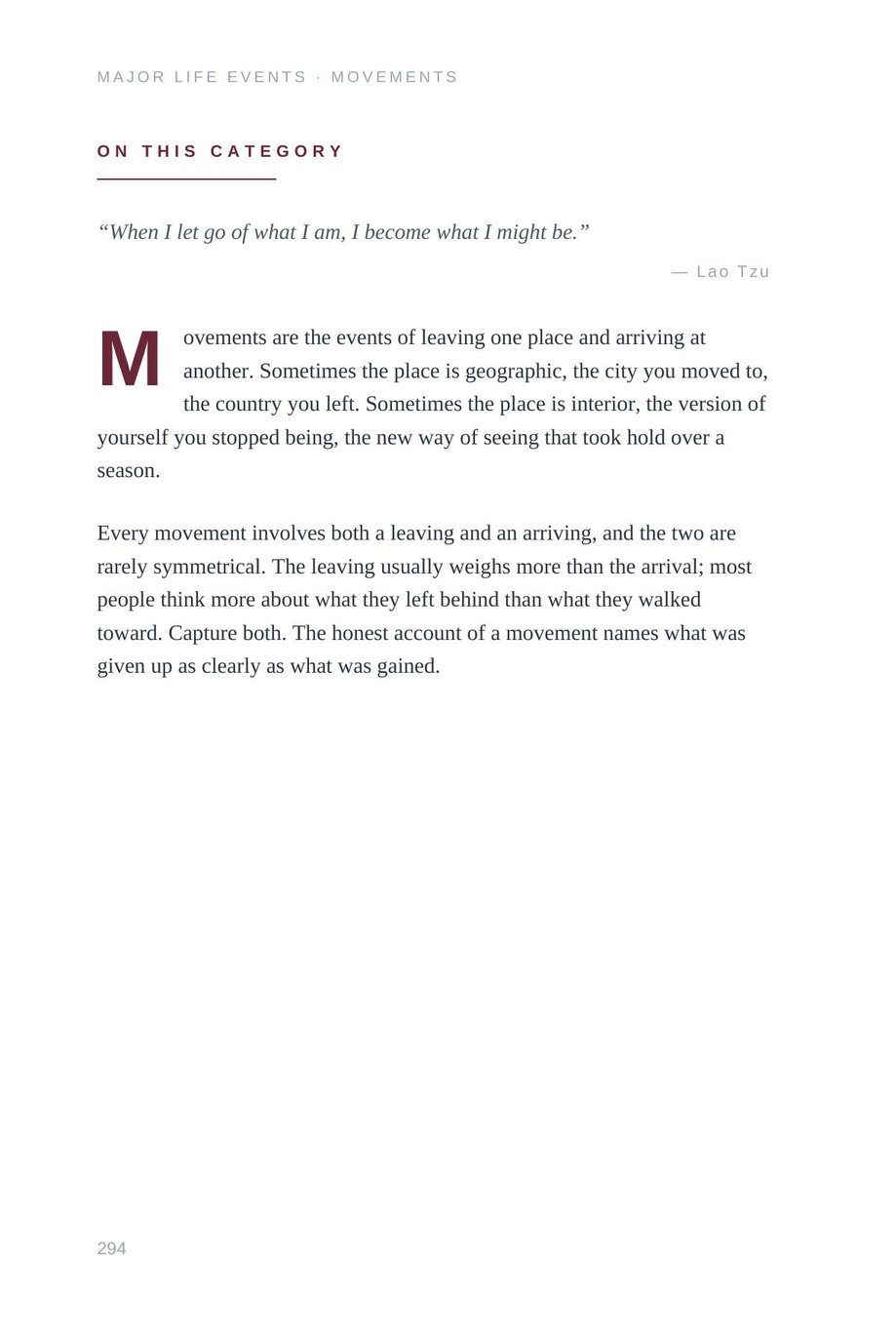
Movements are the events of leaving one place and arriving at another. Sometimes the place is geographic: the city moved to, the country left. Sometimes it is interior: the version of yourself you stopped being, the new way of seeing that took hold over a season. Every movement involves both a leaving and an arriving, and the two are rarely symmetrical. The leaving usually weighs more; most people think far more about what they left behind than what they walked toward. The honest account captures both, and names what was given up as clearly as what was gained.
The five templates
A Move Across Distance, which rearranges friendship, work, family proximity and how time is spent, written from both sides. A Career Pivot, the change that looks small on a resume and reshapes a decade, captured before it is rationalized in retrospect. An Internal Shift, the day you stopped believing something, or started, or saw something you cannot now unsee. Leaving a Faith or Returning to One, the movement that reshapes every other domain and is among the most important records a person can keep. And A Long Travel That Changed You, the journey, particularly the long or solo one, that returned a different person from the one who left.
Write from both sides, on purpose
The template's instruction for the geographic move is the rule for the whole category: write what you left, and write what you arrived into, as two separate accounts rather than one blended feeling. The leaving side is where grief hides in a decision that was correct; the arriving side is where the gains hide, because gains are quieter than losses and go uncounted. A move written only from the leaving side reads as a loss, and a great many people carry a correct decision as a loss for twenty years because they never wrote the other half.
Before it is rationalized
Career pivots and internal shifts share a hazard: within a year the mind produces a clean explanation, and the clean explanation replaces the actual moment, which was usually messier, more accidental and more interesting. Capture the moment of pivot before it is rationalized in retrospect is the template's exact phrase, and it is the reason this category rewards writing fast. The rationalized version can be written later, under the first, and the gap between the two is itself the record of how a person makes sense of their own life.
The movement most worth recording
Movements of faith, toward or away, reshape every other domain, and the book singles that template out as one of the most important records a person can keep, whichever direction the movement ran. The career pivot is the most common Movements entry and a guided post; the move across a border is the largest. Movements are the fourth of the six kinds of life events, and the templates sit in the events section of a certain hardcover, dated, with room for the second account.
Lifetime Blueprint
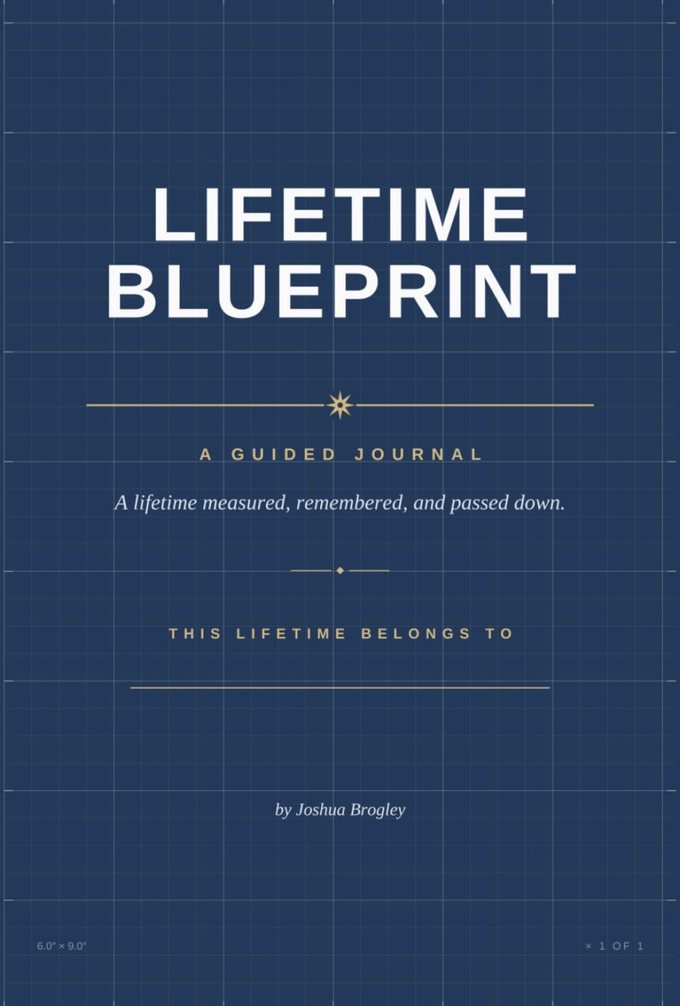
The hardcover built to be inherited: eight life domains scored across decades, thirty life-event templates, and letters written forward, ending in a Final Letter.
What counts as a movement in a life story?
Leaving one place and arriving at another: a geographic move, a career pivot, an internal shift in belief, leaving or returning to a faith, or a journey that changed you. Each has a leaving and an arriving, written separately.
How do you write about moving to a new place?
From both sides. Write what you left, honestly, and write what you arrived into, as two accounts. Moves written only from the leaving side get carried as losses for decades even when the decision was right.
More on Lifetime Blueprint
- Your Twenties: The Decade of Compounding Choices
- Your Thirties: The Building Decade, When Time Starts to Feel Finite
- Your Forties Are a Recalibration, Not a Crisis
- Your Fifties: The Distillation Decade, Subtraction Over Addition
- Why Most People Will Never Write Their Life Down
The method behind every book
- Which 365-Day Book Should I Start With? A One-Minute Guide
- What Is a No Zero Day? The Rule That Saves a Bad Week
- What Is a Realistic Morning Routine? Two Minutes, Not Two Hours
All articles about Lifetime Blueprint → · The book page → · All the books →
written by the author, at the kitchen table, after work.