Home / Blog / Lifetime Blueprint
LIFETIME BLUEPRINT
Inside the Lifetime Blueprint: Every Section, Tool and Method Explained
Part of the series Letters Forward: The Eleven Letters Everyone Should Write
The Lifetime Blueprint is a hardcover built to be scored in, written in and returned to across the rest of a life, and then inherited. It is not a planner, not a resolution system and not motivation; it is an instrument for measuring a whole life honestly, recording what each decade and each major event meant, and speaking to readers who do not exist yet. This is the long walk through it, section by section, with the actual pages, the method behind each part, why the method works, who each part is for, and what it produces. Every section has its own cluster of deeper posts, linked as you go.
What the book is for, and what it is not for
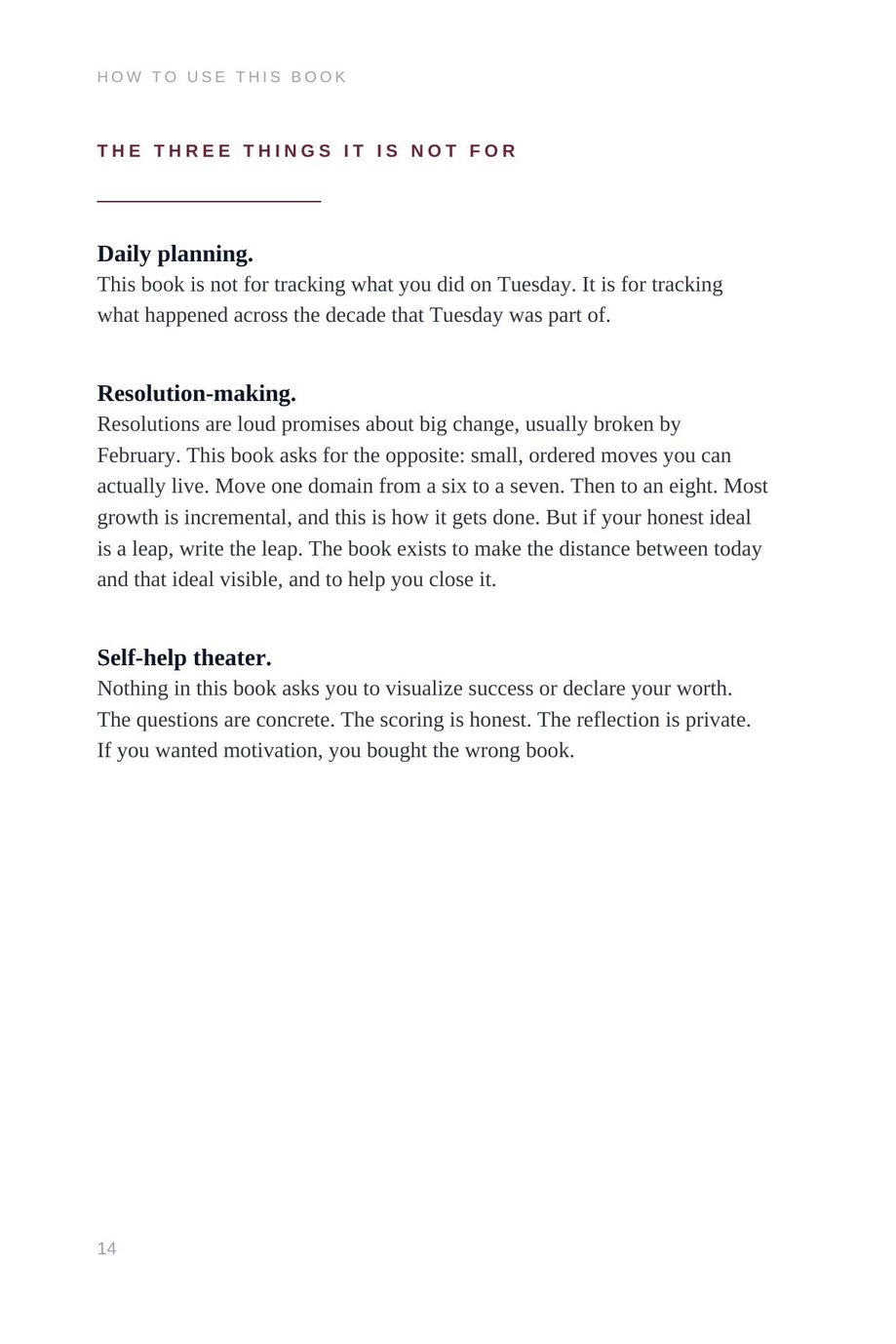
It begins where planners end. A planner assumes you already know who you are trying to become; this book starts with that question, at any age, and helps you answer it across the rest of your life. Three things work together inside it: a measurement, eight domains scored honestly; a structure, snapshots, decade reflections, life events and letters; and a cadence, not daily, not weekly, but the slow clock of years. The book names three jobs it does, measuring honestly, seeing trajectory, defining the destination, and three it refuses: daily planning, which tracks Tuesday rather than the decade Tuesday was part of; resolution-making, the loud promise broken by February; and self-help theater, which it dismisses in one line: if you wanted motivation, you bought the wrong book. The orientation matters because, as the book says, most readers who give up do so because they started scoring before they understood what the scoring was for. What a lifetime journal is and journal versus planner cover the distinction; who it is for and why most people never do this cover the reader.
The map: four layers
The book is built in layers, and the What's Inside map on page seventeen lays them out. The framework: the eight domains, a reference rather than a place to write. The measurement layer: the Origin Snapshot, three scorings in one sitting, paired with the People Who Matter inventory. The reflection layer: a chapter for each decade and thirty templates for the events that mark a life. The ongoing measurement: twelve five-year snapshots across the rest of your life. The letter layer: ten letters forward and, before the book closes, the Final Letter. Then a set of short orientation pieces, where to begin, the physical book, the cadence of return, and two reflections, on drift and on difficult material. The recommended sequence for the first sittings is fixed and useful, and after it the book is opened freely. Where to begin is the sequence with its five doors, at any age.
The eight domains and the rubric
Health, Mind, Faith, Family, Relationships, Work, Money, Growth. The note on page twenty-seven says they are the result of ten years of trying to find a smaller list: fewer than eight leaves real parts of a life unmeasured, more produces noise, and the two most common stumbles, Faith for secular readers and Money for readers who consider themselves above it, are precisely the domains those readers most need to measure. Each domain gets a definition, a list of what the score is not about, two quotations, and a rating guide in six bands with observable criteria: Crisis 0 to 1, Struggling 2 to 3, Surviving 4 to 5, Steady 6 to 7, Thriving 8 to 9, Exceptional 10. Seven hours of sleep, six months of emergency fund, two to five real friendships, six books a year: the rubric exists so that a number cannot be a mood wearing a digit. The domains are scored together because they interact; Health is the substrate the others run on. The eight domains, scored is the cluster pillar with a post per domain, and the free life scoring tool runs the rubric as a questionnaire.
The Origin Snapshot: three points make a line
Block one to two hours. Score all eight domains at three time-points: Past, three to five years ago, the calibration, where honesty is the foundation of honesty everywhere else; Present, today, the most psychologically demanding score, where the temptation to inflate is strongest and the rubric does most of its work; and Ideal, the future you actually want, with no ceiling and no required trade-off. Two points make a line that cannot tell you whether you are accelerating or slowing; three make a trajectory, and from a trajectory a future can be predicted. The gap pages follow: habits to stop, habits to build, relationships to grow or find. Three worked examples, at twenty-six, thirty-four and sixty-three, show what an ideal looks like at different ages. The reference section at the back traces a hypothetical thirty-eight-year-old through the whole thing: Past 32 of 80, Present 53, Ideal 68, a trajectory of plus 21, a gap of 15, and the reading of it in plain words. The Origin Snapshot, drift, and what changes when you score honestly go deep.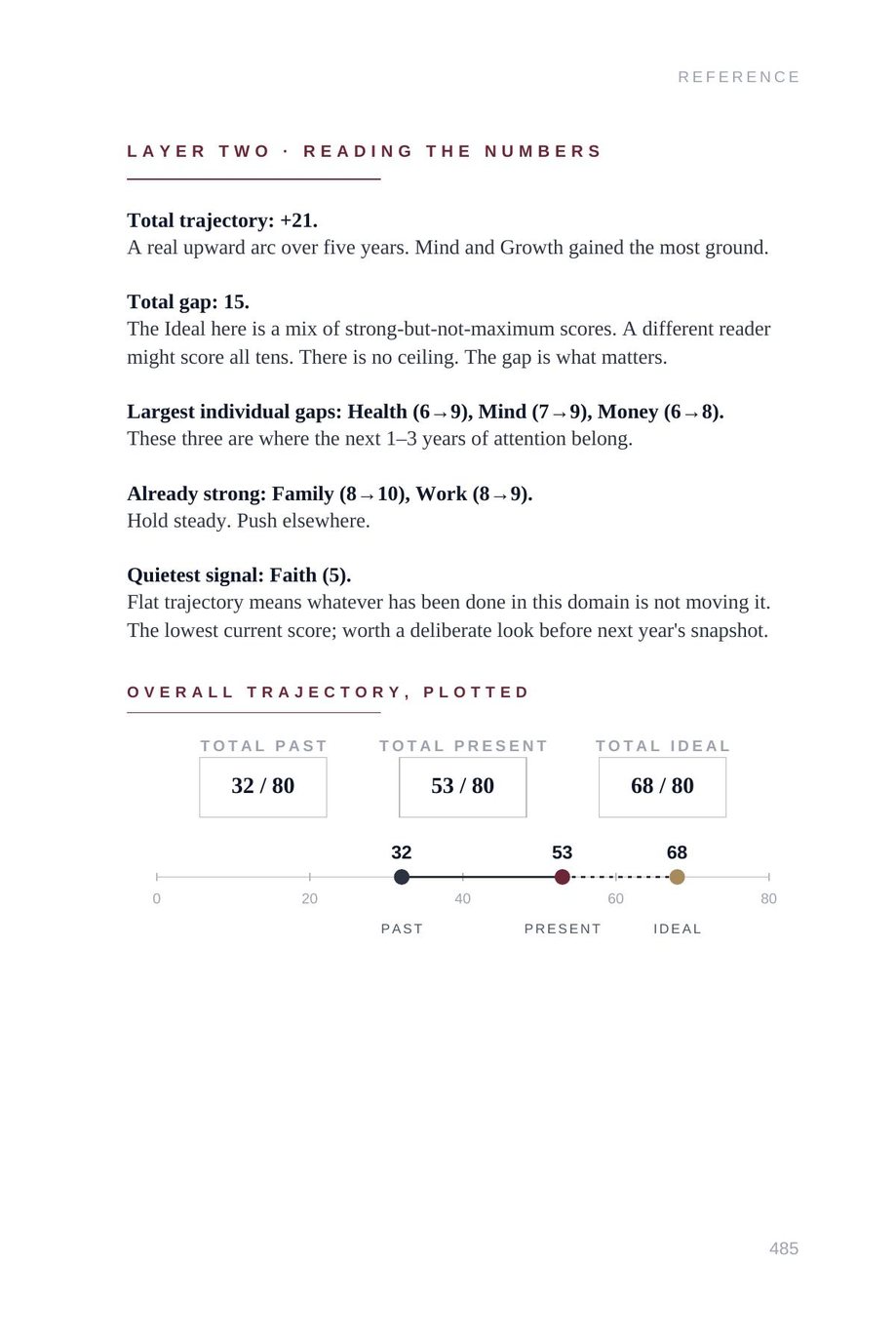
Honest self-assessment: the Feynman rule
A reflection sits between the domains and the snapshot, and it is the discipline the whole book runs on. The first principle is that you must not fool yourself, and you are the easiest person to fool. Honest self-assessment, the book argues, is the rarest skill in adult life, because the feedback we accept tends to confirm what we already believed, and when assessment is privatized, no manager, no audience, no external rubric, the temptation to round upward becomes almost impossible to resist. The rubric is the external standard; the test questions are the check; the witness question, would the person who lives with me agree with this number, is the correction. How to be honest with yourself is the full method.
The People Who Matter: the inventory and the math
Paired with the snapshot and second in the recommended order, because the trajectory of a life is also the trajectory of the relationships inside it. The section exists, the book says, because when people we loved are gone the regret is almost always about time. A table of average remaining years by age, from public life-expectancy data, with one instruction: find the person, read the number, multiply by how often you see them, and sit with the product. Then the inventory: the people whose presence is not guaranteed, their ages, what you most want to say or do. Then the plan: three people, one specific action each within six months, dated when done, revisited in five years. It is the fastest page in the book to change behavior. How many more times will you see your parents does the math; saying the funeral speech while they are alive is the practice it leads to.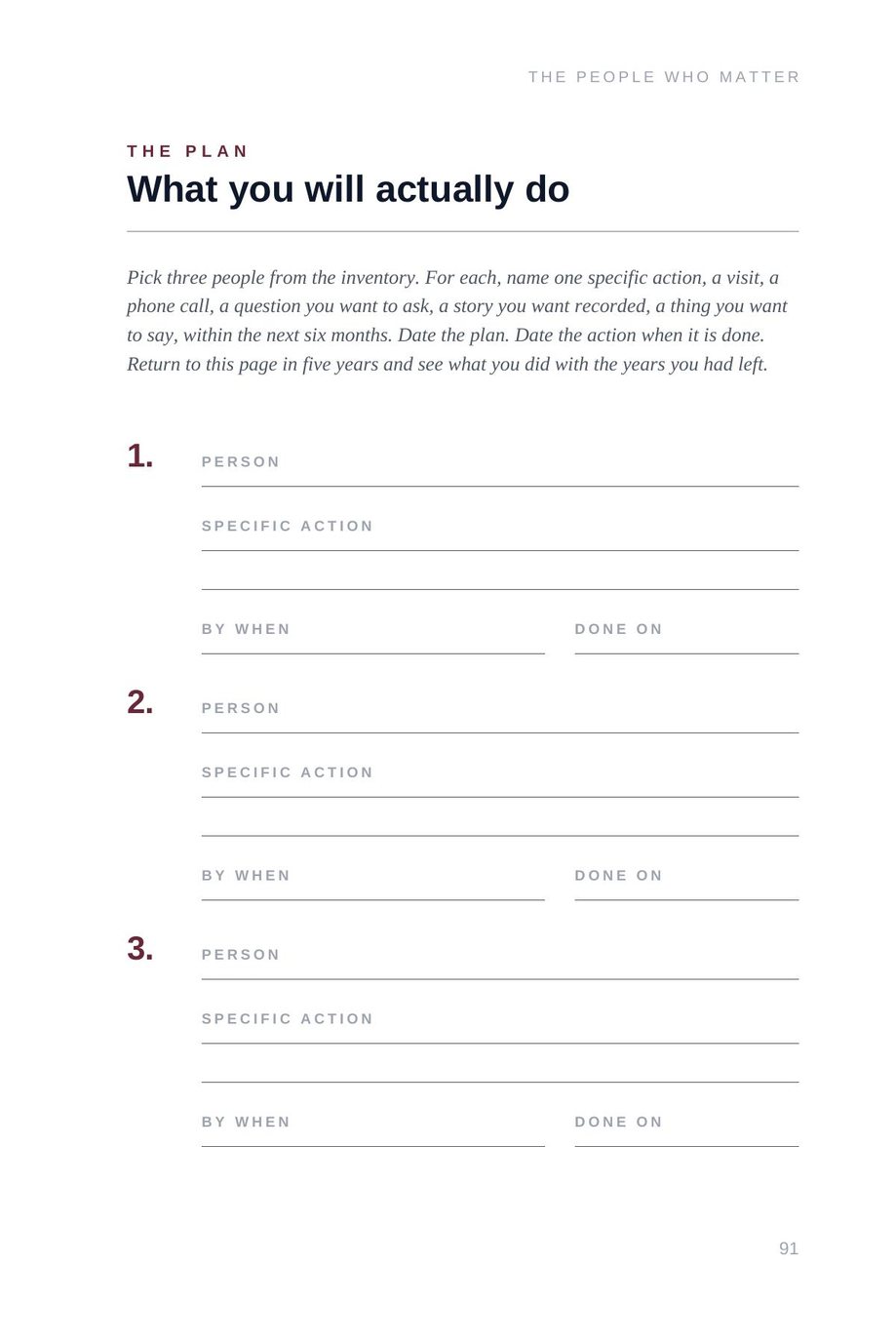
Decade reflections: seven chapters, two scores each
The snapshot compresses a life into three moments; the decade chapters expand it into seven: Childhood, the unauthored decade; Adolescence, becoming yourself; the Twenties, compounding choices; the Thirties, building; the Forties, recalibration; the Fifties, distillation; the Sixties and After, legacy, written in flashes. Each chapter carries a quotation and an essay on what the decade is for, a page on what to focus on and what obstacles to expect, a page on what is coming next and how to thrive, prompts, a log dating every sitting, a photograph index and a page of stories worth keeping. The decade score is a pair: During, weighted across phases, and At the End, the closing band, because a 5 and a 7 is a hard decade closed strong and a 7 and a 5 is a steady decade that ended in decline, from the same average. The worked example on page fifty-four scores a reader's thirties in Health through a back injury and recovery. Reflecting on your life by decade is the cluster pillar, with a post per decade and four worked shapes.
Major life events: six categories, thirty templates
Beginnings, Bindings, Endings, Movements, Turnings, Healings: five templates each, thirty in all, each with a date of event, a date of writing, and prompts that move from what happened to what it changed to what you know now. Beginnings for the part the photograph cannot capture. Bindings for the commitments that trade freedom for direction, recorded with the alternatives given up. Endings, the events most often left unwritten, with the instruction to write anyway and write again. Movements for the leaving and the arriving, which are never symmetrical. Turnings for the quiet decisions, returned to in five years. Healings, the slowest events, recorded unfinished, and the category most often used alongside professional support. The introduction's rule for the whole section: date every entry, and better, return to it later and date the return. The six kinds of life events is the cluster pillar; every category and the strongest templates, a birth, a divorce, a diagnosis, a death, have their own guides.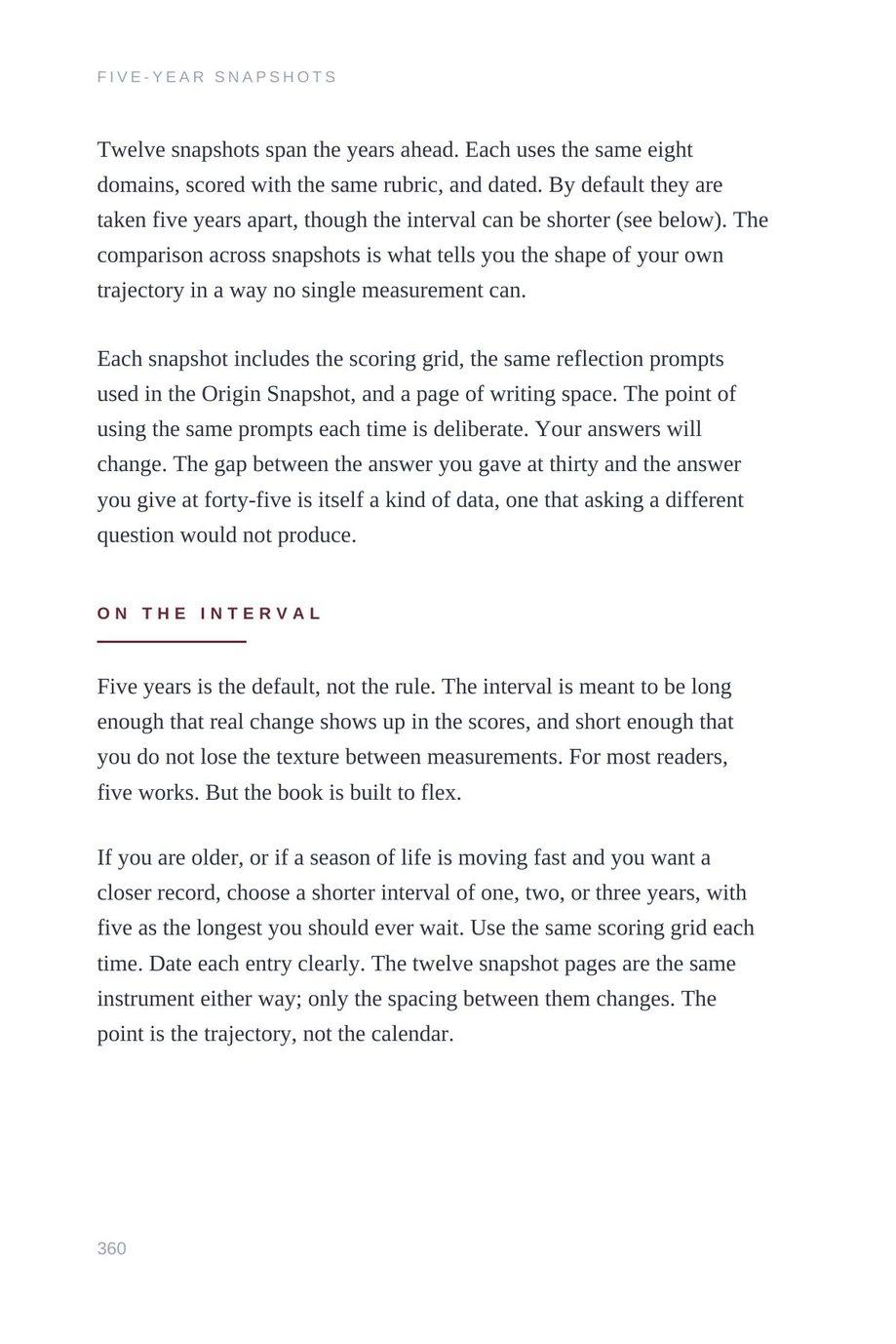
Five-year snapshots: the line over time
Twelve snapshots across the rest of your life, the same eight domains, the same rubric, the same reflection questions every time, dated. Five years is the default, not the rule; choose a shorter interval if a season is moving fast, and never wait longer than five. The section's instructions are precise: take every snapshot on the same anchor date, a birthday or New Year's Eve; do not look at past snapshots before scoring, so the comparison is against who you are and not who you wanted to have become; block at least an hour, because the work is in the reflection. After three snapshots you have a line, after four a trajectory with momentum, and the reading is about patterns: a domain steady across three snapshots will not change without deliberate intervention, one rising is compounding, one falling twice running is asking a question. The eight reflection questions, asked identically each time, are the book's quiet masterpiece; the gap between the answer at thirty and the answer at forty-five is data no different question could produce. How often to journal and measuring growth over years cover the cadence.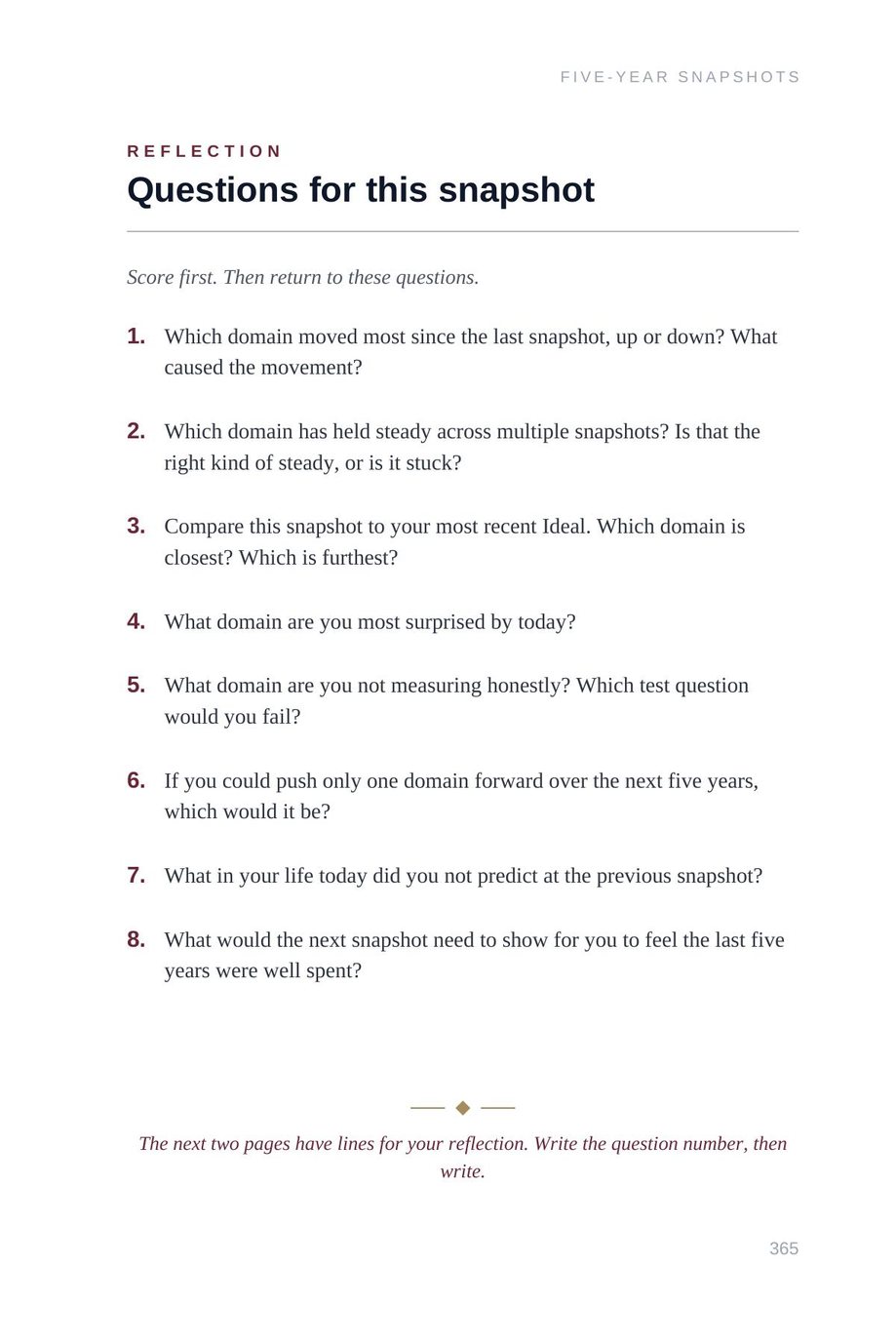
Letters forward, and the Final Letter
Ten letters, each to a specific future reader: your future self at five years and at ten, your partner, your children, your grandchildren, your parents, a friend who has left, your younger self, whoever reads this after you, and the unsent letter to someone who caused harm, written to be read by no one, burned or sealed. Each has a date of writing, an opening date, and four questions to consider; each is witness before advice. Then, before the book closes, the Final Letter: to the people you most loved, to be opened after you are gone, written in your fifties as an exercise in clarity, in your seventies across many sittings, or in the last weeks, all three correct, ending with the question of the one sentence you would leave them. The eleven letters is the cluster pillar; the Final Letter and the letter opened after you die are the method at its most serious.
The cadence of return: fresh beats complete
The mistake new owners make is treating the book like a course to finish, opening it nightly until the early sections are full and then never again. It is built for the opposite rhythm: infrequent, deliberate returns across decades. Return when something significant happens, when a snapshot interval arrives, at a milestone birthday or the end of a year, when a domain or a relationship shifts, when a photograph is worth keeping, when a letter is ready. Write not the whole decade but one paragraph, sometimes one sentence, dated. Pages already filled are not closed: a decade finished at thirty is still open at fifty. The book prints two model entries to show the size of a return, and the size is small. Skipping and returning and backfilling are the two halves of the cadence.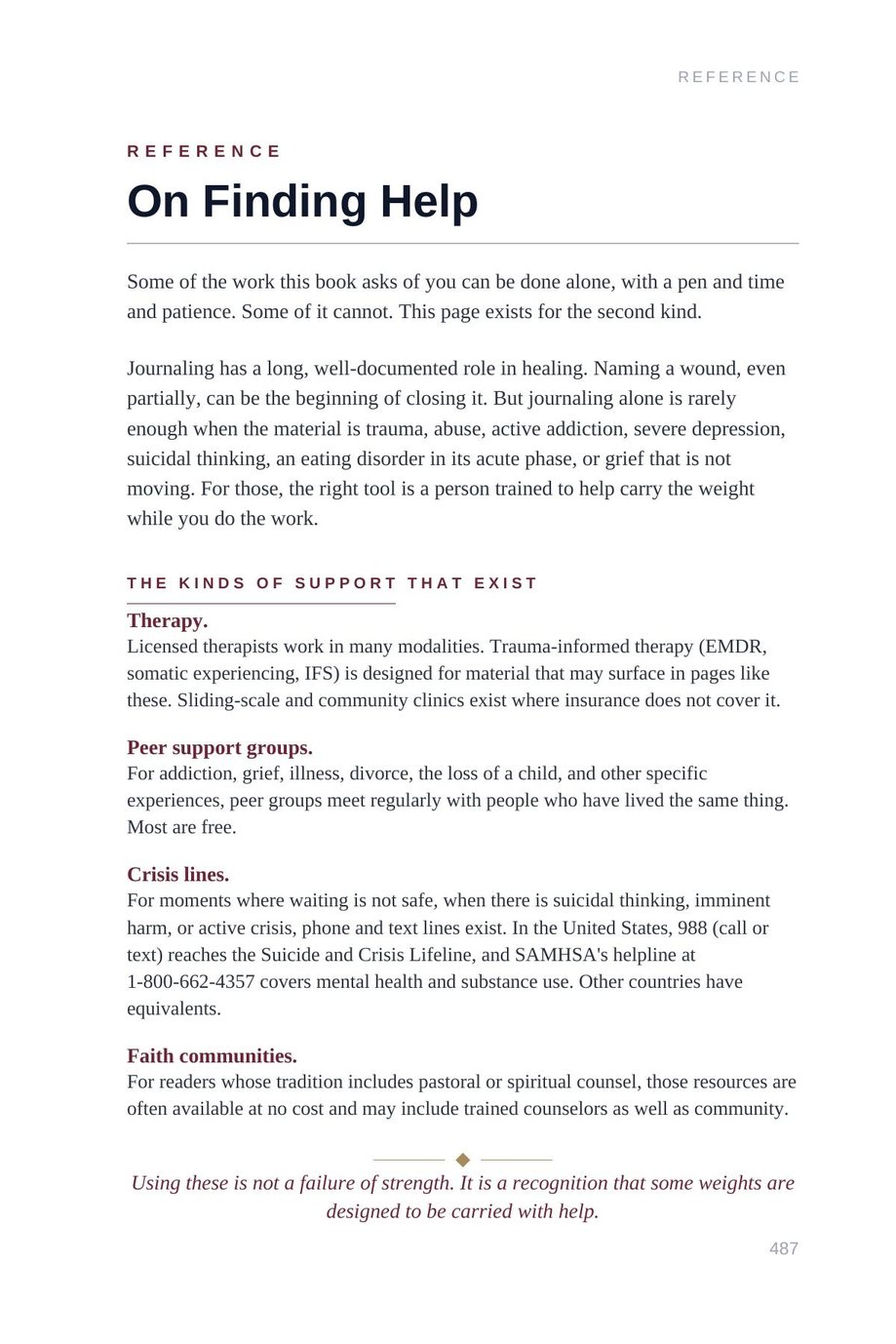
Difficult material, and the page on finding help
An honest life contains hard material, and the book says so on its twenty-ninth page and again at the back. The rules are few: skip what you cannot yet face, the pages will wait; do not score a domain from inside its crisis; write facts before feelings; put the book down without apology if a page makes things worse. And the reference page On Finding Help is explicit that some of the work cannot be done alone with a pen: trauma, abuse, active addiction, severe depression, suicidal thinking, grief that is not moving. It names the kinds of support that exist, therapy including trauma-informed modalities, peer groups, crisis lines, and it is the reason the Healings category and the unsent letter are printed with a note beside them. Healings and the unsent letter carry that note forward.
The book itself, the glossary, and the last page
Hardback, cream pages made for ink, sized to be carried across many years and held by many readers, built to survive the person who first writes in it; written for the writer first and then for whoever finds it next, which is why the honest entries will be worth more than the impressive ones. When it feels finished: keep it findable, tell one person where it is, inscribe the inside cover, choose its next reader. A glossary at the back defines the vocabulary, Origin Snapshot, trajectory, gap, anchor, During and At the End, backfill, cadence of return, so that a reader in thirty years can follow the method without the author. And the last page, in two lines: you cannot navigate to a destination you have not defined; now you have defined it. Walk it on purpose, and when the book is finished, hand it forward. One book your family keeps is the argument; the legacy journal comparison is the buying guide; and the book, all four hundred and ninety pages of it, is the thing this whole site was built around.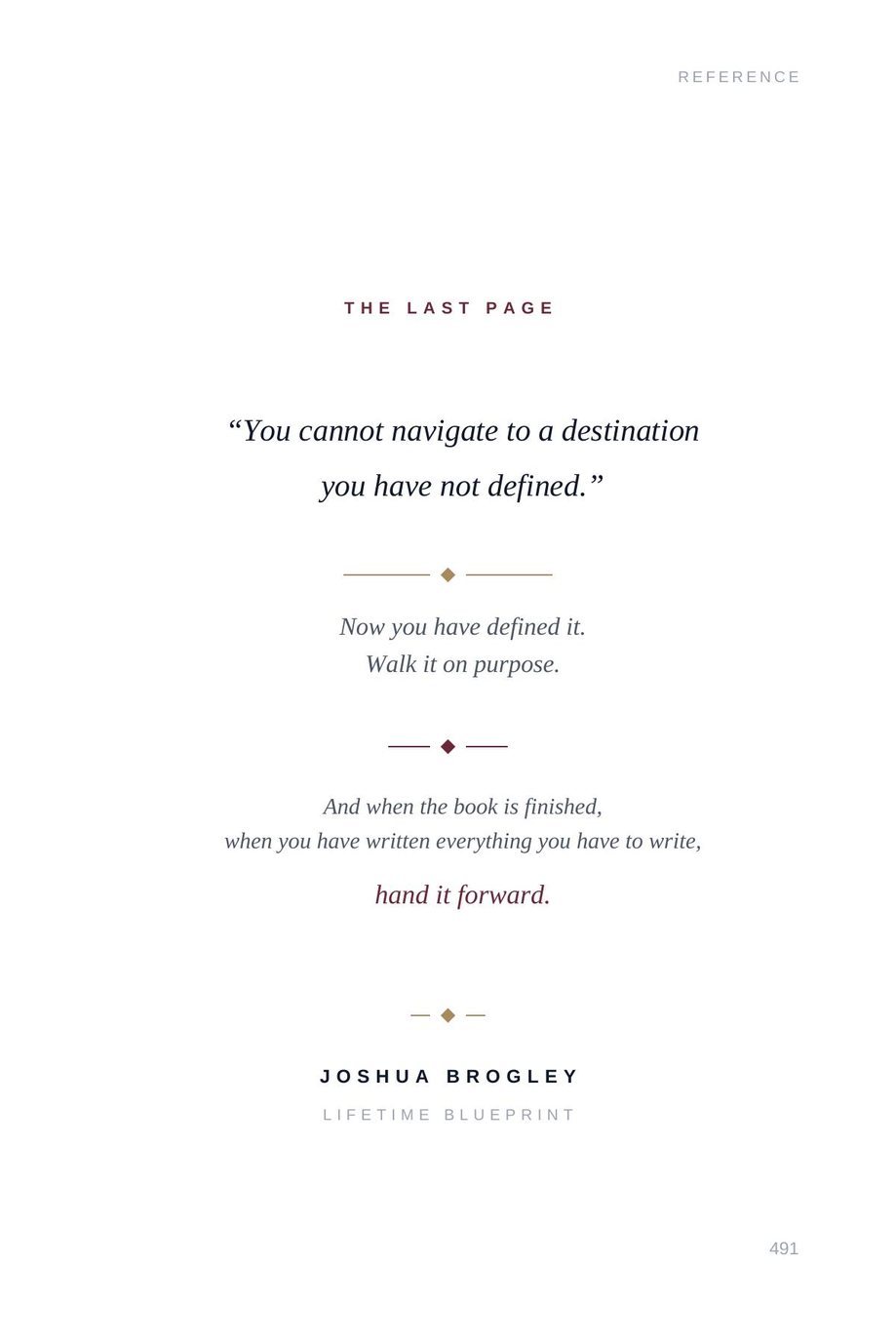
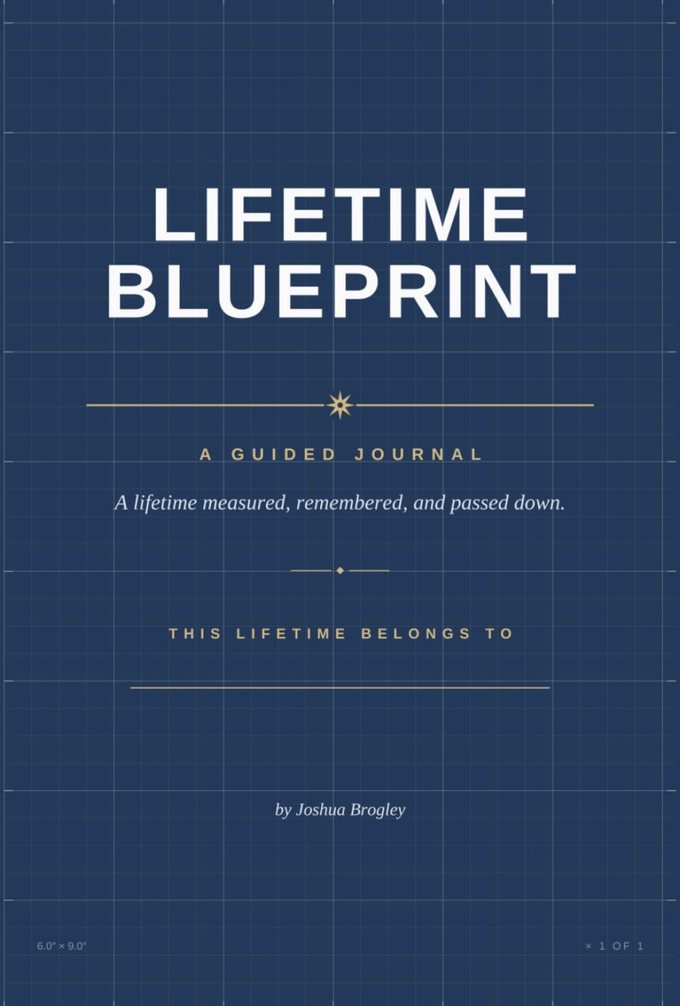
Lifetime Blueprint
The hardcover built to be inherited: eight life domains scored across decades, thirty life-event templates, and letters written forward, ending in a Final Letter.
What is in the Lifetime Blueprint?
Eight scored life domains with a behavioral rubric, an Origin Snapshot of past, present and ideal, a People Who Matter inventory, seven decade chapters with two scores each, thirty life-event templates in six categories, twelve five-year snapshots, ten letters forward, a Final Letter, and reference pages including a worked example and a glossary.
How is the Lifetime Blueprint different from a journal or planner?
It measures a whole life across decades rather than recording days, refuses resolutions and motivation, scores against observable criteria, and is built as a hardcover to be returned to on the slow clock of years and inherited by whoever finds it.
More on Lifetime Blueprint
- Your Twenties: The Decade of Compounding Choices
- Your Thirties: The Building Decade, When Time Starts to Feel Finite
- Your Forties Are a Recalibration, Not a Crisis
- Your Fifties: The Distillation Decade, Subtraction Over Addition
- Why Most People Will Never Write Their Life Down
The method behind every book
- Which 365-Day Book Should I Start With? A One-Minute Guide
- What Is a No Zero Day? The Rule That Saves a Bad Week
- What Is a Realistic Morning Routine? Two Minutes, Not Two Hours
All articles about Lifetime Blueprint → · The book page → · All the books →
written by the author, at the kitchen table, after work.