Home / Blog / Lifetime Blueprint
LIFETIME BLUEPRINT
How to Be Honest With Yourself: The Feynman Rule
Part of the series The Eight Domains of Life, Scored: The Complete Guide
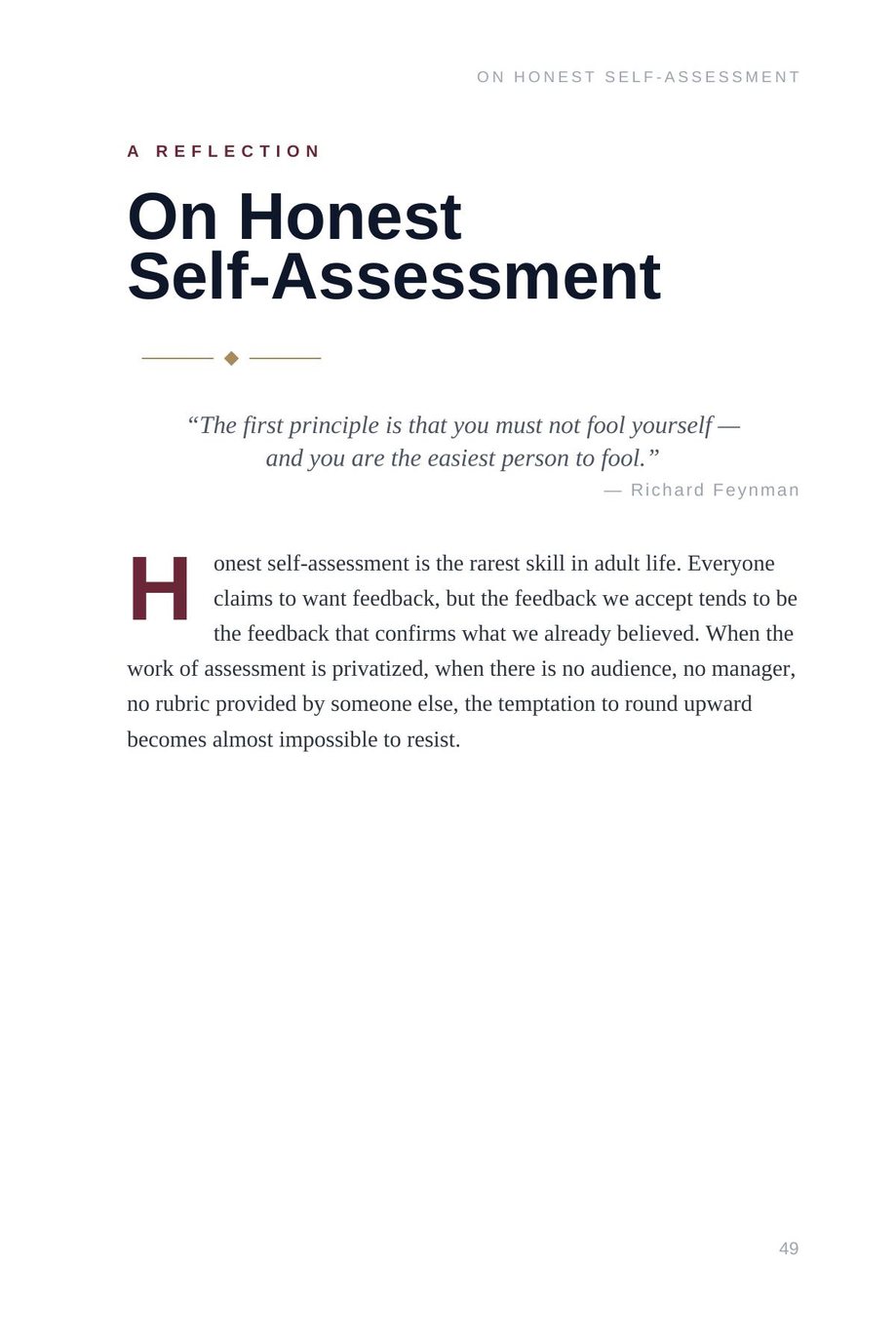
The physicist Richard Feynman put the whole problem in one line: the first principle is that you must not fool yourself, and you are the easiest person to fool. Easiest, because every other deception requires evading someone's scrutiny, while fooling yourself only requires never scheduling any. Self-honesty is not a personality trait some people have. It is a protocol, run on purpose, against three standard deceptions that everyone, including you, including the author, runs by default.
Deception one: grading intentions instead of behavior
Asked how the year went, the inner accountant reaches for what you meant to do, cared about, almost started. Behavior is the only auditable record: what actually happened, how many times, verifiable by a stranger reading your calendar and bank statement. The correction is mechanical, not moral: every self-assessment answers what did I do, never what did I intend, and the gap between the two answers is itself the most useful number you own.
Deception two: choosing a flattering comparison
The self grades on a curve of its own construction: against last year's worse self, against the imagined average person, against whoever makes the current score look chosen. Honest scoring fixes the ruler in advance, in writing, before the grading mood arrives: what does a 7 in Health mean, in observable terms, regardless of who is scoring. A number defined after the fact is not a measurement, it is a mood wearing a digit.
Deception three: vagueness as anesthetic
Pretty good, could be better, working on it: language that cannot be wrong because it does not say anything, and the fog is the function. The counter is the witness question, which is worth writing at the top of any honest review: would the person who lives with me agree with this score? Not because they are right, but because imagining a specific informed reader collapses the fog instantly. Most people revise at least two numbers the moment the question is asked. Those revisions are the honesty arriving.
Honesty needs a place to happen
None of this runs in your head, which is home territory for all three deceptions. It runs on a page: domains defined, scores anchored in advance, evidence written next to each number, dated, and returned to, so that this year's honesty is checked by next year's. That machinery, eight domains, anchored scales, dated snapshots across decades, is the skeleton of a certain hardcover, and the Feynman line is printed in it as a standing reflection because the whole book is downstream of it. The life audit is the single-session version; measuring growth honestly is what the numbers become over years.
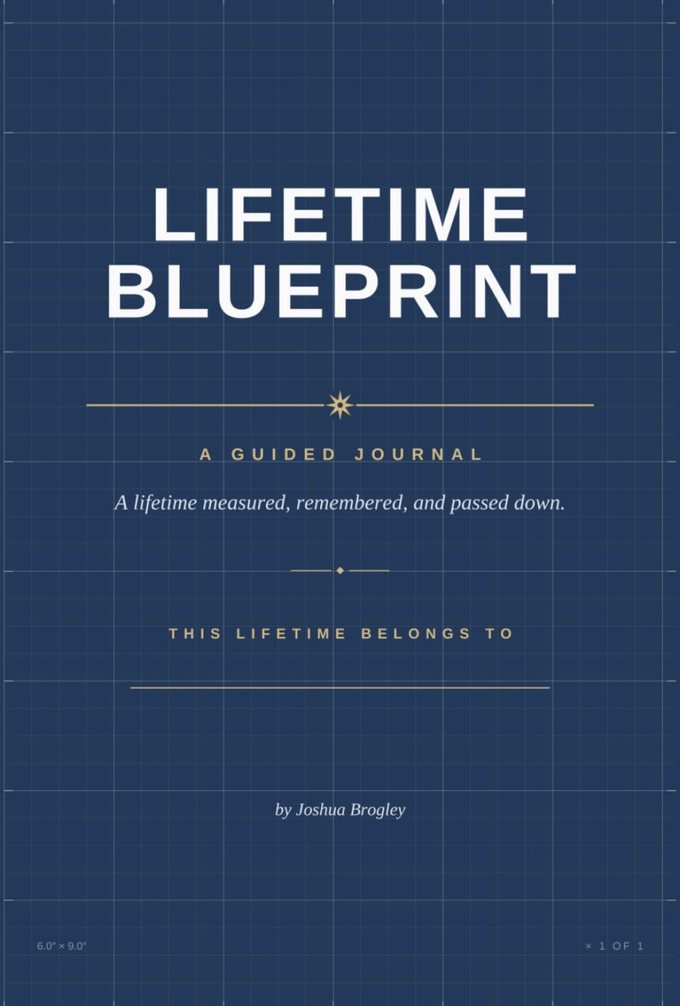
Lifetime Blueprint
The hardcover built to be inherited: eight life domains scored across decades, thirty life-event templates, and letters written forward, ending in a Final Letter.
How do I know if I am lying to myself?
Check for the three standard moves: grading intentions instead of behavior, choosing flattering comparisons after the fact, and vague language that cannot be wrong. If a specific informed person would dispute your self-assessment, part of it is probably deception.
What is the Feynman rule about fooling yourself?
The first principle is that you must not fool yourself, and you are the easiest person to fool: self-deception needs no accomplice and no evasion, so honesty has to be run as a deliberate protocol with fixed rulers and written evidence.
More on Lifetime Blueprint
- Your Twenties: The Decade of Compounding Choices
- Your Thirties: The Building Decade, When Time Starts to Feel Finite
- Your Forties Are a Recalibration, Not a Crisis
- Your Fifties: The Distillation Decade, Subtraction Over Addition
- Why Most People Will Never Write Their Life Down
The method behind every book
- Which 365-Day Book Should I Start With? A One-Minute Guide
- What Is a No Zero Day? The Rule That Saves a Bad Week
- What Is a Realistic Morning Routine? Two Minutes, Not Two Hours
All articles about Lifetime Blueprint → · The book page → · All the books →
written by the author, at the kitchen table, after work.