Home / Blog / Lifetime Blueprint
LIFETIME BLUEPRINT
How to Score Your Work Life: Generative or Extractive, 0 to 10
Part of the series The Eight Domains of Life, Scored: The Complete Guide
Work is what you do with your hours, paid or unpaid, employed or self-employed, creative or operational, in the workforce or out of it. The score is not about salary or title. It is about whether the work itself is generative or extractive, whether you are improving at it, and whether the position you hold reflects what you actually contribute. A retired reader doing meaningful unpaid work can score high. A highly paid reader doing work that hollows them out scores lower than their compensation suggests, and this is the domain where that gap most often surprises the person scoring.
The six bands
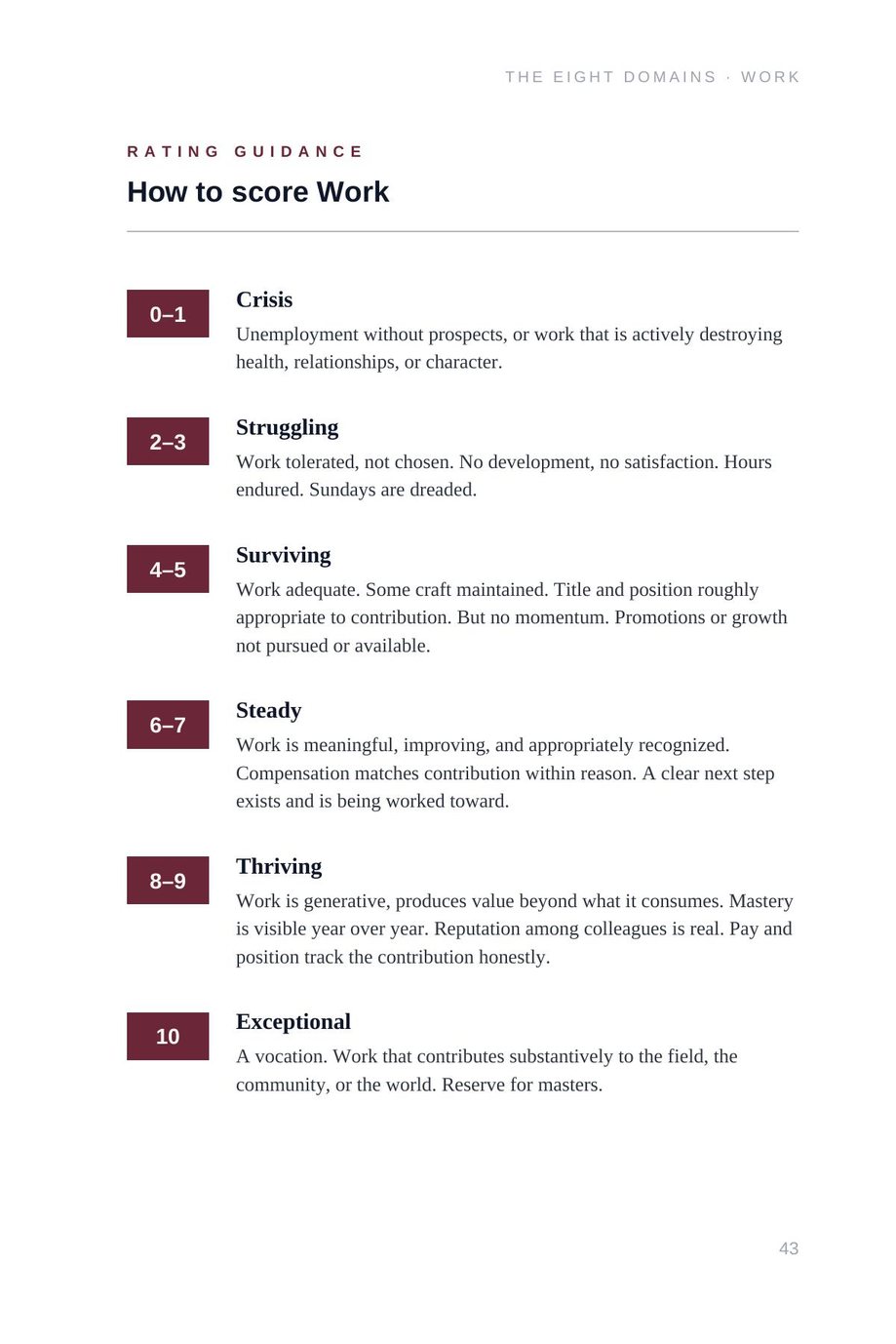
Crisis, 0 to 1: unemployment without prospects, or work actively destroying health, relationships or character. Struggling, 2 to 3: work tolerated, not chosen; no development, no satisfaction, hours endured, Sundays dreaded. Surviving, 4 to 5: work adequate, some craft maintained, title roughly appropriate to contribution, but no momentum; growth not pursued or not available. Steady, 6 to 7: work meaningful, improving and appropriately recognized; compensation matches contribution within reason; a clear next step exists and is being worked toward. Thriving, 8 to 9: work generative, producing more value than it consumes; mastery visible year over year; reputation among colleagues real; pay and position tracking contribution honestly. Exceptional, 10: a vocation that contributes substantively to the field, the community or the world, reserved for masters.
Generative or extractive is the whole question
Two people can hold the same title at the same salary and sit four bands apart. The difference the rubric is built around is direction: does the work leave you with more, in skill, in energy, in standing, than it takes, or does it extract? The Sunday test in the Struggling band is not a joke; dread of Monday, felt on Sunday afternoon, is the most reliable single symptom of extractive work, and it survives raises. The Thriving band's phrase, produces value beyond what it consumes, is the same test read from the other end. Salary is a lagging indicator of contribution at best and a bribe for endurance at worst, and the score is designed to see through it.
Momentum is the hinge between 5 and 6
Adequate work with maintained craft and no next step is Surviving, and it is where a large share of competent people sit for a decade without noticing, because nothing is wrong. The move to Steady requires exactly one thing: a clear next step, named, and being worked toward. Not a promotion necessarily; a skill, a scope, a body of work, a transition. The rubric is indifferent to what the step is and strict about whether it exists. Proving it with receipts is the daily book's month on this; the lifetime book simply asks, every five years, whether the step existed and whether it was taken.
Scoring work outside the workforce
Retired, caregiving, between jobs, studying, building something unpaid: all of it is work by this definition and all of it can score high. A retired reader running something meaningful is Steady or Thriving; a full-time parent whose work is generative and improving scores by the same rubric as an executive, and often better. What scores low is not unpaid work but tolerated work, and the tolerated kind exists at every income. The eight domains holds the system; Money is the entangled neighbor, deliberately scored apart so a high salary cannot disguise a hollow job.
Lifetime Blueprint
The hardcover built to be inherited: eight life domains scored across decades, thirty life-event templates, and letters written forward, ending in a Final Letter.
How do you know if your job is good for you?
Three tests from the rubric: is the work generative or extractive, are you visibly improving at it year over year, and does your position reflect your contribution. Dreading Sunday afternoon is the reliable symptom of extractive work, whatever the salary.
What is a good work-life score?
Steady, 6 to 7: meaningful, improving, appropriately recognized work with a clear next step being worked toward. The single ingredient separating it from Surviving is that named next step.
More on Lifetime Blueprint
- Your Twenties: The Decade of Compounding Choices
- Your Thirties: The Building Decade, When Time Starts to Feel Finite
- Your Forties Are a Recalibration, Not a Crisis
- Your Fifties: The Distillation Decade, Subtraction Over Addition
- Why Most People Will Never Write Their Life Down
The method behind every book
- Which 365-Day Book Should I Start With? A One-Minute Guide
- What Is a No Zero Day? The Rule That Saves a Bad Week
- What Is a Realistic Morning Routine? Two Minutes, Not Two Hours
All articles about Lifetime Blueprint → · The book page → · All the books →
written by the author, at the kitchen table, after work.