Home / Blog / Lifetime Blueprint
LIFETIME BLUEPRINT
How to Score Your Growth: Are You More Capable Than Last Year?
Part of the series The Eight Domains of Life, Scored: The Complete Guide
Growth is the domain of becoming: the skills you are building, the books you are reading, the creative work you are making, the hobbies that compound, the capabilities developing across the years. The score is not about how many courses you have taken. It is about whether you, today, are a more capable and curious person than you were last year. It applies at every age; the eighty-year-old learning a language and the sixteen-year-old picking up an instrument both belong here, and it is the domain whose decline is hardest to notice, because nobody feels the absence of the skill they never started.
The six bands
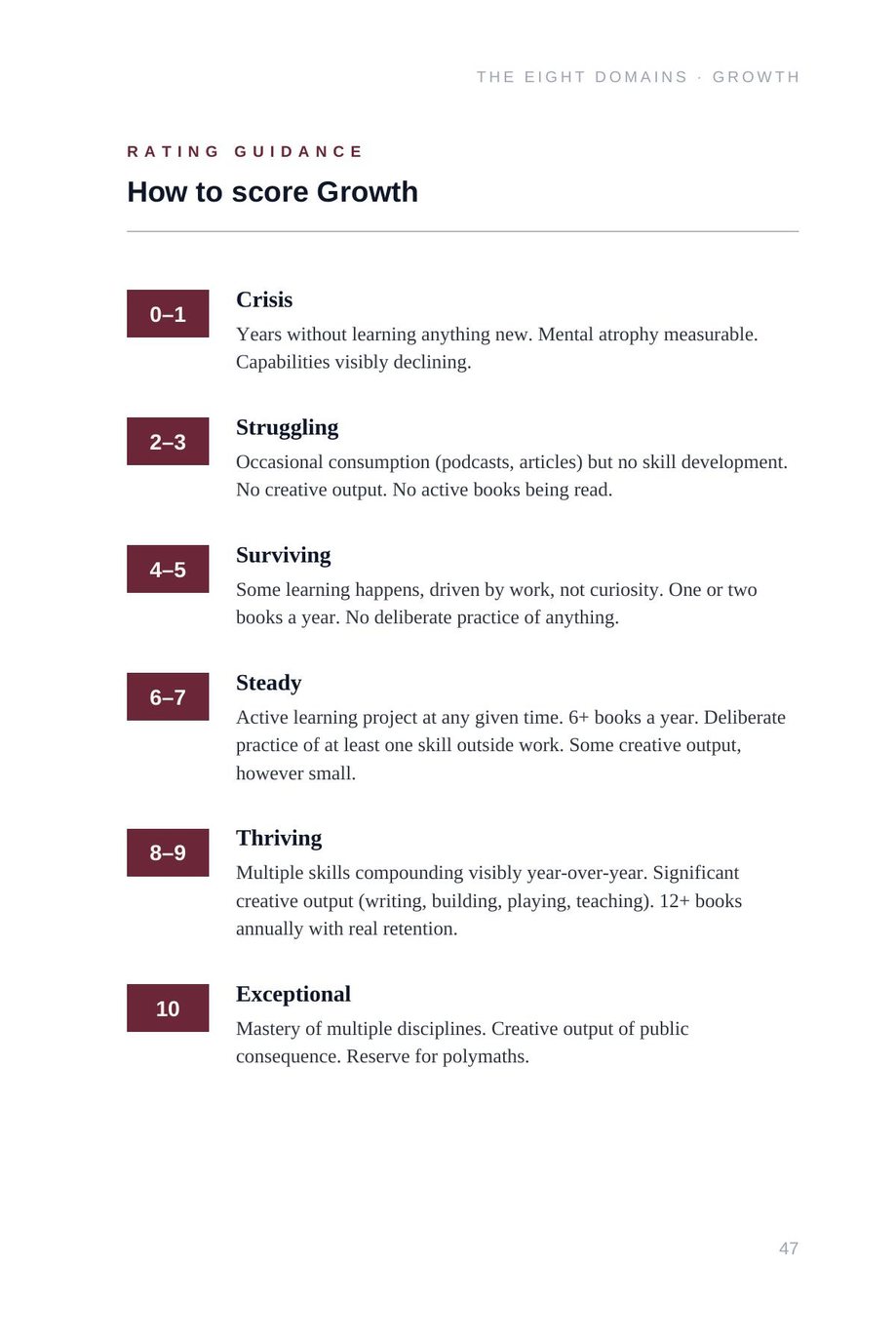
Crisis, 0 to 1: years without learning anything new, mental atrophy measurable, capabilities visibly declining. Struggling, 2 to 3: occasional consumption, podcasts, articles, but no skill development, no creative output, no active books. Surviving, 4 to 5: some learning, driven by work rather than curiosity, one or two books a year, no deliberate practice of anything. Steady, 6 to 7: an active learning project at any given time, six-plus books a year, deliberate practice of at least one skill outside work, some creative output however small. Thriving, 8 to 9: multiple skills compounding visibly year over year, significant creative output in writing, building, playing or teaching, twelve-plus books a year with real retention. Exceptional, 10: mastery of multiple disciplines and creative output of public consequence, reserved for polymaths.
Consumption is not growth, and the rubric is strict about it
The most common self-deception in this domain is mistaking intake for development. Podcasts on the commute, articles, a documentary a week: the Struggling band names all of it as consumption and gives it a 3, because none of it leaves a capability behind. The line into Steady requires three things that consumption cannot fake: an active project, deliberate practice of a skill outside work, and output. Output is the tell. If nothing has been made, written, built, played or taught in a year, the honest score is below 6 regardless of how well-informed the person is. Informed is a pleasant way to stay the same.
Why it is the first domain sacrificed and the last noticed
Growth has no emergency. A neglected body sends pain, a neglected marriage sends silence, a neglected bank account sends letters; a neglected mind sends nothing, for years, until a person realizes at fifty that they have not been genuinely bad at anything new since their twenties. The domain exists in the eight precisely because it would otherwise be absorbed into Work, and work-driven learning is the Surviving band by definition. It is also the domain with the highest return per hour at every age, because compounding skills are the only asset that appreciates faster the longer you have held it.
The move: one project, one skill, one thing made
From Surviving to Steady is unusually concrete. Name one active learning project. Choose one skill outside work and practice it deliberately, which means with feedback and difficulty, not just repetition. Make one thing this year, of any size. Read six books, which at twenty pages a night is not a stretch. That set, held for twelve months, is a 6, and the five-year snapshot will show whether it compounded into more. The eight domains holds the system; Mind is the neighbor most often confused with it, and the distinction is simple: Mind observes the inner life, Growth expands what the person can do.
Lifetime Blueprint
The hardcover built to be inherited: eight life domains scored across decades, thirty life-event templates, and letters written forward, ending in a Final Letter.
How do you measure personal growth each year?
By capability, not consumption: is there an active learning project, deliberate practice of a skill outside work, something made this year, and books read with retention. If nothing was produced in a year, the honest score is below Steady however well-informed you are.
What counts as personal growth?
Skills built, creative work made, capabilities compounding, at any age. Podcasts and articles are consumption and score as Struggling on their own; the rubric requires output.
More on Lifetime Blueprint
- Your Twenties: The Decade of Compounding Choices
- Your Thirties: The Building Decade, When Time Starts to Feel Finite
- Your Forties Are a Recalibration, Not a Crisis
- Your Fifties: The Distillation Decade, Subtraction Over Addition
- Why Most People Will Never Write Their Life Down
The method behind every book
- Which 365-Day Book Should I Start With? A One-Minute Guide
- What Is a No Zero Day? The Rule That Saves a Bad Week
- What Is a Realistic Morning Routine? Two Minutes, Not Two Hours
All articles about Lifetime Blueprint → · The book page → · All the books →
written by the author, at the kitchen table, after work.