Home / Blog / Lifetime Blueprint
LIFETIME BLUEPRINT
The Eight Domains of Life, Scored: The Complete Guide
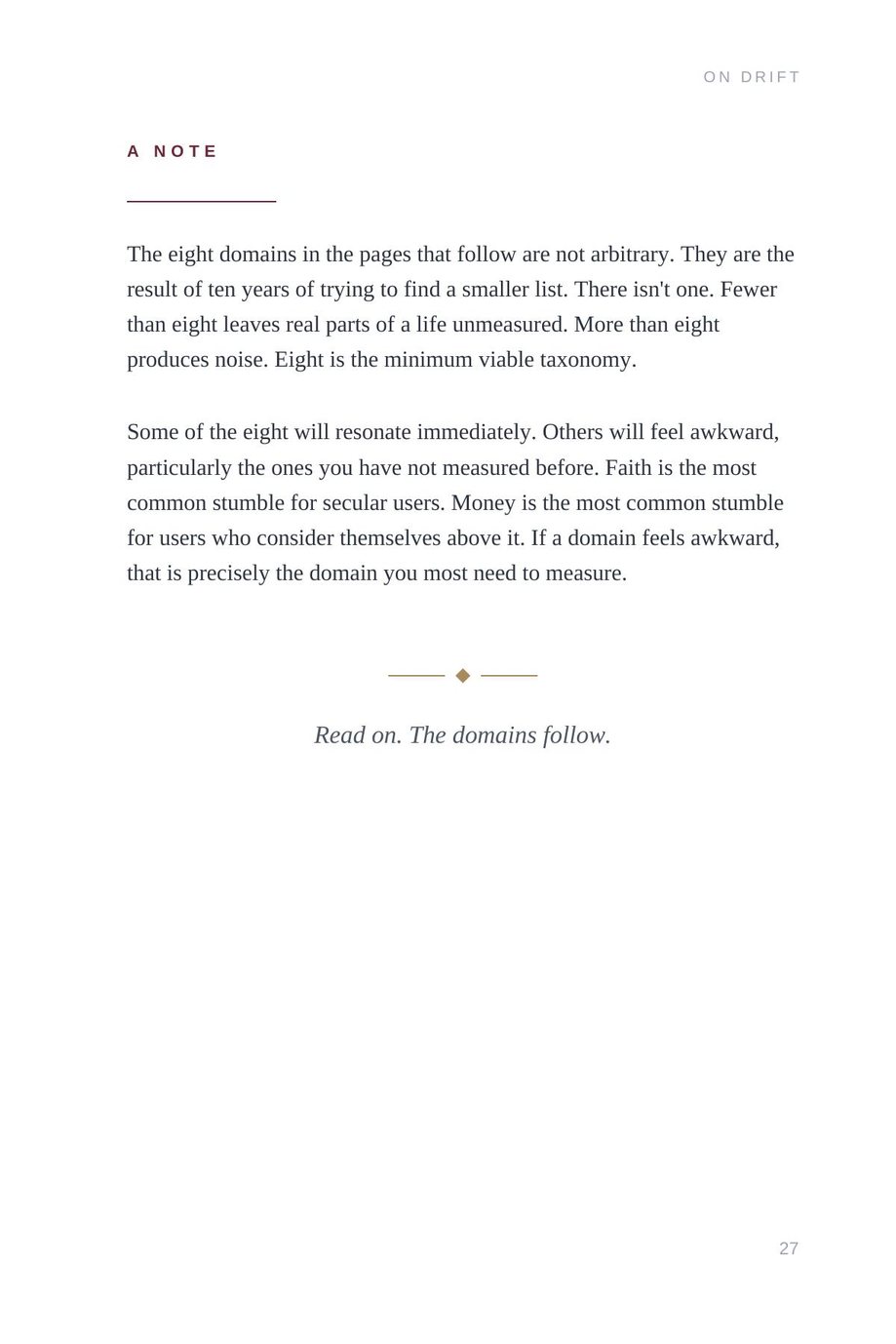
A life can be divided many ways, and this method uses eight: Health, Mind, Faith, Family, Relationships, Work, Money and Growth. The eight are not arbitrary; they are what was left after ten years of trying to find a smaller list. Fewer than eight leaves real parts of a life unmeasured. More than eight produces noise. Each domain has a short definition, a set of scores it is explicitly not about, and a rating guide that describes what a 3, a 7 and a 10 look like in observable terms, so the number is a measurement rather than a mood. Below is the whole system, and a door into each domain.
Try it: score all eight in about twelve minutes with the free life scoring tool.
Why these eight, and why a domain that feels awkward is the one you need
Health is the substrate everything else runs on. Mind is the inner life, observed. Faith is the relationship with what is larger than the self, in whatever form, including the considered absence of one. Family is the bonds you are born to or build. Relationships are the chosen connections beyond family. Work is what you do with your hours, paid or not. Money is earning, spending, saving, giving. Growth is skills, learning and creative work: the domain of becoming. Some of the eight will resonate immediately and one or two will feel awkward, particularly the ones you have never measured. Faith is the most common stumble for secular readers and Money for readers who consider themselves above it, and the book's own note is blunt about it: if a domain feels awkward, that is precisely the domain you most need to measure.
How the 0 to 10 scale works: six bands, observable terms
Every domain uses the same six bands. Crisis, 0 to 1: active emergency, cannot function in other domains. Struggling, 2 to 3: chronic neglect, functioning but barely. Surviving, 4 to 5: basics maintained with no margin, will degrade without correction. Steady, 6 to 7: consistent, intentional, sustainable indefinitely. Thriving, 8 to 9: improving year over year, with energy left over for others. Exceptional, 10: rare, reserved for lives whose practice in that domain is itself an accomplishment or a contribution. The rubric matters most for the Present Snapshot, where the temptation to inflate is strongest, because it forces a 7 to mean something checkable: seven hours of sleep, six months of emergency fund, six books a year, two to five real friendships. A number you cannot point evidence at is not a score.
The domains interact, which is why you score all eight at once
Health taxes everything: a 3 there drags Mind, Work and Family down regardless of effort spent on them, which is why it goes first in triage. Money and Work are entangled but not identical; a highly paid reader doing hollowing work scores lower than the salary suggests, and a retiree doing meaningful unpaid work scores higher. Family and Relationships are separated deliberately, because a full household and a total absence of friends is a common and specific shape that a single social domain would hide. Growth is the one most often sacrificed to the others and the one whose decline is hardest to see, because nobody notices the book they did not read. Scoring all eight in one sitting exposes these dependencies; scoring one at a time hides them. Which area to fix first is the triage logic that falls out of the interactions.
Each domain, in depth
One post per domain follows, each with the full rubric in observable terms, what the score is not about, why the domain matters more than it looks, why people avoid measuring it, and how to move one band in a year. Health. Mind. Faith. Family. Relationships. Work. Money. Growth. The domains are a reference, not a place to write: you return to them whenever you score elsewhere, first in the Origin Snapshot, then at every five-year snapshot and every decade reflection for the rest of your life. That reference, with the rubric printed beside each domain, is the opening section of a certain hardcover built to be scored in for decades, and the shorter overview of life areas is the place to start if all of this is new.
Lifetime Blueprint
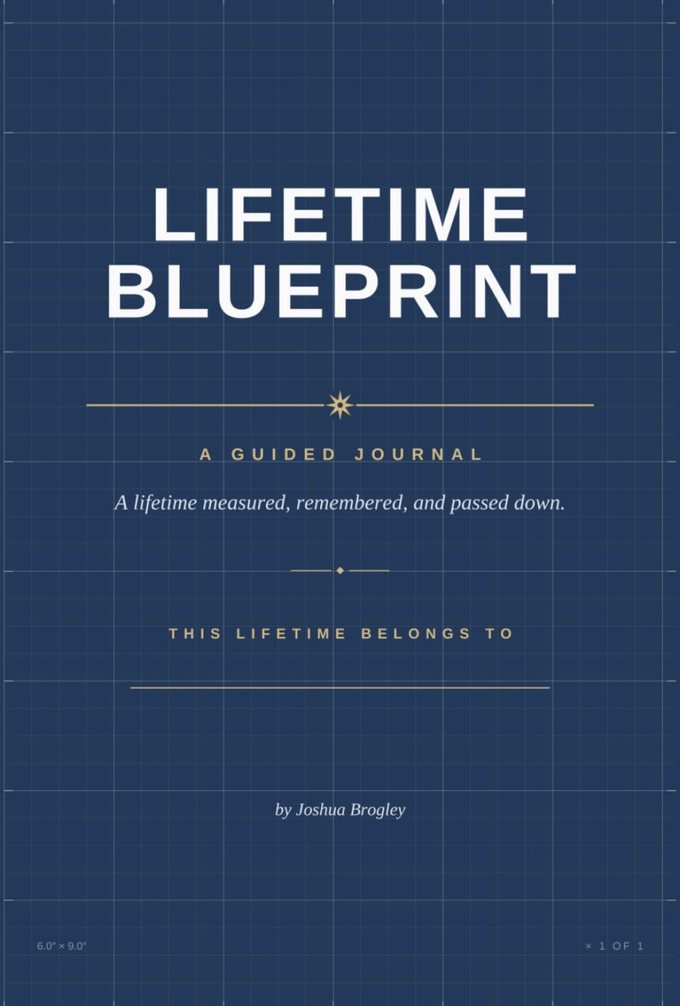
The hardcover built to be inherited: eight life domains scored across decades, thirty life-event templates, and letters written forward, ending in a Final Letter.
What are the eight domains of life?
Health, Mind, Faith, Family, Relationships, Work, Money and Growth: the minimum set that leaves no real part of a life unmeasured without producing noise. Each is scored 0 to 10 against a rubric with observable criteria.
How do you score the areas of your life?
With six bands, Crisis through Exceptional, each defined in checkable terms per domain, scored for past, present and ideal in one sitting so the domains can be read against each other rather than in isolation.
More on Lifetime Blueprint
- Your Twenties: The Decade of Compounding Choices
- Your Thirties: The Building Decade, When Time Starts to Feel Finite
- Your Forties Are a Recalibration, Not a Crisis
- Your Fifties: The Distillation Decade, Subtraction Over Addition
- Why Most People Will Never Write Their Life Down
The method behind every book
- Which 365-Day Book Should I Start With? A One-Minute Guide
- What Is a No Zero Day? The Rule That Saves a Bad Week
- What Is a Realistic Morning Routine? Two Minutes, Not Two Hours
All articles about Lifetime Blueprint → · The book page → · All the books →
written by the author, at the kitchen table, after work.