Home / Blog / Lifetime Blueprint
LIFETIME BLUEPRINT
How to Score Your Relationships: Depth and Reciprocity, Not Contacts
Part of the series The Eight Domains of Life, Scored: The Complete Guide
Relationships are the chosen connections beyond family: friends, mentors, colleagues, community. The score is not about how many people know your name. It is about whether you have a small number of people who would catch you if you fell, and whether you are that person for anyone else. A deeply introverted reader content with a tight circle of two or three can score high. A reader with hundreds of contacts and no real intimacy scores low. The question is depth and reciprocity, not breadth, and the rubric puts numbers on both.
The six bands
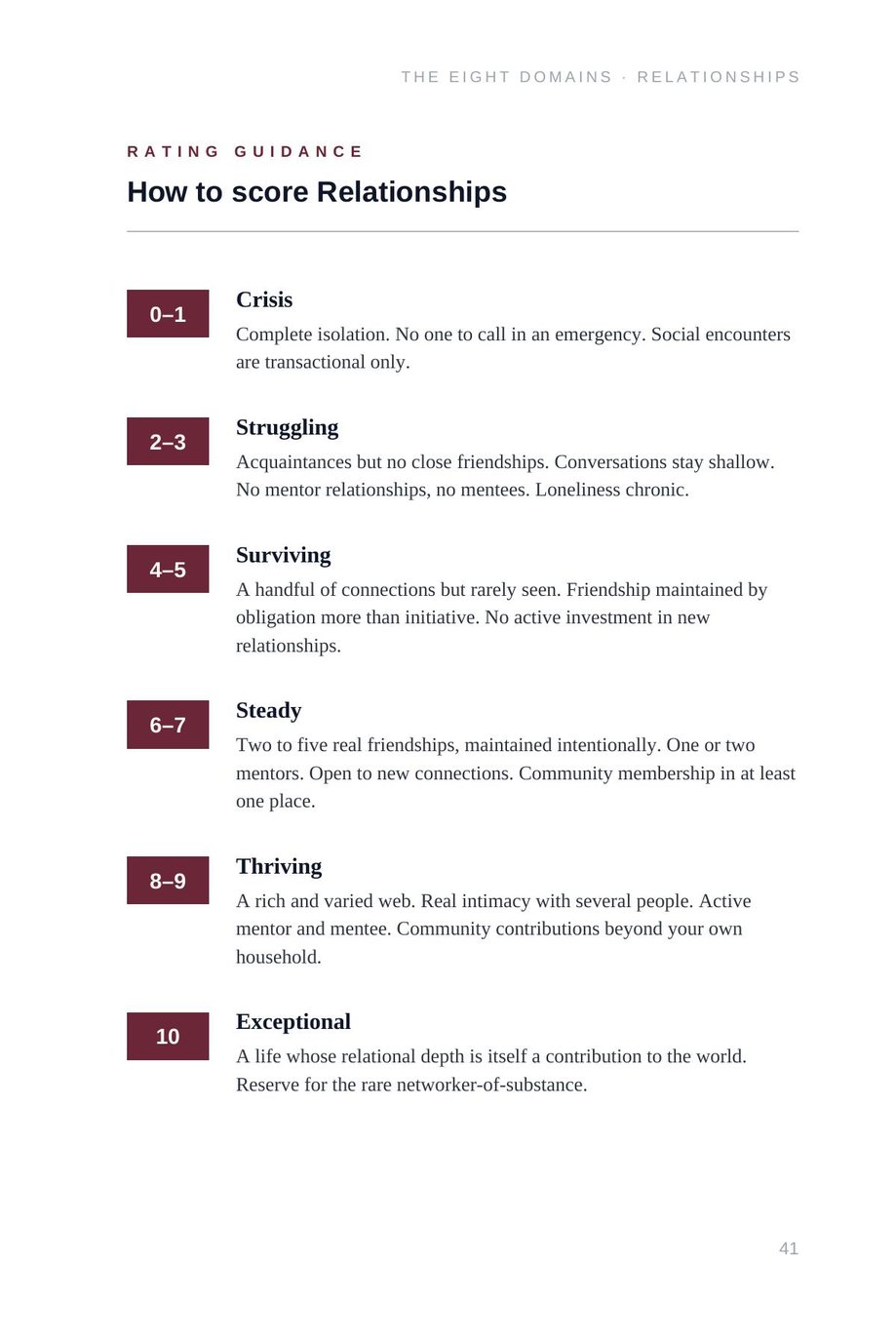
Crisis, 0 to 1: complete isolation, no one to call in an emergency, social encounters transactional only. Struggling, 2 to 3: acquaintances but no close friendships, conversations that stay shallow, no mentors and no mentees, loneliness chronic. Surviving, 4 to 5: a handful of connections rarely seen, friendship maintained by obligation more than initiative, no active investment in new relationships. Steady, 6 to 7: two to five real friendships maintained intentionally, one or two mentors, openness to new connections, membership in at least one community. Thriving, 8 to 9: a rich and varied web, real intimacy with several people, an active mentor and an active mentee, contribution to a community beyond your own household. Exceptional, 10: a life whose relational depth is itself a contribution to the world, reserved for the rare networker of substance.
The emergency-call test
The fastest honest score in the domain: name, without thinking, the people you would call at three in the morning with something you could not tell anyone else. Zero is Crisis regardless of how full the weekend is. One is Struggling. Two to five, actually maintained, is Steady, and the rubric's phrase for the failure mode between them is obligation more than initiative: friendships kept alive by birthdays and the other person's effort. Reciprocity is the second half, and the mentee line is where most competent adults discover a gap: they are mentored, or were, and mentor no one, which caps the score at Steady no matter how loved they are.
Why this domain decays silently in the thirties and forties
Family and work are loud; friendship is not, so it is the domain that absorbs every cut, and the decline is invisible because nothing dramatic happens. No fight, no ending, just eighteen months since the last real conversation, repeated across the whole circle. The rubric catches it in the Surviving band's rarely seen, and the fix is embarrassingly mechanical: a standing date with two or three people, on the calendar, defended. Readers who score this honestly at forty are often shocked to find it lower than Family, and that shock is the most useful thing the snapshot produces that year. Making friends as an adult is the rebuild; auditing your circle is the daily book's month on the same problem.
Moving up: one investment each way
From Surviving to Steady needs one new intentional friendship or one revived one, one mentor relationship, and one community you actually attend. From Steady to Thriving needs the direction to reverse: a mentee, and a contribution beyond your own household. None of it requires being extroverted; all of it requires initiative, which is the word the rubric uses on purpose. Score it, name the person in the relationships-to-grow-or-find line, and see who is in the five-year snapshot. The eight domains holds the system; Family is the neighboring domain, kept separate so that a full house and an empty circle cannot hide inside one score.
Lifetime Blueprint
The hardcover built to be inherited: eight life domains scored across decades, thirty life-event templates, and letters written forward, ending in a Final Letter.
How many close friends should you have?
The rubric's Steady band is two to five real friendships maintained intentionally, plus one or two mentors. Depth and reciprocity matter, not count; a tight circle of three scores higher than a large network with no intimacy.
How do you measure the quality of your relationships?
By who you could call at three in the morning, whether friendships run on your initiative or the other person's, and whether you mentor anyone. Those three questions place most people in a band within a minute.
More on Lifetime Blueprint
- Your Twenties: The Decade of Compounding Choices
- Your Thirties: The Building Decade, When Time Starts to Feel Finite
- Your Forties Are a Recalibration, Not a Crisis
- Your Fifties: The Distillation Decade, Subtraction Over Addition
- Why Most People Will Never Write Their Life Down
The method behind every book
- Which 365-Day Book Should I Start With? A One-Minute Guide
- What Is a No Zero Day? The Rule That Saves a Bad Week
- What Is a Realistic Morning Routine? Two Minutes, Not Two Hours
All articles about Lifetime Blueprint → · The book page → · All the books →
written by the author, at the kitchen table, after work.