Home / Blog / Lifetime Blueprint
LIFETIME BLUEPRINT
How to Score Your Faith Even If You Are Not Religious
Part of the series The Eight Domains of Life, Scored: The Complete Guide
Faith is the domain most often skipped and the one most easily misread. For some readers it is religious practice; for others a relationship with meaning, awe, mystery, or whatever is larger than the self; for others still it is the deliberate absence of such a relationship, lived with integrity. The score is not about doctrine. It is about whether your engagement with this question, whatever form it takes, is conscious or unconsidered. A reader at peace with secular humanism can score as high here as a contemplative monastic. A reader who has never thought about it scores lower regardless of belief.
The six bands
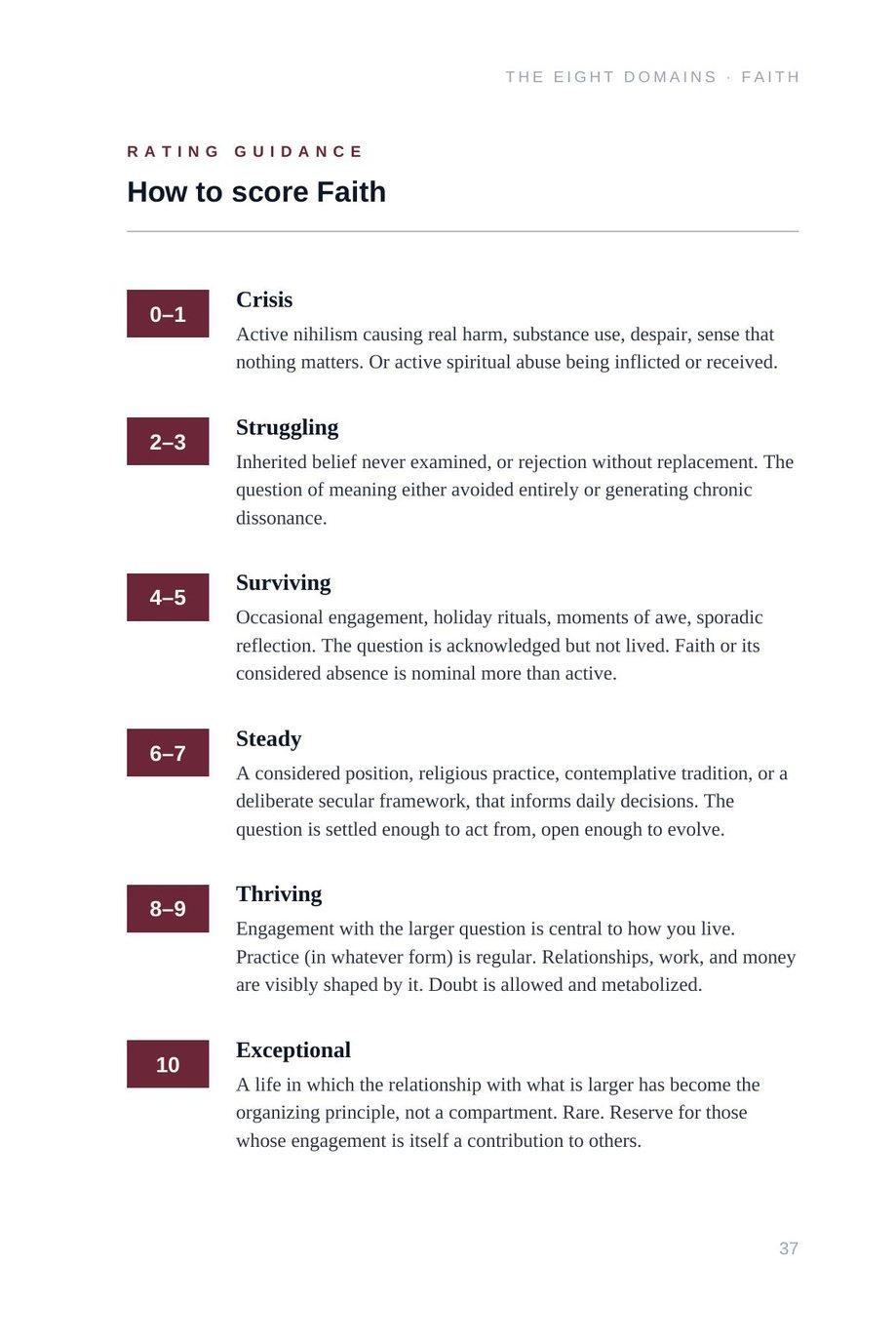
Crisis, 0 to 1: active nihilism causing real harm, substance use, despair, a sense that nothing matters; or active spiritual abuse being inflicted or received. Struggling, 2 to 3: inherited belief never examined, or rejection without replacement; the question of meaning avoided entirely or generating chronic dissonance. Surviving, 4 to 5: occasional engagement, holiday rituals, moments of awe, sporadic reflection; the question acknowledged but not lived, faith or its considered absence nominal rather than active. Steady, 6 to 7: a considered position, religious, contemplative or deliberately secular, that informs daily decisions; settled enough to act from, open enough to evolve. Thriving, 8 to 9: engagement with the larger question central to how you live, practice regular in whatever form, relationships, work and money visibly shaped by it, doubt allowed and metabolized. Exceptional, 10: the relationship with what is larger has become the organizing principle rather than a compartment, rare, reserved for those whose engagement is itself a contribution to others.
Why secular readers stumble here, and why the stumble is the point
The book's own note names Faith as the most common stumble for secular users, and the rubric shows why the stumble is informative rather than insulting: the Struggling band includes rejection without replacement, which describes a great many thoughtful people who left a tradition at nineteen and never built anything in the vacated space. That is not a belief problem; it is a consideration problem, and the fix is the same for the believer and the unbeliever: sit with the question until you hold a position you could explain to a child, then let it inform decisions. A deliberate secular framework, lived, is a 6 or 7. An inherited faith never examined is a 3. The scale is measuring attention, not allegiance.
Why believers mis-score it too
In the other direction, attendance gets mistaken for engagement. The Steady band asks whether the position informs daily decisions, and the Thriving band asks whether relationships, work and money are visibly shaped by it and whether doubt is allowed. A reader with perfect attendance and a money domain untouched by their stated convictions is, by the rubric, Surviving, and most know it when the question is put that way. Faith in this method is scored by its footprint in the other seven domains, which is a harder and more honest test than any creed. It is also why the domains are scored together rather than separately.
Moving a band is mostly a practice, again
From Surviving to Steady: choose a practice, prayer, contemplation, a reading discipline, a considered ethical framework revisited weekly, and hold it for a year until the position is settled enough to act from. From Steady to Thriving: let it reach the other domains, which is visible and therefore scoreable, in how money is given, how work is chosen, how the difficult person in the family is treated. The book's Christian edition and secular edition score this domain identically, on purpose. The eight domains holds the full system; values and priorities is the adjacent work; honest self-assessment is what keeps the score from being a costume.
Lifetime Blueprint
The hardcover built to be inherited: eight life domains scored across decades, thirty life-event templates, and letters written forward, ending in a Final Letter.
Can you score faith if you are not religious?
Yes, as high as anyone. The domain measures whether your relationship with what is larger than the self, including a deliberate secular framework, is conscious and informs decisions. Inherited belief never examined and rejection without replacement both score low.
What does a high faith score mean?
Thriving, 8 to 9: engagement with the larger question is central to how you live, practice is regular in whatever form, and relationships, work and money are visibly shaped by it, with doubt allowed rather than suppressed.
More on Lifetime Blueprint
- Your Twenties: The Decade of Compounding Choices
- Your Thirties: The Building Decade, When Time Starts to Feel Finite
- Your Forties Are a Recalibration, Not a Crisis
- Your Fifties: The Distillation Decade, Subtraction Over Addition
- Why Most People Will Never Write Their Life Down
The method behind every book
- Which 365-Day Book Should I Start With? A One-Minute Guide
- What Is a No Zero Day? The Rule That Saves a Bad Week
- What Is a Realistic Morning Routine? Two Minutes, Not Two Hours
All articles about Lifetime Blueprint → · The book page → · All the books →
written by the author, at the kitchen table, after work.