Home / Blog / Lifetime Blueprint
LIFETIME BLUEPRINT
Faith Journal Prompts That Ask Harder Questions Than a Devotional
Part of the series The Eight Domains of Life, Scored: The Complete Guide
Most faith journals hand you a verse and a line to respond to it. That is a good practice, and it rarely asks the harder thing: is what you say you believe actually shaping how you live? The Lifetime Blueprint treats Faith as one of the eight domains of a life and asks exactly that, in a way that works for a pastor, a doubter and a thoughtful secular reader alike.
Quick answer: Ask what you believe is larger than you, whether you have examined what you were handed, and whether your answer shapes your days, money, work and relationships. Watch for the signs of drift: avoiding the question, practice shrinking to holidays and emergencies, belief and life drifting apart. Score the domain against a written guide, not a feeling.
What the Faith domain measures
The book defines Faith as what is larger than the self, and it is careful about what the score is not: not about doctrine. For some readers it means religious practice; for others a relationship with meaning, awe or mystery; for others a deliberate, considered absence of belief. The score asks whether your engagement with the question, whatever form it takes, is conscious or unexamined. A thoughtful secular reader can score as high here as a monk. A reader who has never considered the question scores lower, whatever they believe. The page carries two quotations, Pascal's line that the heart has its reasons which reason knows nothing of, and Hebrews 11:1 in the King James.

Three questions the domain asks
- What do I believe is larger than me?
- Have I examined what I was handed?
- Does my answer shape how I actually live?
Three signs of drift
- You avoid the question because it feels unresolved.
- Your practice has shrunk to holidays and emergencies.
- What you say you believe and how you live have drifted apart.
Prompts that go further
From the book's decade and event templates, the faith questions worth writing on:
- When did you come to faith, come back to it, or walk away from it? Was there a single moment?
- What had to give way for that to be possible?
- Who was the human face of it: a teacher, a friend, a stranger, a writer long dead?
- What did you keep struggling with?
- What did you believe about the world as a child that you no longer believe? When did you stop?
- What do you understand now that you wish you had understood sooner?
Score it, then keep scoring it
The Faith scoring guide puts a considered position that shapes everyday decisions, settled enough to act from and open enough to grow, at Steady, 6 to 7. Thriving, 8 to 9, is when your answer is central to how you live, practice is regular, your relationships, work and money visibly reflect it, and doubt is allowed and worked through. Score it honestly, then score it again at your next life review and see which way it moved. How to score your Faith has the full guide; the eight domains puts it in context.
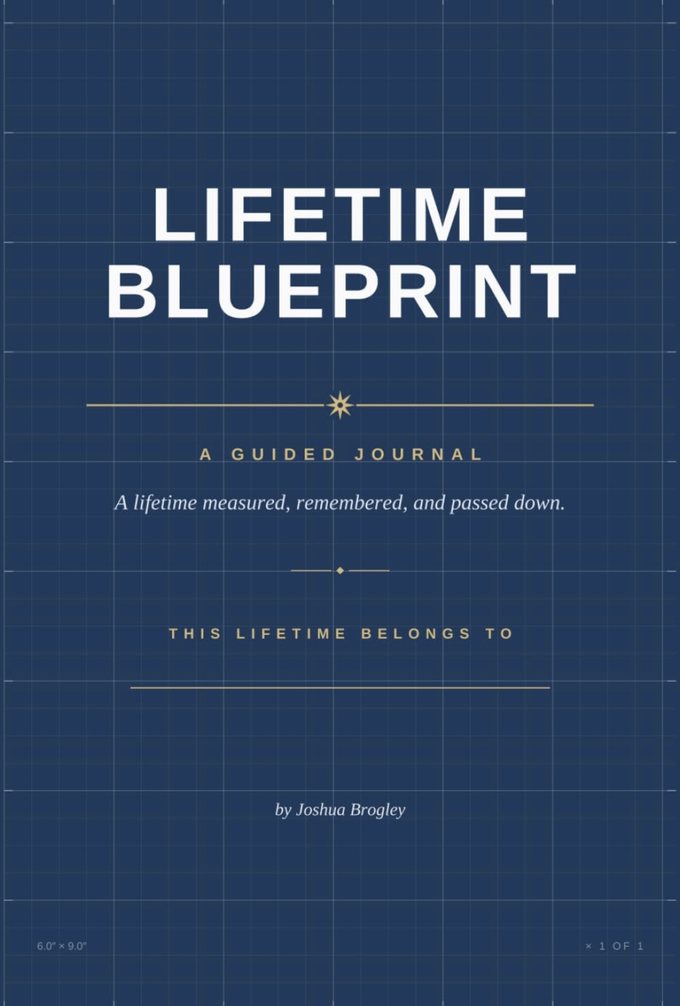
Lifetime Blueprint
The hardcover built to be inherited: eight life domains scored across decades, thirty life-event templates, and letters written forward, ending in a Final Letter.
What are good faith journal prompts?
What do I believe is larger than me? Have I examined what I was handed? Does my answer shape how I actually live, in my money, work and relationships? When did my faith begin, return or leave, and what had to give way for it?
Can a faith journal work if I have doubts?
Yes. The Lifetime Blueprint scores whether your engagement with the question is conscious, not what you conclude. Doubt that is allowed and worked through sits in its highest levels.
How do you measure spiritual growth?
Score your Faith domain against a written guide at regular intervals and compare. The question is whether your answer to what is larger than you increasingly shapes how you live.
More on Lifetime Blueprint
- Why Most People Will Never Write Their Life Down
- Your Fifties: The Distillation Decade, Subtraction Over Addition
- Your Forties Are a Recalibration, Not a Crisis
- Your Thirties: The Building Decade, When Time Starts to Feel Finite
- Your Twenties: The Decade of Compounding Choices
The method behind every book
- Which 365-Day Book Should I Start With? A One-Minute Guide
- What Is a No Zero Day? The Rule That Saves a Bad Week
- What Is a Realistic Morning Routine? Two Minutes, Not Two Hours
All articles about Lifetime Blueprint → · The book page → · Group and bulk orders →
written by the author, at the kitchen table, after work.