Home / Blog / Lifetime Blueprint
LIFETIME BLUEPRINT
How to Score Your Money From 0 to 10 (It Is Not Net Worth)
Part of the series The Eight Domains of Life, Scored: The Complete Guide
Money is the domain people most often pretend not to care about while privately obsessing over. The score is not about net worth. It is about whether you understand what you earn and why, what you spend and why, what you save and why, and whether the answers add up to a life of abundance or one of quiet lack you have not yet named. Are you earning what your work is worth? Spending in line with what you value? Giving in proportion to what you have? Preparing for what is coming, children, aging parents, your own later years? This domain rewards clarity. The score rises with honest answers, not with high numbers.
The six bands
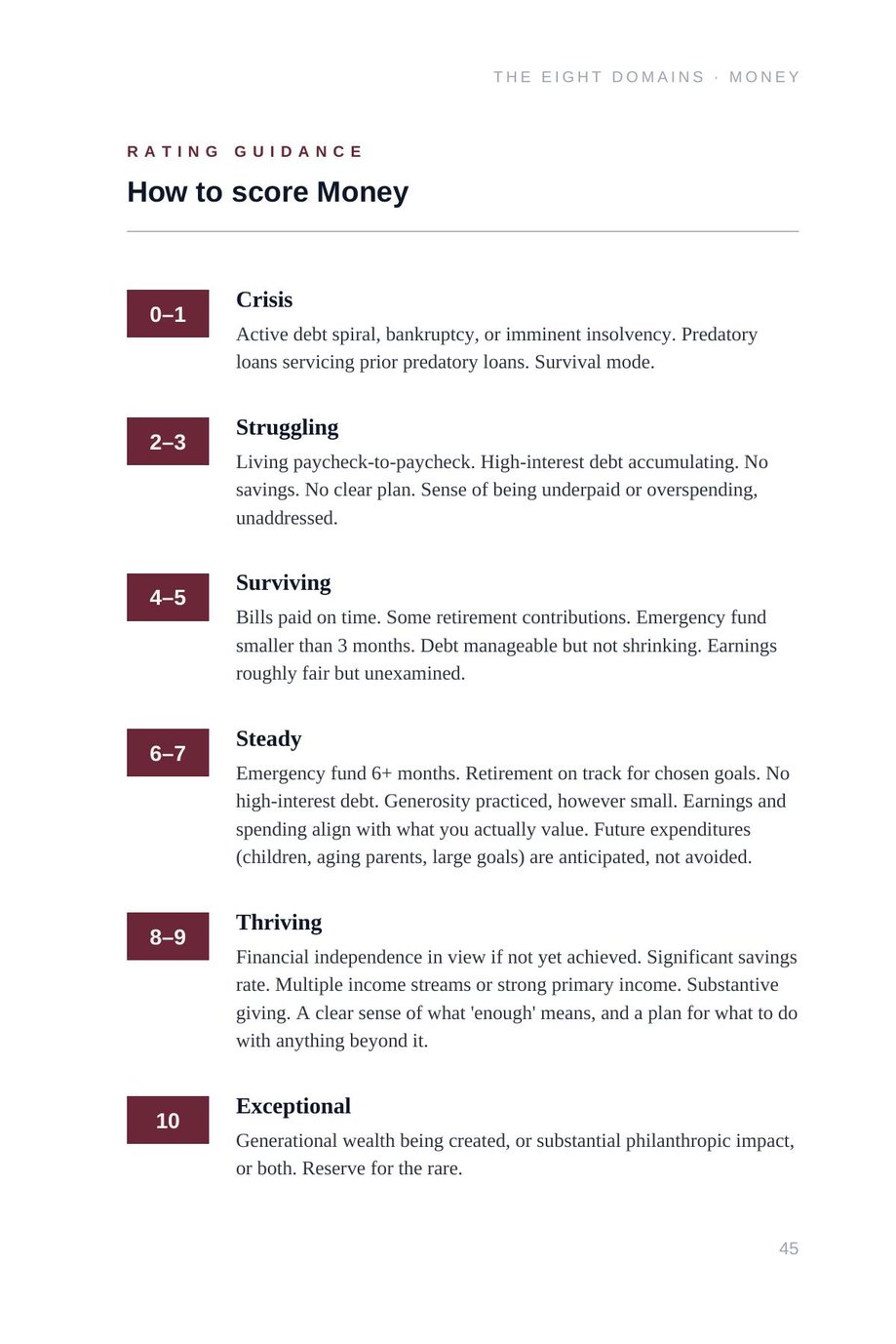
Crisis, 0 to 1: active debt spiral, bankruptcy or imminent insolvency, predatory loans servicing prior predatory loans, survival mode. Struggling, 2 to 3: paycheck to paycheck, high-interest debt accumulating, no savings, no plan, a sense of being underpaid or overspending left unaddressed. Surviving, 4 to 5: bills paid on time, some retirement contribution, an emergency fund under three months, debt manageable but not shrinking, earnings roughly fair but unexamined. Steady, 6 to 7: six-plus months of emergency fund, retirement on track for chosen goals, no high-interest debt, generosity practiced however small, spending aligned with values, future expenditures anticipated rather than avoided. Thriving, 8 to 9: financial independence in view, a significant savings rate, strong or multiple income, substantive giving, and a clear sense of what enough means with a plan for anything beyond it. Exceptional, 10: generational wealth being created or substantial philanthropic impact, reserved for the rare.
Why the score is about clarity
Two households with identical income can sit three bands apart, and the difference is almost never earning. It is whether the spending is examined, whether the future is anticipated, and whether giving exists at all. The rubric's Steady band contains no large numbers; it contains six months of margin, no expensive debt, generosity however small, and alignment between where money goes and what the person says they value. That last item is the quiet killer: a bank statement is the most honest values document a person owns, and most have never read theirs as one. Readers who consider themselves above money are, per the book's own note, the ones most likely to be scoring a 4 they believe is a 7.
Enough is a number, and most people have never set it
The Thriving band introduces the phrase that separates finance from anxiety: a clear sense of what enough means, and a plan for what to do with anything beyond it. Without a number for enough, every raise is absorbed and every level feels like slightly less than required, forever. With one, the domain stops being a treadmill and becomes a project with a finish line, which is the only version of money that can be scored honestly across decades. Setting it is a single sitting and it belongs in the ideal snapshot. Getting your money right is the daily book's month on the mechanics; the lifetime book asks whether the number exists.
From Surviving to Steady: three items, twelve months
The band boundary is precise enough to plan against. Emergency fund from under three months to six or more. High-interest debt from manageable to gone. Giving from zero to something, however small, because the rubric treats generosity as a marker of clarity rather than a luxury. Those three, plus one evening reading the statement as a values document, are a year's work for most households and they move the score a full band. Thriving is a different decade's project. The eight domains holds the system; Work is scored separately on purpose, so that salary and vocation can be read against each other rather than blurred.
Lifetime Blueprint
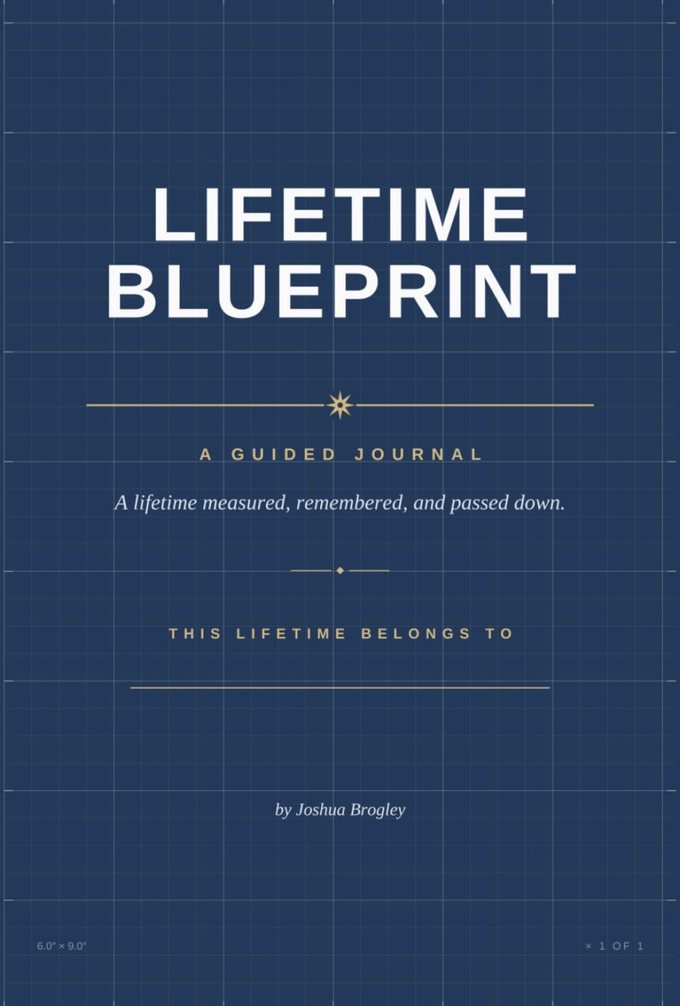
The hardcover built to be inherited: eight life domains scored across decades, thirty life-event templates, and letters written forward, ending in a Final Letter.
How do you rate your financial health without net worth?
Against clarity and margin: months of emergency fund, presence of high-interest debt, whether spending matches stated values, whether giving exists, and whether future costs are anticipated. Steady is six months of margin, no expensive debt, and generosity however small.
What does financially steady mean?
Six-plus months of emergency fund, retirement on track for chosen goals, no high-interest debt, some giving, spending aligned with values, and children, aging parents and later years anticipated rather than avoided. No large numbers are required.
More on Lifetime Blueprint
- Your Twenties: The Decade of Compounding Choices
- Your Thirties: The Building Decade, When Time Starts to Feel Finite
- Your Forties Are a Recalibration, Not a Crisis
- Your Fifties: The Distillation Decade, Subtraction Over Addition
- Why Most People Will Never Write Their Life Down
The method behind every book
- Which 365-Day Book Should I Start With? A One-Minute Guide
- What Is a No Zero Day? The Rule That Saves a Bad Week
- What Is a Realistic Morning Routine? Two Minutes, Not Two Hours
All articles about Lifetime Blueprint → · The book page → · All the books →
written by the author, at the kitchen table, after work.