Home / Blog / Lifetime Blueprint
LIFETIME BLUEPRINT
What Is the Origin Snapshot? Past, Present and Ideal, Scored
Part of the series Where to Begin a Lifetime Journal: Five Ways In, and Who Each Is For
The Origin Snapshot is the first measurement of a life: eight domains, Health, Mind, Faith, Family, Relationships, Work, Money and Growth, each scored three times in one sitting. Past is where you were three to five years ago. Present is where you actually are today, when no one is asking. Ideal is where you genuinely want to go, with no ceiling. Three points, one line, and for the first time a trajectory you can look at instead of a mood you can only feel.
Past is the calibration, and the place people cheat first
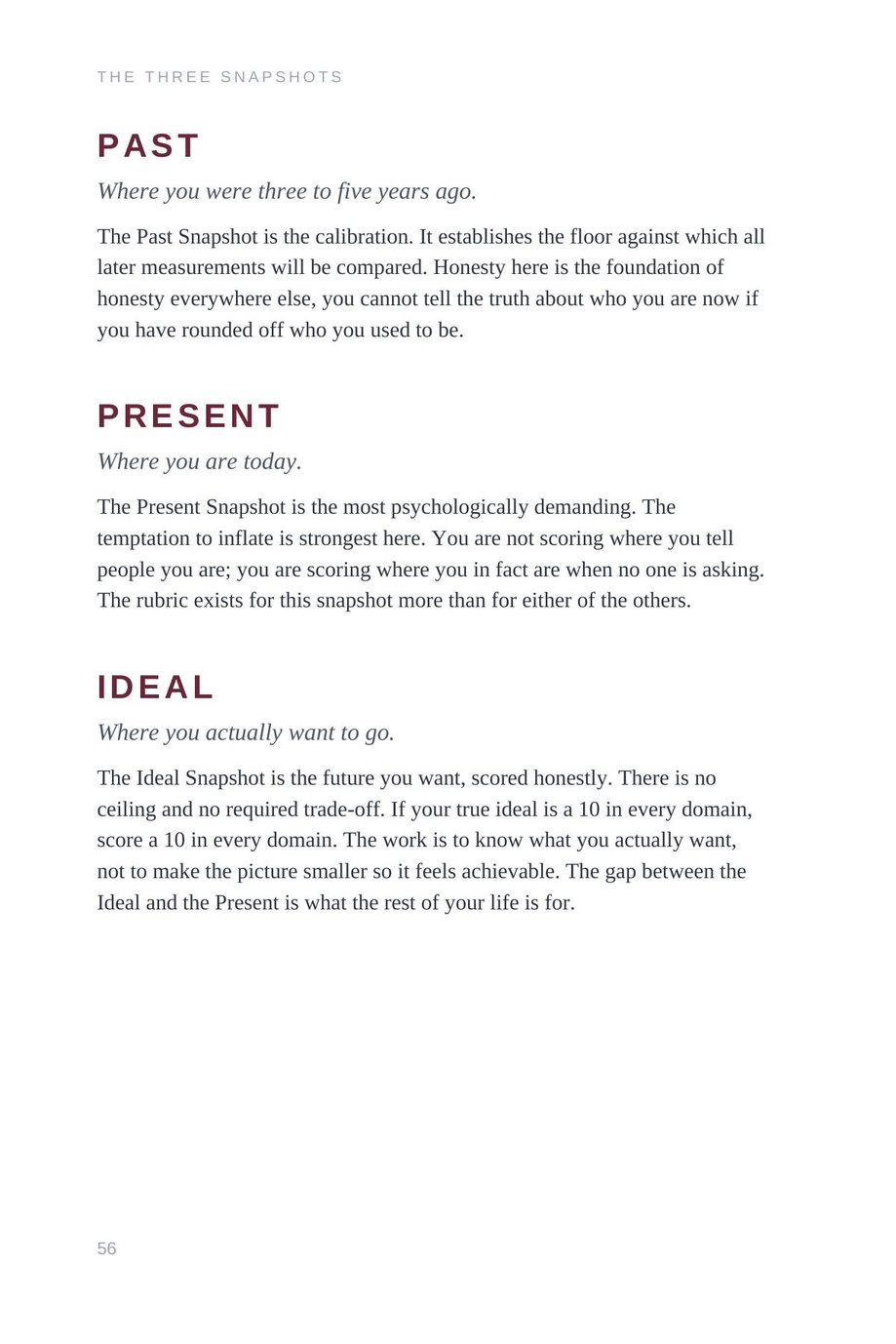
The Past Snapshot establishes the floor every later measurement is compared to, which is why honesty there is the foundation of honesty everywhere else: you cannot tell the truth about who you are now if you have rounded off who you used to be. The common distortion is flattering memory in one direction and self-punishment in the other, so anchor to evidence: what was the bank balance, who did you see weekly, how did you sleep. Three to five years back is chosen deliberately, far enough that the change is measurable, close enough that the evidence still exists.
Present is the most demanding score in the book
The temptation to inflate is strongest here, because the Present is the version you have been presenting at dinner parties for years. You are not scoring where you tell people you are; you are scoring where you are when nobody is asking, and the rating guidance for each domain exists mostly for this snapshot: it describes what a 3, a 7 and a 10 look like in observable terms so that the number cannot be a mood wearing a digit. If a domain feels awkward to score, that is precisely the domain you most need to measure. Faith is the usual stumble for secular readers; Money for readers who consider themselves above it.
Ideal has no ceiling and no required trade-off
If your true ideal is a 10 in every domain, score a 10 in every domain. The work is knowing what you actually want, not shrinking the picture until it feels achievable, which is the reflex most goal-setting quietly trains. Choose the ideal age deliberately: a 34-year-old might score the peak years of forty to fifty, a recently retired 63-year-old might score the whole of the rest of life rather than a single year. The gap between Ideal and Present is then named on two facing pages: habits to stop, habits to build, relationships to grow or find. That gap is, in the book's own words, what the rest of your life is for.
Why one sitting, and what it does to the years after
Block one to two hours and do all three in one go, because the three scores only mean something in relation to each other and memory reorders them if they are spread across weeks. Then the Origin becomes the fixed point twelve later five-year snapshots are compared against, dated and side by side, so that at fifty you can watch the line you were on at thirty-five. The whole reason a hardcover exists for this rather than a spreadsheet is that the comparison has to survive fifteen years of house moves. Where to begin puts the snapshot in sequence with the other doors; the Feynman rule is the discipline it runs on.
Lifetime Blueprint
The hardcover built to be inherited: eight life domains scored across decades, thirty life-event templates, and letters written forward, ending in a Final Letter.
How long does the Origin Snapshot take?
One to two hours in a single sitting: eight domains scored three times each, past, present and ideal, using the rating guidance so every number has an observable meaning.
Should my ideal scores be realistic?
No. The Ideal Snapshot has no ceiling and no required trade-off; it records what you genuinely want. Shrinking it to feel achievable defeats the measurement. Realism belongs in the gap pages that follow, where you name what has to change.
More on Lifetime Blueprint
- Your Twenties: The Decade of Compounding Choices
- Your Thirties: The Building Decade, When Time Starts to Feel Finite
- Your Forties Are a Recalibration, Not a Crisis
- Your Fifties: The Distillation Decade, Subtraction Over Addition
- Why Most People Will Never Write Their Life Down
The method behind every book
- Which 365-Day Book Should I Start With? A One-Minute Guide
- What Is a No Zero Day? The Rule That Saves a Bad Week
- What Is a Realistic Morning Routine? Two Minutes, Not Two Hours
All articles about Lifetime Blueprint → · The book page → · All the books →
written by the author, at the kitchen table, after work.