Home / Blog / Lifetime Blueprint
LIFETIME BLUEPRINT
Starting a Lifetime Journal at 18, 30, 45 or 60: Same Method
Part of the series Where to Begin a Lifetime Journal: Five Ways In, and Who Each Is For
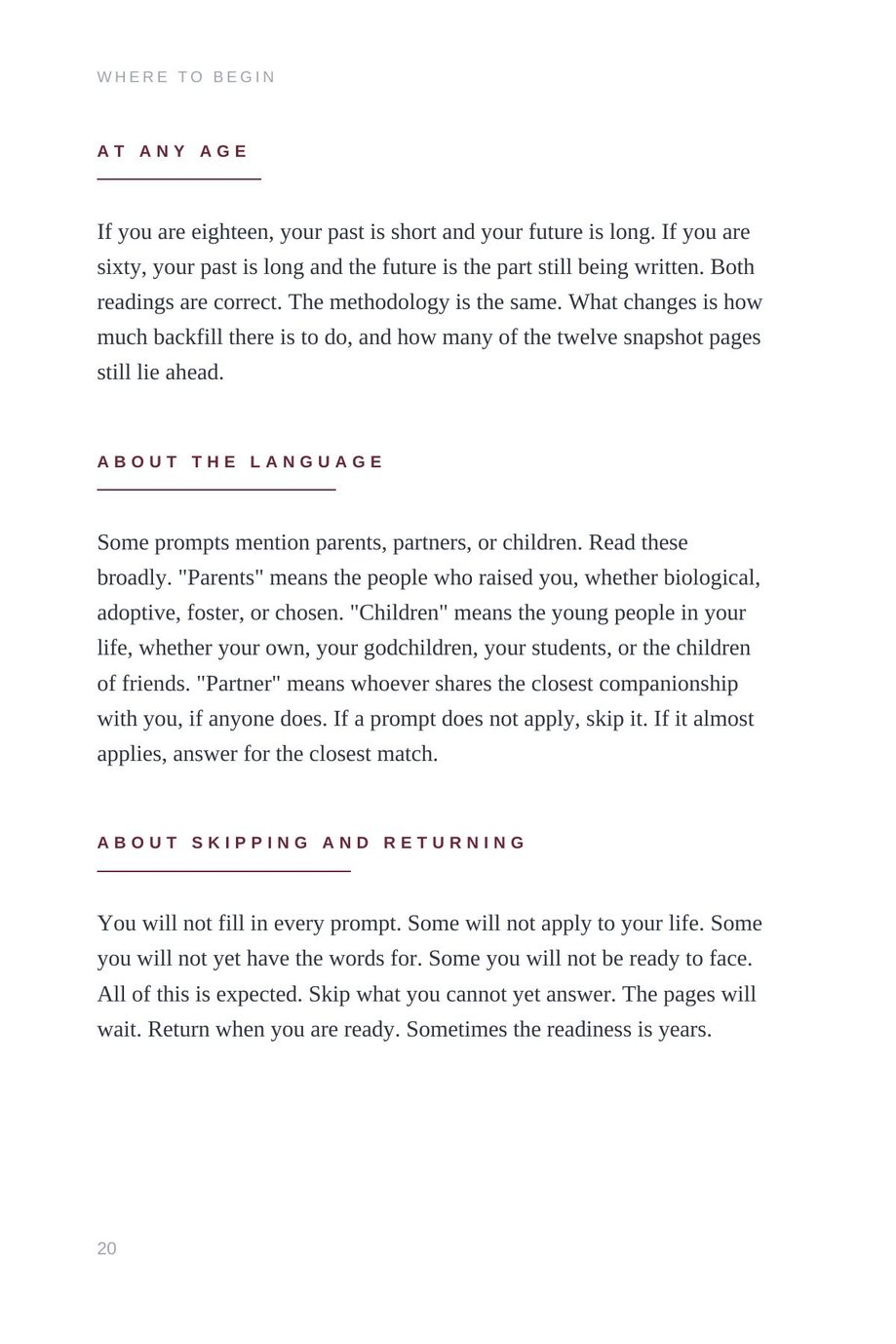
If you are eighteen, your past is short and your future is long. If you are sixty, your past is long and the future is the part still being written. Both readings are correct, and the methodology does not change between them: eight domains, three snapshots, decades, events, letters. What changes is the mix. At eighteen almost everything is snapshot and letter; at sixty almost everything is backfill; at forty it is the rare age where the two halves are the same size, which is why forty is when most people finally open one.
Eighteen to twenty-five: mostly future, one crucial floor
The young reader's temptation is to skip the past because there is so little of it, and that is the one mistake worth stopping: the Origin Snapshot's Past score, taken at twenty, becomes the floor for a fifty-year trajectory nobody else will ever have. Backfill is short, childhood and adolescence, and it should be done while the witnesses are alive to be asked. Then the letters: the letter to your younger self is strange at twenty, but the letter to a future self at ten years is the single most valuable page a young reader can write, because they will actually get to open it while the writer is still recognizable.
Thirty to fifty: the compounding decades, measured live
This is the age the book is most often bought and least often finished, because the twenties and thirties are the years of compounding choices and the reader is inside the compounding. The backfill has real weight now, one or two decades that changed everything, and the five-year snapshots start landing at intervals short enough to watch a line bend. The pairing that matters most here is the snapshot beside the people inventory, since these are the years parents move from seventy to eighty and the remaining-visits arithmetic gets loud. That math is usually done in this decade or not at all.
Sixty and after: mostly backfill, and the letters that count
The older reader's temptation is the opposite: to treat the book as memoir and skip the measurement. But the Ideal Snapshot at sixty-three, scored for the whole rest of life rather than a single year, is one of the worked examples in the book precisely because it changes what the remaining decades get spent on. Backfill is long and should be logged across many sittings, not attempted whole. And the letters stop being rehearsal: the letter to a grandchild, the letter to whoever reads this after you, and the Final Letter are written by people at this age with a seriousness that the young cannot fake. Is it too late answers the question directly, and the answer is no.
Read the prompts broadly, at every age
The book's language is deliberately elastic. Parents means the people who raised you, biological, adoptive, foster or chosen. Children means the young people in your life, your own, godchildren, students, the children of friends. Partner means whoever shares the closest companionship with you, if anyone does. If a prompt does not apply, skip it; if it almost applies, answer for the closest match. At every age some prompts will not yet have words, and the pages wait for them. Where to begin is the same sequence at every age; only the proportions shift.
Lifetime Blueprint
The hardcover built to be inherited: eight life domains scored across decades, thirty life-event templates, and letters written forward, ending in a Final Letter.
What age should you start a lifetime journal?
Any age; the method is identical. At eighteen the work is mostly snapshots and letters forward, at sixty mostly backfill and the letters that count, and at forty the two halves are about equal, which is why forty is the most common starting age.
Is a lifetime journal only for older people?
No. A twenty-year-old's Origin Snapshot becomes the floor of a fifty-year trajectory no one else will have, and the ten-year letter to a future self is most valuable when the writer is young enough to open it.
More on Lifetime Blueprint
- Your Twenties: The Decade of Compounding Choices
- Your Thirties: The Building Decade, When Time Starts to Feel Finite
- Your Forties Are a Recalibration, Not a Crisis
- Your Fifties: The Distillation Decade, Subtraction Over Addition
- Why Most People Will Never Write Their Life Down
The method behind every book
- Which 365-Day Book Should I Start With? A One-Minute Guide
- What Is a No Zero Day? The Rule That Saves a Bad Week
- What Is a Realistic Morning Routine? Two Minutes, Not Two Hours
All articles about Lifetime Blueprint → · The book page → · All the books →
written by the author, at the kitchen table, after work.