Home / Blog / Lifetime Blueprint
LIFETIME BLUEPRINT
How Many More Times Will You See Your Parents? Do the Math
Part of the series Where to Begin a Lifetime Journal: Five Ways In, and Who Each Is For
Take a parent in their seventies. Average remaining years, from public life-expectancy tables, run somewhere around ten to fifteen. Multiply by how many times a year you actually see them. If the answer is twice a year, you are looking at twenty or thirty more encounters, total, for the rest of both of your lives. Almost nobody has done this multiplication, and the ones who have describe the same thing: it does not feel like statistics. It feels like a deadline they had been pretending was not there.
Why the regret is always about time
When people we loved are gone, the regret is almost never about words; it is about hours. The visits kept postponing, the calls meant to make, the presence offered only after they could no longer receive it. The rest of any honest life review asks who you are becoming. This one section asks something different: who, right now, is not guaranteed to be here for the years ahead, and what will you do with the time left with them? Grandparents in their eighties, parents in their seventies, the mentor, the aunt who saw you clearly, the friend from before you became who you are: all aging at the same rate you are, and the window is shorter than it feels.
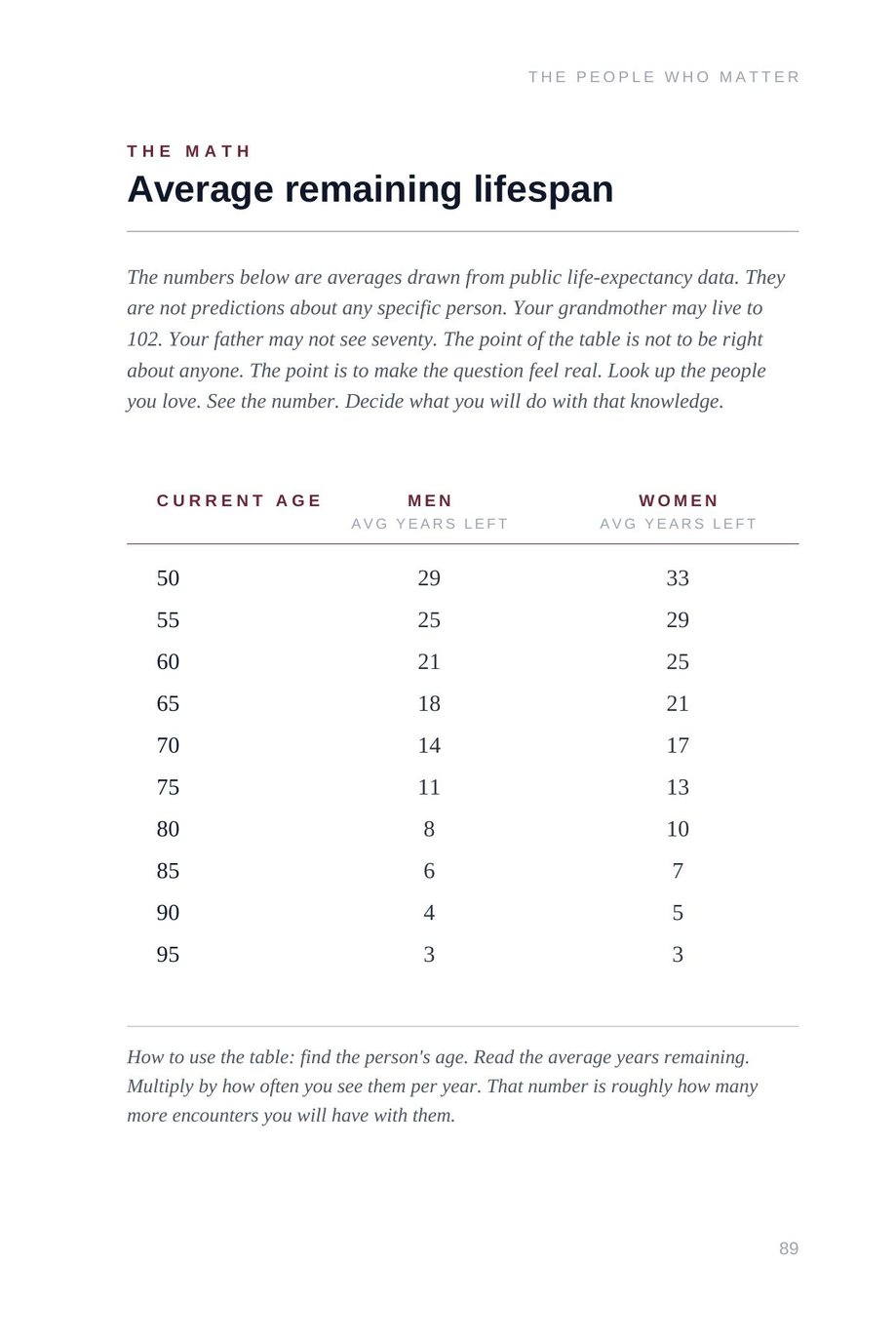
The table is not a prediction; it is a nudge
The averages are averages. Your grandmother may reach 102 and your father may not see seventy, and the table is not trying to be right about anyone. Its job is to make the question feel real: look up the person, read the number, multiply by visits per year, and sit with the product. A man of 80 has, on average, eight years; at one visit a year, that is eight more visits. At one a month, ninety-six. The difference between those two numbers is entirely a decision you are making, this year, mostly by default.
The inventory, then the plan, then the date
The method is three pages. First the inventory: list the people whose presence is not guaranteed, their ages, and what you most want to say or do before you no longer can. Second, the plan: pick three of them and name one specific action each, a visit, a call, a question, a story you want recorded, a thing you want said, within the next six months, with a by-when date. Third, the receipts: date the action when it is done, and return to the page in five years to see what you did with the years you had. It is deliberately the fastest page in the book to change behavior, because it converts vague love into a calendar.
Where it sits, and why it comes second
In the book this inventory is paired with the Origin Snapshot, second in the recommended order, because the trajectory of a life is also the trajectory of the relationships inside it, and measuring yourself without measuring the time left with your people produces a strangely lonely graph. If a parent is already old, this is the right first door instead. Two practices follow naturally from it: the questions to ask while you still can, and the one that costs the most and pays the most, saying the funeral speech while they are alive. Where to begin has the rest of the sequence.
Lifetime Blueprint
The hardcover built to be inherited: eight life domains scored across decades, thirty life-event templates, and letters written forward, ending in a Final Letter.
How do you calculate how many times you will see someone again?
Take the average remaining years for their age from a life-expectancy table, multiply by how many times a year you actually see them. The product is a rough count of remaining encounters, and it is usually far smaller than it feels.
What is the People Who Matter inventory?
A short written list of the people whose time with you is finite, their ages, what you most want to say or do, and a dated plan of three specific actions in the next six months, revisited five years on.
More on Lifetime Blueprint
- Your Twenties: The Decade of Compounding Choices
- Your Thirties: The Building Decade, When Time Starts to Feel Finite
- Your Forties Are a Recalibration, Not a Crisis
- Your Fifties: The Distillation Decade, Subtraction Over Addition
- Why Most People Will Never Write Their Life Down
The method behind every book
- Which 365-Day Book Should I Start With? A One-Minute Guide
- What Is a No Zero Day? The Rule That Saves a Bad Week
- What Is a Realistic Morning Routine? Two Minutes, Not Two Hours
All articles about Lifetime Blueprint → · The book page → · All the books →
written by the author, at the kitchen table, after work.