Home / Blog / Lifetime Blueprint
LIFETIME BLUEPRINT
How Do I Do a Life Audit? The Eight-Domain Method
Part of the series How Often Should You Review Your Life? Choose an Interval by Your Age
A life audit is one honest measurement of every area of your life at the same moment. The method that works: pick a fixed set of domains, score each on the same zero-to-ten scale using written rubrics rather than feelings, date it, and repeat at an interval. Lifetime Blueprint runs eight domains, Health, Mind, Faith, Family, Relationships, Work, Money and Growth, scored Past, Present and Ideal, so the audit shows trajectory, not just a snapshot.
Why most life audits lie
They score feelings. On a good day the family domain gets an eight; on a rough Sunday, a four. Nothing changed but the weather. A useful audit needs behavioral anchors: what does a six actually look like in how you live? That is the difference between a mood and a measurement.

Past, Present, Ideal
The Blueprint scores each domain three times at the Origin: where you were at a fixed past point, where you are now, and where you intend to be. The gap between Present and Ideal is your assignment. The gap between Past and Present is your evidence that things move.
Score, then read across
Eight numbers on one page tell a story a page of prose cannot. Two domains high, two collapsing, four holding: that pattern is your life right now, and it changes what you do next week. The single most useful thing an audit produces is the honest shape.
Repeat on a schedule you can keep
An audit once is a photograph. An audit every few years is a film. The Blueprint has twelve Lifetime Snapshots built in and a table for choosing the interval by age: about every five years at 20, three at 40, two at 60, yearly at 70. If you want a daily engine to move the numbers between snapshots, Step The F*ck Up is the sibling built for that.
A worked audit, start to finish
The Blueprint prints one complete worked example so you can see what a finished audit looks like: a hypothetical reader at 38. Past total 32 of 80, Present 53, Ideal 68. Trajectory plus 21, a strong upward arc with Mind gaining the most ground. Gap 15. Largest gap: Health, 6 to 9, the only domain with a gap of three, so that is where the next few years belong. Slowest mover: Relationships, plus 1, the quietest signal on the page. Lowest score today: Faith at 5, climbing from the lowest start. Already strong: Family and Work at 8, hold steady and push elsewhere. The next page draws the same numbers as eight small slope charts. The exercise, worked through takes it line by line.
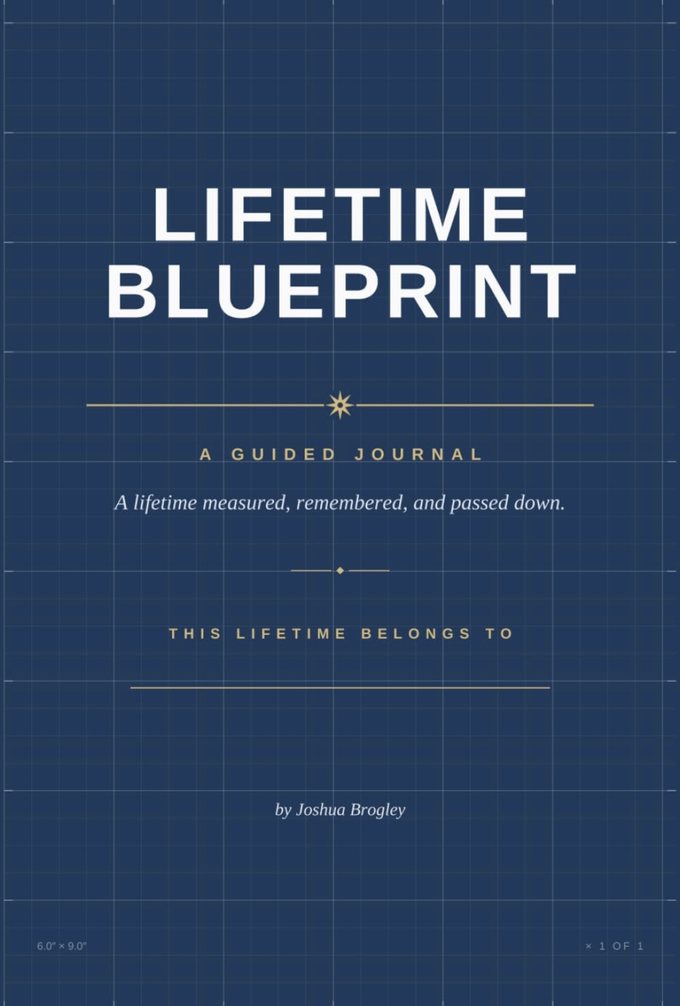
Lifetime Blueprint
A guided journal built for the long arc of a life: eight domains, seven decades, twelve snapshots, eleven letters, one record honest enough to be inherited.
What areas should a life audit cover?
Enough to be complete, few enough to hold in your head. Eight is the sweet spot the Blueprint uses: Health, Mind, Faith, Family, Relationships, Work, Money, Growth. Every part of a life lands somewhere in those.
How do I score a life audit honestly?
Use rubrics, not moods. A written description of what a 3, a 6 and a 9 look like in behavior, agreed with yourself before you score, stops the number from moving with your day. The Blueprint anchors every domain from Crisis to Exceptional.
More on Lifetime Blueprint
- Your Twenties: The Decade of Compounding Choices
- Your Thirties: The Building Decade, When Time Starts to Feel Finite
- Your Forties Are a Recalibration, Not a Crisis
- Your Fifties: The Distillation Decade, Subtraction Over Addition
- Why Most People Will Never Write Their Life Down
The method behind every book
- Which 365-Day Book Should I Start With? A One-Minute Guide
- What Is a No Zero Day? The Rule That Saves a Bad Week
- What Is a Realistic Morning Routine? Two Minutes, Not Two Hours
All articles about Lifetime Blueprint → · The book page → · All the books →
written by the author, at the kitchen table, after work.