Home / Blog / Lifetime Blueprint
LIFETIME BLUEPRINT
How to Write a Letter to Whoever Reads This After You
Part of the series Letters Forward: The Eleven Letters Everyone Should Write
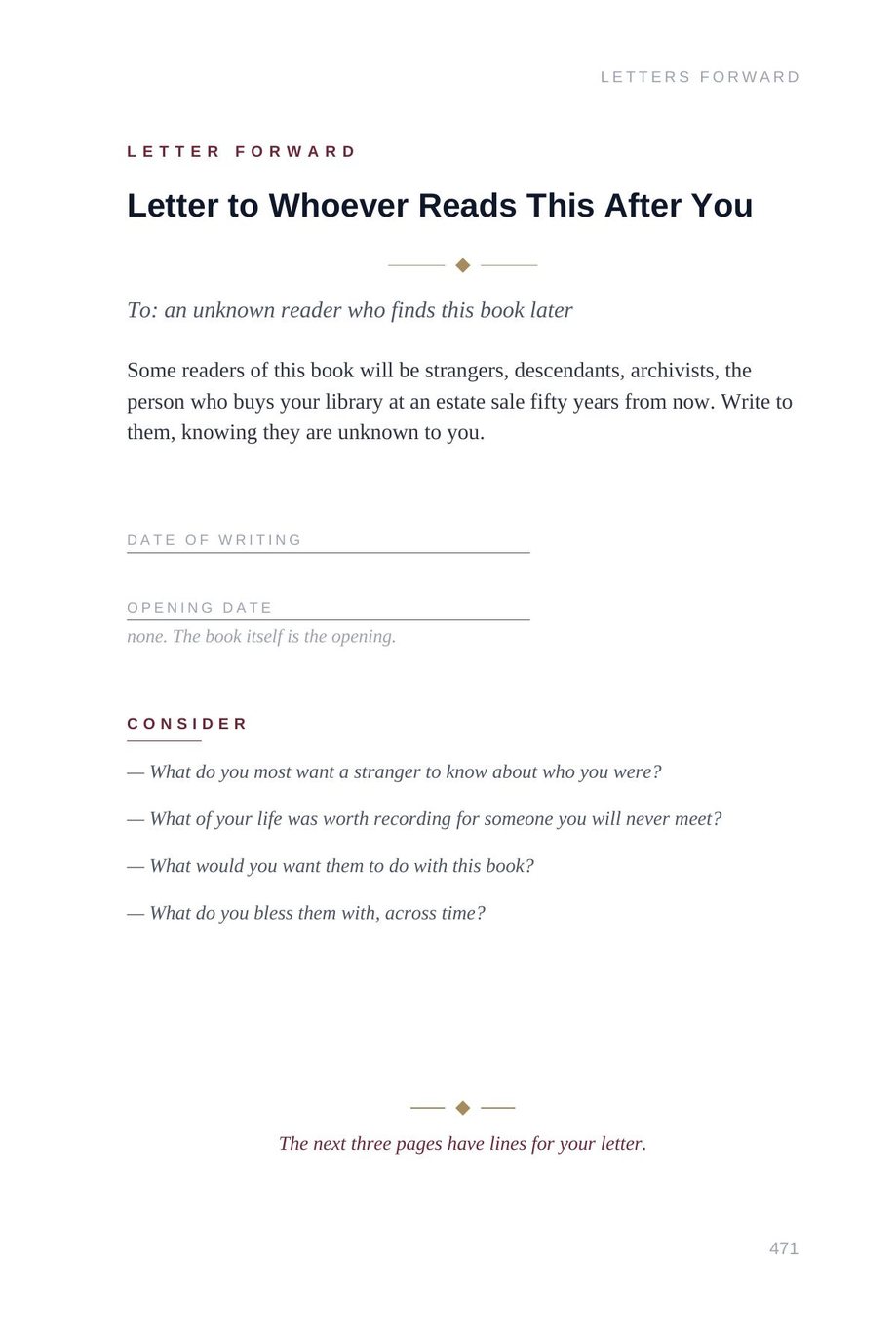
The letter to whoever reads this after you is addressed to an unknown reader who finds the book later: some readers will be strangers, the template says, descendants, archivists, the person who buys your library at an estate sale fifty years from now. Write to them, knowing they are unknown to you. There is no opening date; the book itself is the opening. It is, for a lot of people, the easiest letter to write first, because a reader you cannot picture cannot judge you, and it teaches the voice that every other letter in the section needs.
The four questions
What do you most want a stranger to know about who you were? Not your accomplishments, which the rest of the book records, but the thing a stranger could not infer from them. What of your life was worth recording for someone you will never meet? This is a hard and clarifying question, and the answer is rarely what the writer would have guessed before sitting down. What would you want them to do with this book? Keep it, pass it on, read one section, burn the unsent letter. And what do you bless them with, across time, which is the line that turns the letter from a note into a gift.
The safest audience, and why that matters
Every other letter in the section has a reader with a face, and the face edits the letter before it is written. The unknown reader has no face, so the writing is unusually honest, and readers who cannot start the letter to their partner or their parent often start here and find the others open afterward. The book recommends this letter as one of three good first gestures for exactly that reason. It is also the letter that most often gets rewritten, years later, by a writer who has become someone else, and both versions belong on the page.
Write it as the inside-cover inscription's long form
The book asks, on its page about the finished volume, for an inscription on the inside cover to whoever finds it: who you were, what you hoped, what you ask of them. This letter is that inscription at full length, and the two should agree. Some readers write the letter first and distill it to the inscription; some inscribe first, decades early, and write the letter when the book has begun to feel finished. The instruction to keep the book findable and tell one person where it is exists so that this letter finds its reader.
Where it sits, and its companions
The letter to whoever reads this after you is the ninth of the eleven letters forward, and its closest companions are the letter to grandchildren who do not yet exist and the Final Letter, which can be addressed the same way: to whoever opens this book after I am gone. All eleven letters; writing for descendants; the inherited book and its inscription; why this is a good first letter. Its page sits in a certain hardcover that is, itself, the opening date.
Lifetime Blueprint
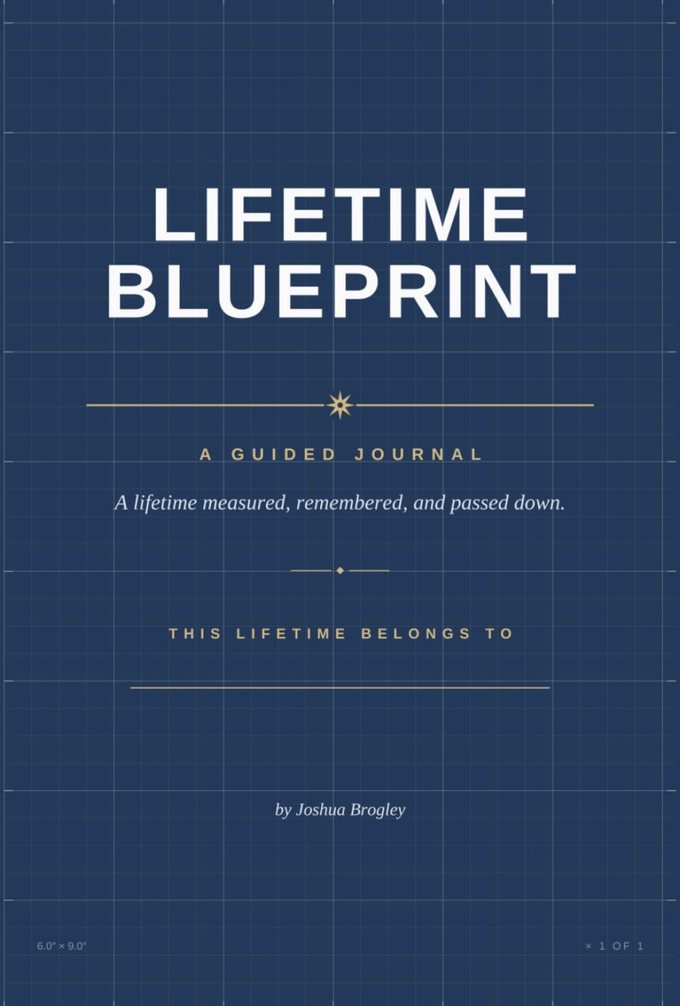
The hardcover built to be inherited: eight life domains scored across decades, thirty life-event templates, and letters written forward, ending in a Final Letter.
What would you write to a stranger who finds your journal?
What you most want them to know about who you were that they could not infer, what of your life was worth recording for someone you will never meet, what you would like them to do with the book, and a blessing across time.
Why write a letter to an unknown reader?
Because a reader with no face cannot edit the letter before it is written; it is the most honest voice in the section and the easiest place to start. It is also the long form of the inside-cover inscription to whoever finds the book.
More on Lifetime Blueprint
- Your Twenties: The Decade of Compounding Choices
- Your Thirties: The Building Decade, When Time Starts to Feel Finite
- Your Forties Are a Recalibration, Not a Crisis
- Your Fifties: The Distillation Decade, Subtraction Over Addition
- Why Most People Will Never Write Their Life Down
The method behind every book
- Which 365-Day Book Should I Start With? A One-Minute Guide
- What Is a No Zero Day? The Rule That Saves a Bad Week
- What Is a Realistic Morning Routine? Two Minutes, Not Two Hours
All articles about Lifetime Blueprint → · The book page → · All the books →
written by the author, at the kitchen table, after work.