Home / Blog / Lifetime Blueprint
LIFETIME BLUEPRINT
How to Write a Letter to Your Partner (What Is Hardest to Say in Person)
Part of the series Letters Forward: The Eleven Letters Everyone Should Write
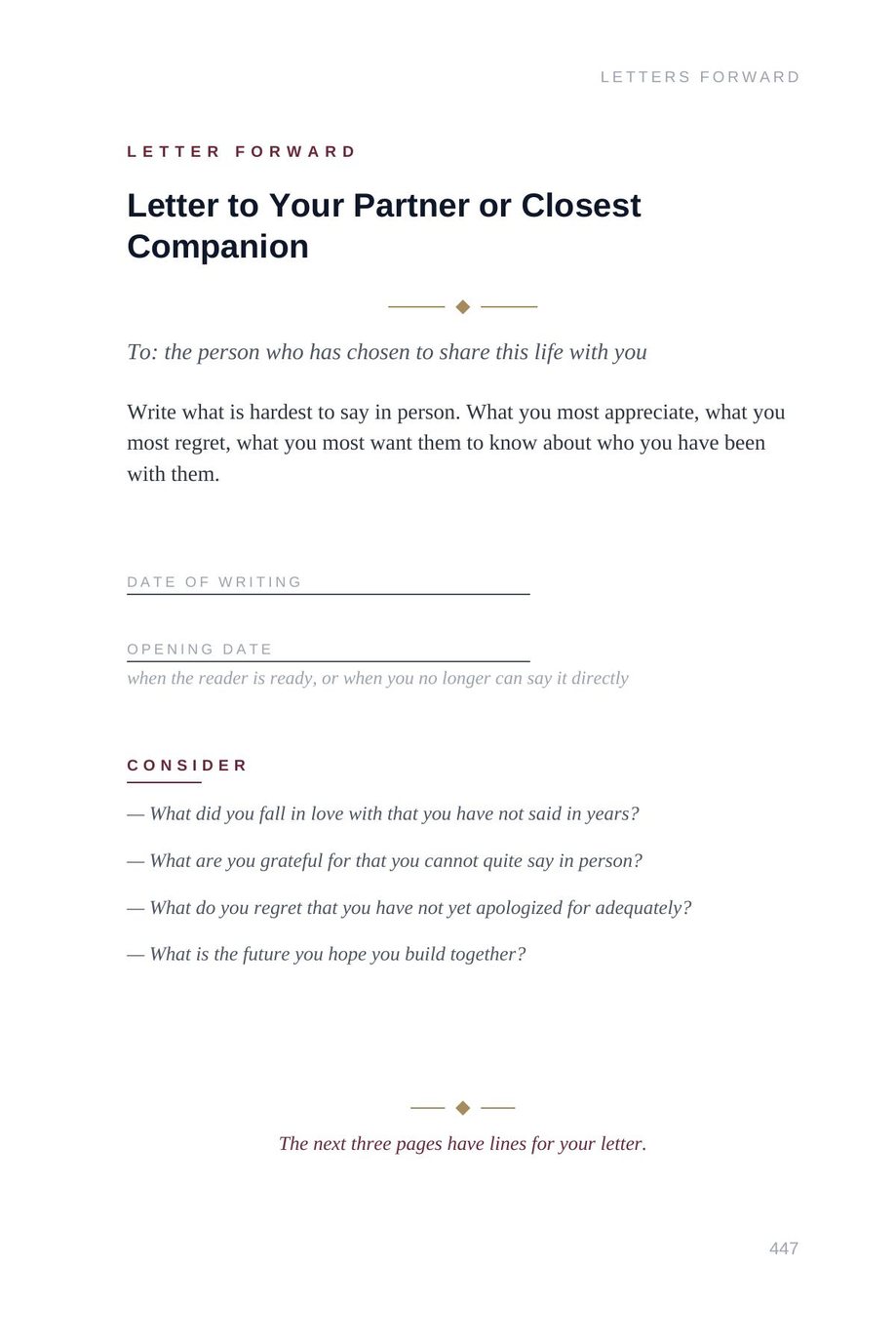
The letter to your partner is addressed, in the template's words, to the person who has chosen to share this life with you, and its instruction is to write what is hardest to say in person: what you most appreciate, what you most regret, what you most want them to know about who you have been with them. The opening date is left to you: when the reader is ready, or when you can no longer say it directly. Most long partnerships run on a large unspoken account, and this is the page that settles it while both people are still here to read the statement.
The four questions
What did you fall in love with that you have not said in years? Not what you love now, which is easy, but the original thing, which has usually gone unmentioned since the second year. What are you grateful for that you cannot quite say in person? The gratitude that would sound strange out loud in a kitchen and reads perfectly on a page. What do you regret that you have not yet apologized for adequately? Adequately is the operative word; most of us have apologized, briefly, once. And what is the future you hope you build together, said concretely enough to be checked against later.
Why on paper, and why now
Spoken words in a long relationship get absorbed into the ambient noise of the household; written ones sit on a shelf and get reread at three in the morning after an argument. That is the practical case. The other case is the opening date: when you can no longer say it directly. Partners are on the People Who Matter list too, and the remaining-visits arithmetic applies to the person across the table as much as to a parent. The letter written at forty and opened at sixty is a different object from the one that was never written.
How to write it without it becoming a performance
Witness before advice, plainly: what you have seen them do, what it cost them, what you noticed and never said. No instructions for how they should live after you; the Final Letter can hold a little of that, and this one should hold none. One paragraph is a complete letter. Date it, address it by name, and either give it now, seal it in the book, or both: some readers write it twice, one to hand over on an anniversary and one to be found.
Where it sits, and what goes with it
The letter to your partner is the third of the eleven letters forward, and it has a natural pair in the events section: the Beginning of a Marriage template, which asks for the real start and the doubts dismissed. Read together, they are the beginning and the meaning of the same thing. All eleven letters; writing the beginning; the daily version of saying the unsaid; and the page itself, with its two dates and three lined pages, in a certain hardcover the two of you will keep.
Lifetime Blueprint
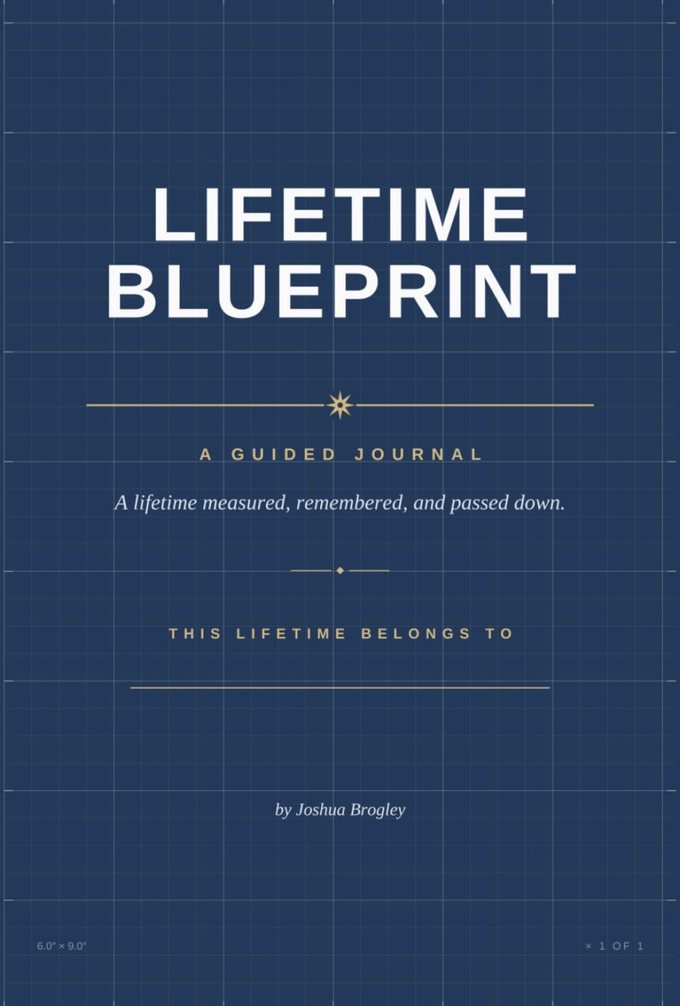
The hardcover built to be inherited: eight life domains scored across decades, thirty life-event templates, and letters written forward, ending in a Final Letter.
What do you write in a letter to your partner?
What you fell in love with and have not said in years, what you are grateful for that is hard to say aloud, what you regret and have not apologized for adequately, and the future you hope to build together. Witness, not instruction; one paragraph is enough.
When should you give a letter to your spouse?
The template leaves the opening date to you: on an anniversary, when the reader is ready, or when you can no longer say it directly. Some write two, one to hand over and one to be found.
More on Lifetime Blueprint
- Your Twenties: The Decade of Compounding Choices
- Your Thirties: The Building Decade, When Time Starts to Feel Finite
- Your Forties Are a Recalibration, Not a Crisis
- Your Fifties: The Distillation Decade, Subtraction Over Addition
- Why Most People Will Never Write Their Life Down
The method behind every book
- Which 365-Day Book Should I Start With? A One-Minute Guide
- What Is a No Zero Day? The Rule That Saves a Bad Week
- What Is a Realistic Morning Routine? Two Minutes, Not Two Hours
All articles about Lifetime Blueprint → · The book page → · All the books →
written by the author, at the kitchen table, after work.