Home / Blog / Lifetime Blueprint
LIFETIME BLUEPRINT
The Unsent Letter: Writing to Someone Who Caused Harm
Part of the series Letters Forward: The Eleven Letters Everyone Should Write
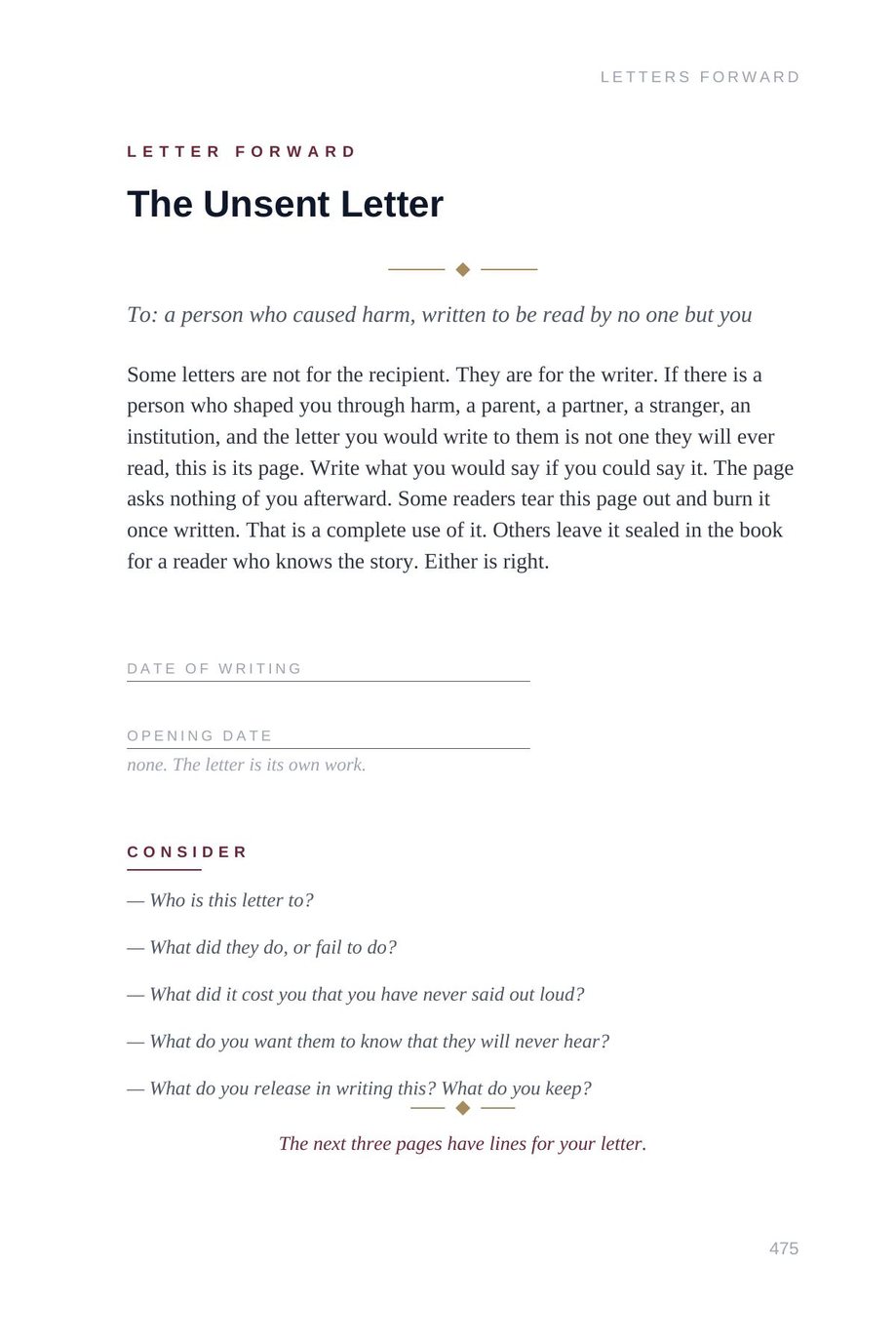
Some letters are not for the recipient. They are for the writer. If there is a person who shaped you through harm, a parent, a partner, a stranger, an institution, and the letter you would write to them is not one they will ever read, this is its page. The instruction is to write what you would say if you could say it, and the template promises something no other page in the book does: it asks nothing of you afterward. Some readers tear the page out and burn it once written, and the book calls that a complete use. Others leave it sealed for a reader who knows the story. Either is right.
The questions, and why they run in this order
Who is this letter to? Named, even if only to yourself. What did they do, or fail to do? Both halves, because a great deal of harm is omission. What did it cost you that you have never said out loud? This is the question the letter exists for, and the cost is usually larger and more specific than the writer has ever allowed. What do you want them to know that they will never hear? And then a final question about what you will do with the page, which is the only instruction: decide, and do it.
Why unsent, and why it still works
A sent letter is a negotiation; it anticipates a reply and edits itself accordingly. An unsent one has no reader to manage, so it can say the true size of the thing, which is the size that has been unsaid for years and has been doing damage at that size. Naming the cost, in full, on a page, dated, is the mechanism; the book does not claim it is a cure and says plainly, in the Healings section, that some material is too large to write alone. It claims, and readers confirm, that the letter moves the thing from the body to the page, where it can be looked at.
Burn or seal: the two complete uses
Tearing the page out and burning it is a ritual with a long history and the book endorses it without reservation; the page is designed to be removable. Sealing it in the book for a reader who knows the story is the other use, and it changes what the book is: an honest record of a life includes the harm done to it, and a future reader who finds the sealed page learns something about you and about the person, and about what an honest record can hold. Neither use is more correct. The choice is the last line of the letter.
Where it sits, and the note beside it
The unsent letter is the tenth of the eleven letters forward, placed just before the Final Letter, and it is the page the book most clearly pairs with professional support: if it opens material you cannot navigate by writing, the reference page at the back gives guidance on finding help, and the letter can wait. All eleven letters; the Healings category and its Letting Go template, which is often where the unsent letter leads; the book's rules for hard material. Its removable page sits in a certain hardcover that expects some pages to be burned.
Lifetime Blueprint
The hardcover built to be inherited: eight life domains scored across decades, thirty life-event templates, and letters written forward, ending in a Final Letter.
What is an unsent letter and why write one?
A letter to someone who caused harm, written to be read by no one but you. It names what they did or failed to do and what it cost, at full size, without a reader to manage. It moves the thing from the body to the page; then the page is burned or sealed.
Should you burn a letter you never send?
The template endorses both: burn it once written, which is a complete use, or seal it in the book for a reader who knows the story. Decide and do it; the page asks nothing of you afterward.
More on Lifetime Blueprint
- Your Twenties: The Decade of Compounding Choices
- Your Thirties: The Building Decade, When Time Starts to Feel Finite
- Your Forties Are a Recalibration, Not a Crisis
- Your Fifties: The Distillation Decade, Subtraction Over Addition
- Why Most People Will Never Write Their Life Down
The method behind every book
- Which 365-Day Book Should I Start With? A One-Minute Guide
- What Is a No Zero Day? The Rule That Saves a Bad Week
- What Is a Realistic Morning Routine? Two Minutes, Not Two Hours
All articles about Lifetime Blueprint → · The book page → · All the books →
written by the author, at the kitchen table, after work.