Home / Blog / Lifetime Blueprint
LIFETIME BLUEPRINT
What to Write for Grandchildren Who Don't Exist Yet
Part of the series Letters Forward: The Eleven Letters Everyone Should Write
Writing to a grandchild who does not exist yet sounds like a stunt and is actually the purest form of the whole recording practice, because it forces the right question: what survives fifty years of distance? Not advice; advice ages like technology. What survives is the ordinary: what a Tuesday was like, what things cost, what you worried about, what the kitchen smelled like. To a reader half a century out, the mundane is the treasure. It is the only thing they cannot get anywhere else.
Why the mundane outlasts the profound
Your profundities have competition: every era produces wisdom, and most of it interchanges. Your Tuesday has no competition. The commute, the prices, the phone you complained about, the meal that meant celebration, what you did when it rained: these are unrecoverable once you stop being able to report them, and they are precisely what descendants hunt for in old letters, skipping the sermons to find the detail where an actual person suddenly stands there. Write the texture. The texture is you.
Voice beats polish, so write like you talk
The instinct is to elevate the register for posterity, and elevation is embalming: it produces a document, and the reader wanted a person. Write the way you actually speak, jokes intact, complaints included, sentence fragments where you use them. Fifty years out, your syntax is your voice recording. The one thing to add deliberately is dating in the deep sense: not just the date, but your age, your chapter, what season of life the letter comes from, because the reader will want to know who is talking, not just when.
Address a person, not an audience
To whoever comes after produces a speech; to you, specifically, produces a letter, even when the you is unknown. Make one assumption about them, that they wonder where they come from, and write to that wonder: here is where. What your people did for work, what was survived, the history that predates everyone now living, and one honest account of what you hoped for the family. Hoped, not required. Hopes held loosely age into blessings; requirements age into weights, and the difference is entirely in the writing.
Seal it into something built to arrive
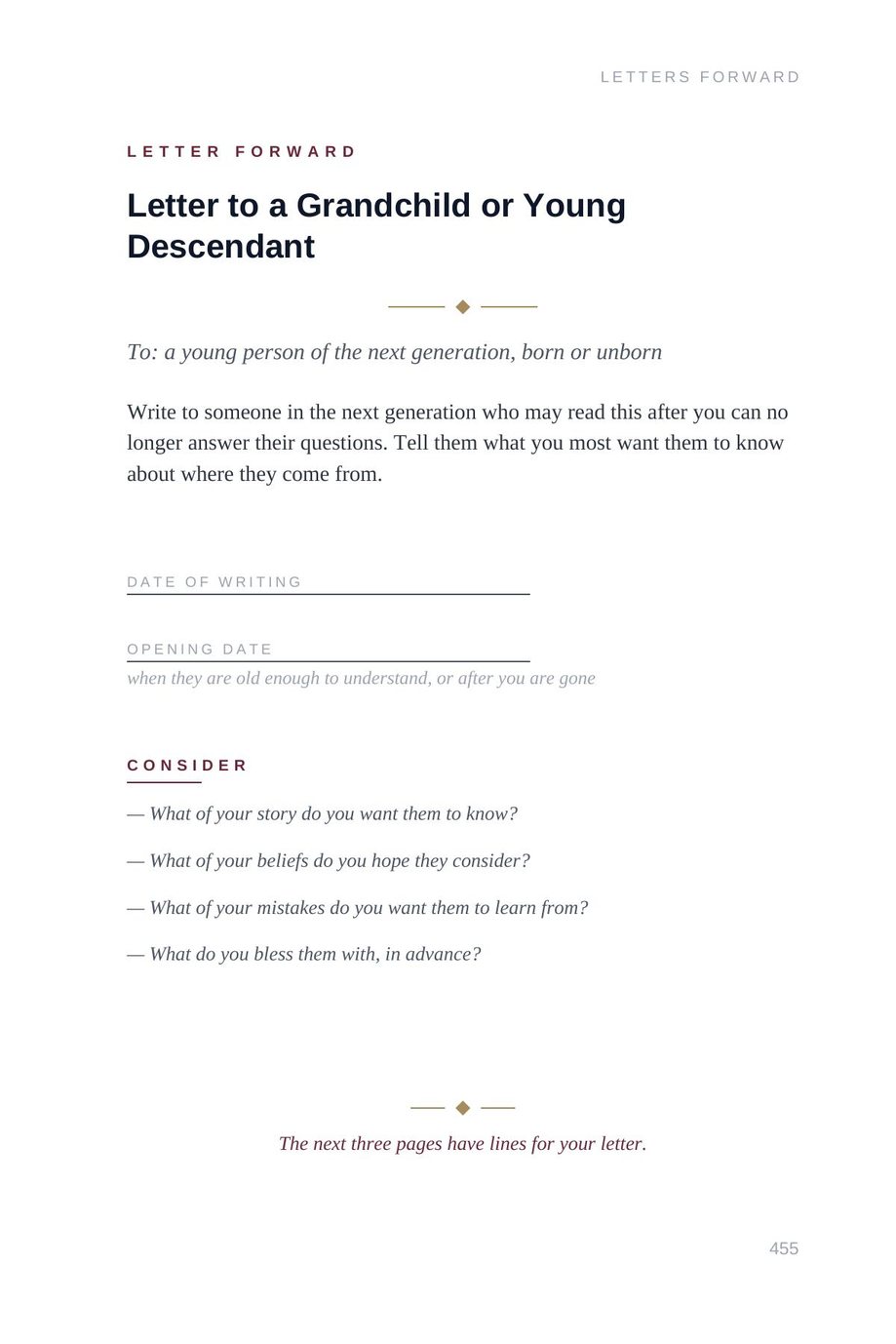
A letter like this has a delivery problem measured in decades, and loose paper loses that bet. The version engineered to arrive: a dedicated Letter to a Grandchild or Young Descendant, with a writing date and an opening date, sealed by instruction, inside a hardcover whose whole design brief is being inherited, alongside the scored life and the recorded events that give the letter its context. It sits in a series, future self, partner, child, whoever reads this after you, ending in a Final Letter, and together they are the letters that wait. Leaving a legacy was never mostly about money.
Lifetime Blueprint
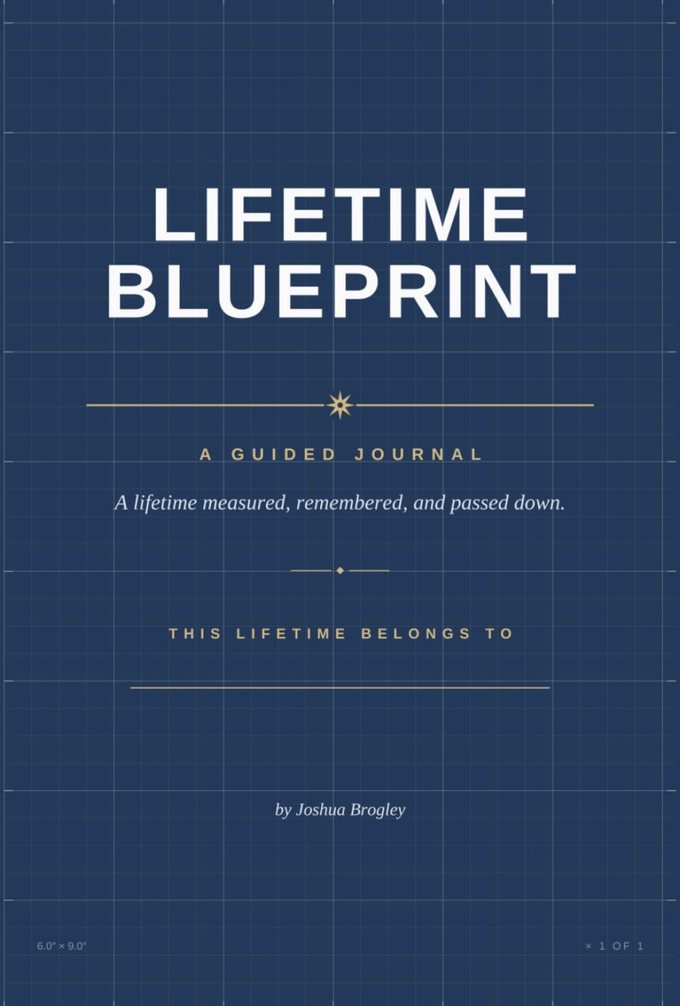
The hardcover built to be inherited: eight life domains scored across decades, thirty life-event templates, and letters written forward, ending in a Final Letter.
What should I write to my future grandchildren?
The ordinary: your Tuesdays, prices, worries, kitchens, work, jokes, in your actual voice, dated with your age and season of life. Skip the advice; the texture of your era is the one thing they cannot get elsewhere.
Why write letters to people who do not exist yet?
Because the questions they will have, where do I come from, who were these people, can only be answered now. The letter waits decades; the ability to write it does not.
More on Lifetime Blueprint
- Your Twenties: The Decade of Compounding Choices
- Your Thirties: The Building Decade, When Time Starts to Feel Finite
- Your Forties Are a Recalibration, Not a Crisis
- Your Fifties: The Distillation Decade, Subtraction Over Addition
- Why Most People Will Never Write Their Life Down
The method behind every book
- Which 365-Day Book Should I Start With? A One-Minute Guide
- What Is a No Zero Day? The Rule That Saves a Bad Week
- What Is a Realistic Morning Routine? Two Minutes, Not Two Hours
All articles about Lifetime Blueprint → · The book page → · All the books →
written by the author, at the kitchen table, after work.