Home / Blog / Lifetime Blueprint
LIFETIME BLUEPRINT
One Book Your Family Keeps: The Case for Writing to Be Inherited
Part of the series Why Most People Will Never Write Their Life Down
Most journals are written for the writer, get finished, and get cleared out. This one is built to be inherited: hardback cover, cream pages made for ink rather than typing, sized to be carried across many years and held by many readers, meant to survive the person who first writes in it. The reader after you is part of why the pages exist: the child who discovers it in a drawer thirty years on, the grandchild who reads it after the funeral, the friend given it in an envelope sealed with their name. Write accordingly.
Why a family has never had this before
Photographs survive; the reasons behind them do not. Almost every family carries a box of faces nobody can name and a set of stories reduced to one sentence each, because the people who could have written the long version never had a place built to hold it. Diaries are private, planners are disposable, and social media is owned by someone else and written for an audience. A single physical volume with the scored decades, the recorded events and the letters forward is a category that has not really existed at household scale. The book's whole design brief is to be that volume, and to still be readable when the writer is a name on a stone.
Not for show, but for record
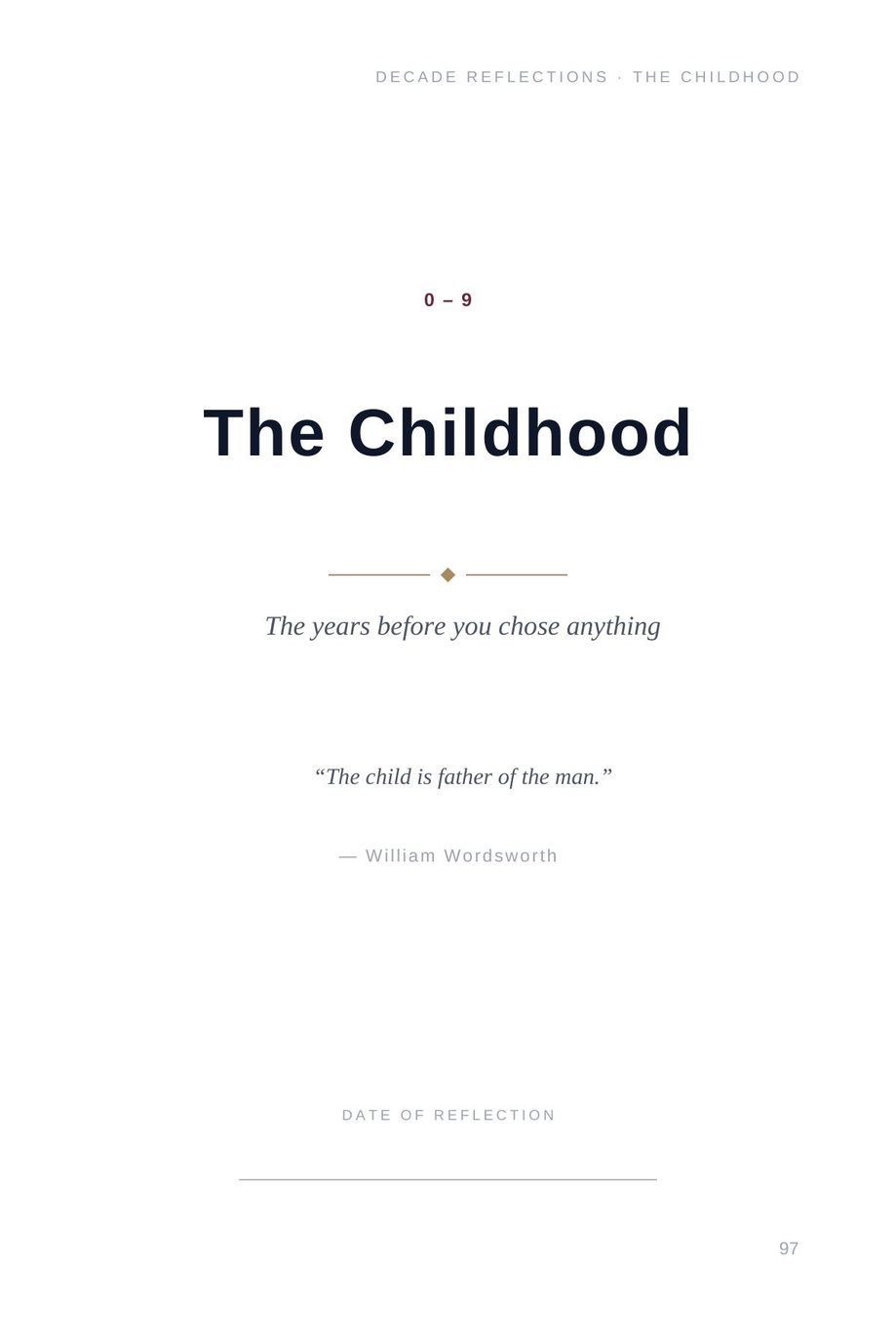
The instruction that matters most is written on the page about the book itself: write not for the page but for the person who has not yet opened it, not for show but for record, because the honest entries will be worth more to whoever inherits them than the impressive ones. This changes the writing in a specific way. The impressive version of your thirties will be skipped by a grandchild in one paragraph; the honest version, what it cost, what you did not know, the Tuesday texture, is what they will read twice. Inheritance is the strongest argument for honesty the book has, stronger than self-improvement, because you cannot fool a reader who was not born yet.
What to do with the finished book
When the book has been carried across enough years to feel weathered, when the early entries are someone you no longer fully are, decide what it becomes next, and the book gives four instructions. Keep it where you can find it: on a shelf near the books you most return to, not a box in the basement. Tell one person where it is, as inheritance planning rather than morbid logistics, because books that are not known about get cleared out, not opened. Inscribe the inside cover to whoever finds it: who you were, what you hoped, what you ask of them. And choose its next reader, at any chosen moment: some give it to a child at thirty, some to a grandchild at graduation, some leave it on the shelf and trust the right person to find it.
The book's second job
Write the book. Then let the book do its second job, which is the one the writer never sees. The letters forward are the sharpest expression of this, especially the one to a grandchild who does not yet exist and the Final Letter to the people most loved, but the whole volume is a letter forward in slower form: a scored life, handed on. Writing for descendants covers what survives fifty years; leaving a legacy makes the case that this is what legacy mostly is; who this is for includes the reader who came for exactly this and nothing else.
Lifetime Blueprint
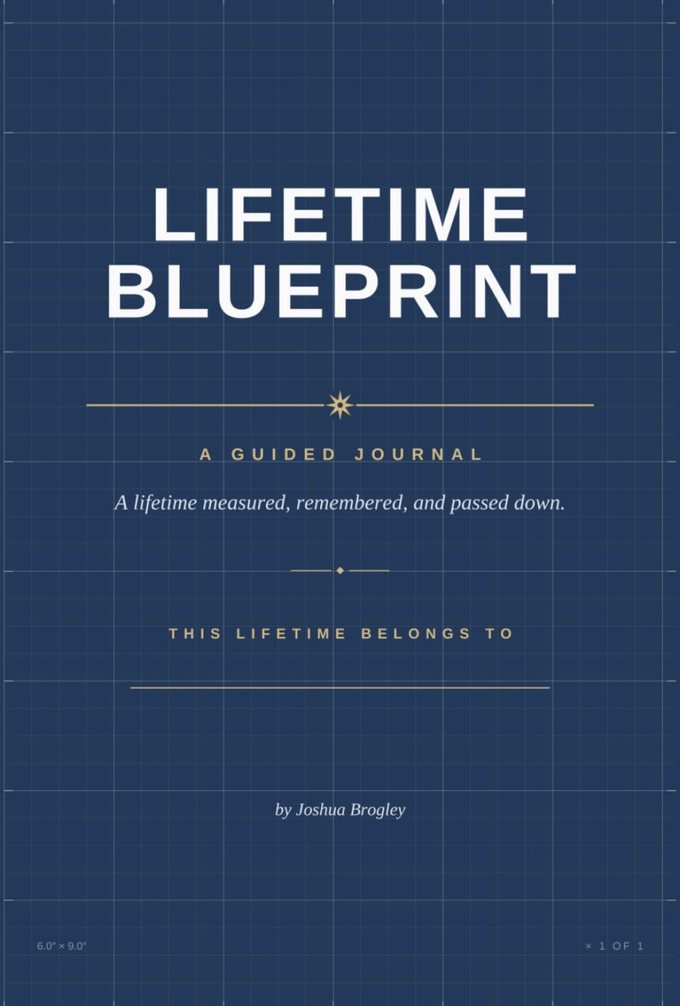
The hardcover built to be inherited: eight life domains scored across decades, thirty life-event templates, and letters written forward, ending in a Final Letter.
What is a journal meant to be passed down called?
A lifetime or legacy journal: a single hardcover volume of scored life domains, recorded decades and events, and letters written forward, built to be kept and read by the family after the writer.
What should I do with a finished lifetime journal?
Keep it findable on a shelf, tell one person where it is, inscribe the inside cover to whoever finds it, and choose its next reader, at your death or at any chosen moment, such as a child turning thirty.
More on Lifetime Blueprint
- Your Twenties: The Decade of Compounding Choices
- Your Thirties: The Building Decade, When Time Starts to Feel Finite
- Your Forties Are a Recalibration, Not a Crisis
- Your Fifties: The Distillation Decade, Subtraction Over Addition
- Why Most People Will Never Write Their Life Down
The method behind every book
- Which 365-Day Book Should I Start With? A One-Minute Guide
- What Is a No Zero Day? The Rule That Saves a Bad Week
- What Is a Realistic Morning Routine? Two Minutes, Not Two Hours
All articles about Lifetime Blueprint → · The book page → · All the books →
written by the author, at the kitchen table, after work.