Home / Blog / Lifetime Blueprint
LIFETIME BLUEPRINT
What Is Drift? Why Most Lives End Up Somewhere Nobody Chose
Part of the series Why Most People Will Never Write Their Life Down
Most lives drift. Not because of a single wrong turn, which is rarer than we admit, but because of a thousand small unmade decisions, each defensible on its own, which together compound into a life the person living it would not have chosen if it had been offered to them whole. Drift is not a moral failure. It is the default state of an unmeasured life: a river does not choose its course, gravity and resistance choose it, and a human without an instrument is in exactly the same position.
Why drift is invisible while it happens
No single day of drift looks like anything. The job kept because leaving was inconvenient, the friendship allowed to lapse, the health let slide by one percent a year, the decision postponed to a calmer month that never came: each one is reasonable, and reasonable things do not trigger alarms. You only notice drift later, when you look up and the years have done their work and the person in the mirror is not the person you meant to become. Most people make that discovery in their forties. Some earlier. A few never do, which may be the worst of the three outcomes.
The drift question is not the resolution question
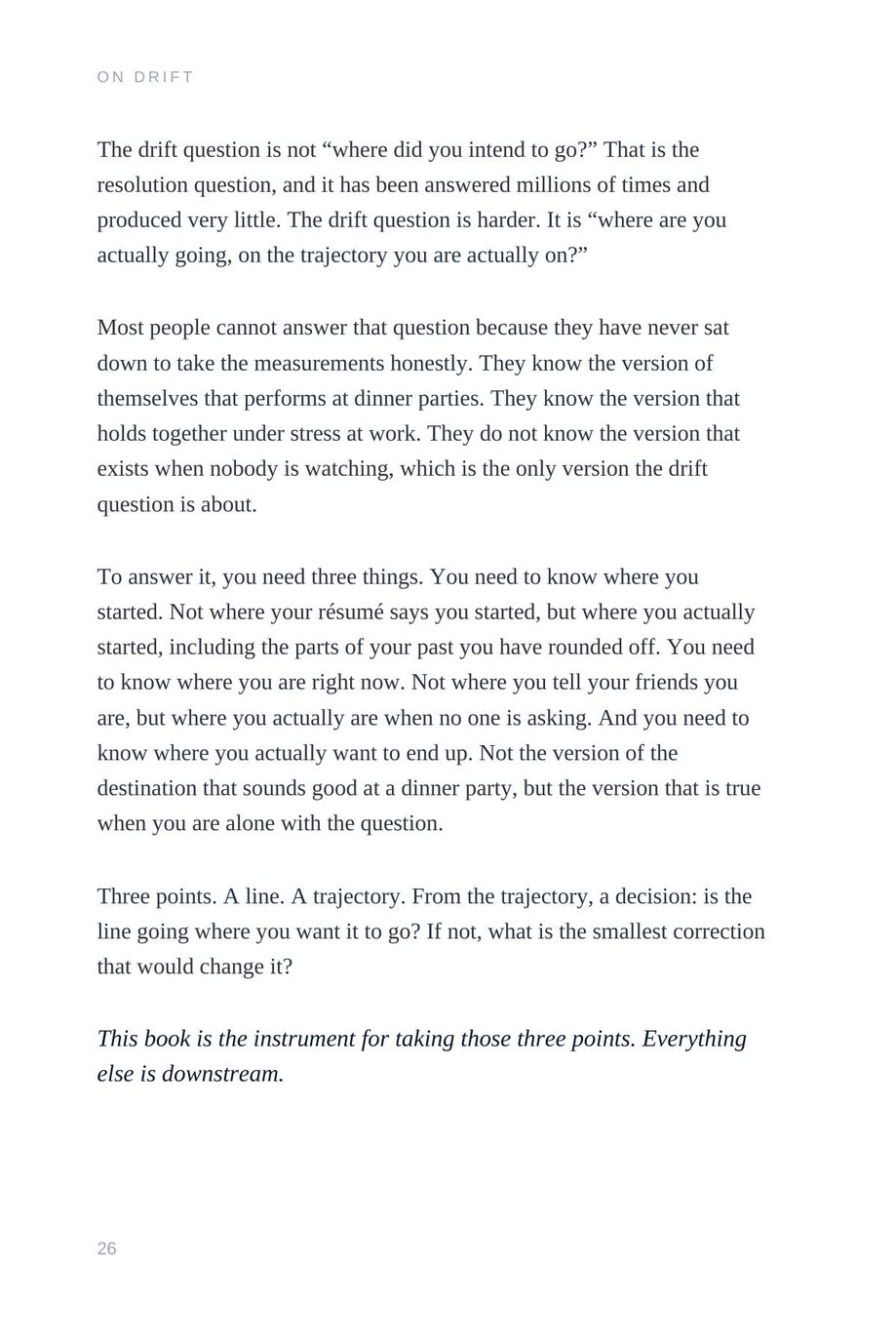
The resolution question is where did you intend to go, and it has been answered millions of times every January to very little effect. The drift question is harder and rarely asked: where are you actually going, on the trajectory you are actually on? Most people cannot answer it, because they know the version of themselves that performs at dinner parties and the version that holds together at work, and they do not know the version that exists when nobody is watching, which is the only version the drift question is about.
Three points, a line, a decision
Answering it requires three honest measurements. Where you started: not where the resume says, but where you actually started, including the parts you have rounded off. Where you are right now: not where you tell friends, but where you actually are when no one is asking. And where you actually want to end up: not the destination that sounds good out loud, but the one that is true when you are alone with the question. Three points make a line. The line is a trajectory. From the trajectory, one decision: is it going where you want, and if not, what is the smallest correction that would change it? That is the entire logic of the Origin Snapshot, past, present and ideal, scored across eight domains in one sitting.
Small corrections, taken early, are the whole game
The reason to measure at thirty-five rather than discover at fifty is arithmetic: a trajectory caught early needs a correction of a degree or two, and the same trajectory caught fifteen years later needs a reversal. Drift is cheap to fix and expensive to ignore, and the only difference between the two prices is whether an instrument existed. The book is that instrument, and everything else in it, the decades, the events, the letters, is downstream of these three points. Why most people never take the measurement is the uncomfortable companion to this post; measuring growth is what the line becomes over years.
Lifetime Blueprint
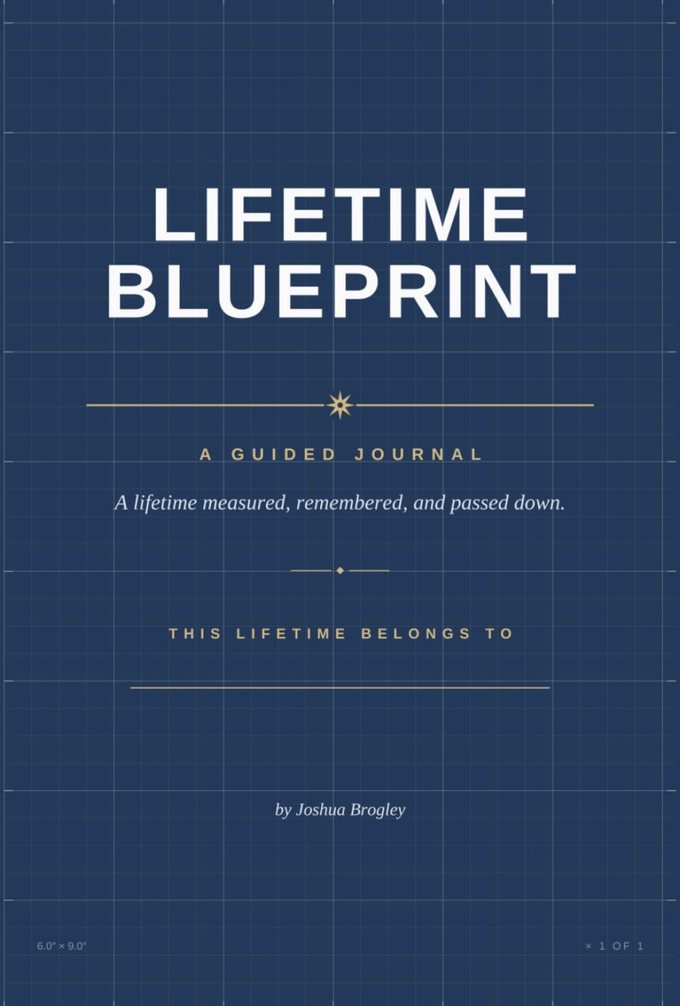
The hardcover built to be inherited: eight life domains scored across decades, thirty life-event templates, and letters written forward, ending in a Final Letter.
What does it mean to drift in life?
To end up somewhere you did not choose through a thousand small unmade decisions rather than one wrong turn. Drift is the default state of an unmeasured life and is invisible while it happens; it is usually noticed in the forties.
How do you stop drifting through life?
Take three honest measurements, where you started, where you actually are, and where you actually want to go, and read the line they make. Then make the smallest correction that changes it, early, while the correction is still a degree rather than a reversal.
More on Lifetime Blueprint
- Your Twenties: The Decade of Compounding Choices
- Your Thirties: The Building Decade, When Time Starts to Feel Finite
- Your Forties Are a Recalibration, Not a Crisis
- Your Fifties: The Distillation Decade, Subtraction Over Addition
- Why Most People Will Never Write Their Life Down
The method behind every book
- Which 365-Day Book Should I Start With? A One-Minute Guide
- What Is a No Zero Day? The Rule That Saves a Bad Week
- What Is a Realistic Morning Routine? Two Minutes, Not Two Hours
All articles about Lifetime Blueprint → · The book page → · All the books →
written by the author, at the kitchen table, after work.