Home / Blog / Lifetime Blueprint
LIFETIME BLUEPRINT
What Actually Changes When You Score Your Life Honestly
Part of the series Why Most People Will Never Write Their Life Down
Score eight domains of your life honestly, twice, present and ideal, and put the two rows side by side. What changes is not motivation, which is a chemical and fades by Thursday. Three structural things change. The gap stops being dread and becomes a finite list. The priority order corrects itself, usually away from the loudest domain toward the one that has been quietly decaying. And the next decade acquires a plan with dates, because the difference between two rows of numbers is, in the book's phrase, what the rest of your life is for.
The gap becomes finite
Before scoring, the distance between your life and the life you meant to have is a fog, and fog cannot be worked on; it can only be felt, at 2 a.m., in a general way. After scoring, it is eight specific distances, each with a number on it: Health is a 4 and wants to be an 8, Money is a 6 and wants a 7, Faith is a 2 and the honest ideal is a 6. Several gaps turn out to be smaller than the dread suggested. One or two turn out to be larger, and those were the ones the fog was hiding. Either way, finite things can be planned. That conversion is the first and largest impact, and it happens in the sitting itself.
The priority order corrects
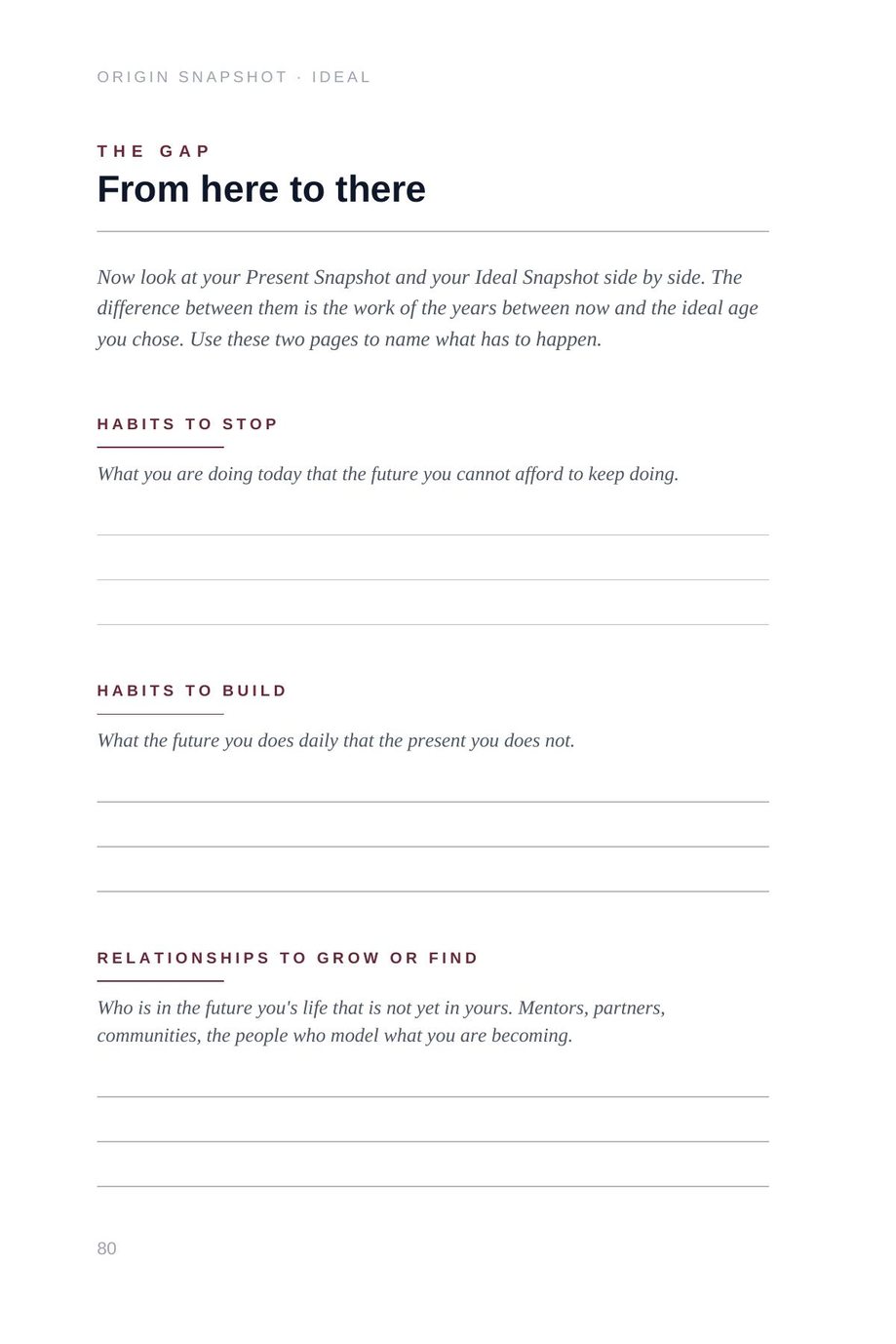
The area that feels most broken is usually just the loudest, and honest scores routinely reorder the list: the reader who came in to fix work discovers Relationships is a 3 and has been for six years, or that Health is taxing every other domain because it is the substrate they all run on. The two pages that follow the snapshot do this work explicitly: habits to stop, what the future you cannot afford to keep doing; habits to build, what the future you does daily that the present you does not; relationships to grow or find, who is in the future you's life that is not yet in yours. Which area to fix first is the triage logic in full.
The next decade gets dates
Vague ambition has no calendar. A named gap does: the ideal was scored at a chosen age, so the years between now and then are the budget, and the habits to build become the first thirty days of something, and the relationships to find become names. The people inventory sits beside this on purpose, three specific actions in six months, dated when done, so that the plan touches other humans and not only the self. Readers report this is where the book stops feeling like reflection and starts feeling like operations, which is the point of measuring anything.
What does not change, honestly
Nothing about scoring makes the work easier; it makes it visible. A 4 in Health does not become a 6 because it was written down, and the book is not a motivational device and never claims to be. What the honest score does is remove the two most expensive things a person carries: not knowing, and knowing vaguely. Everything after that is ordinary effort, applied in the right place, checked against the number five years on. The Origin Snapshot is where the two rows come from; the Feynman rule is what keeps them honest; who this is for is who came away with the plan.
Lifetime Blueprint
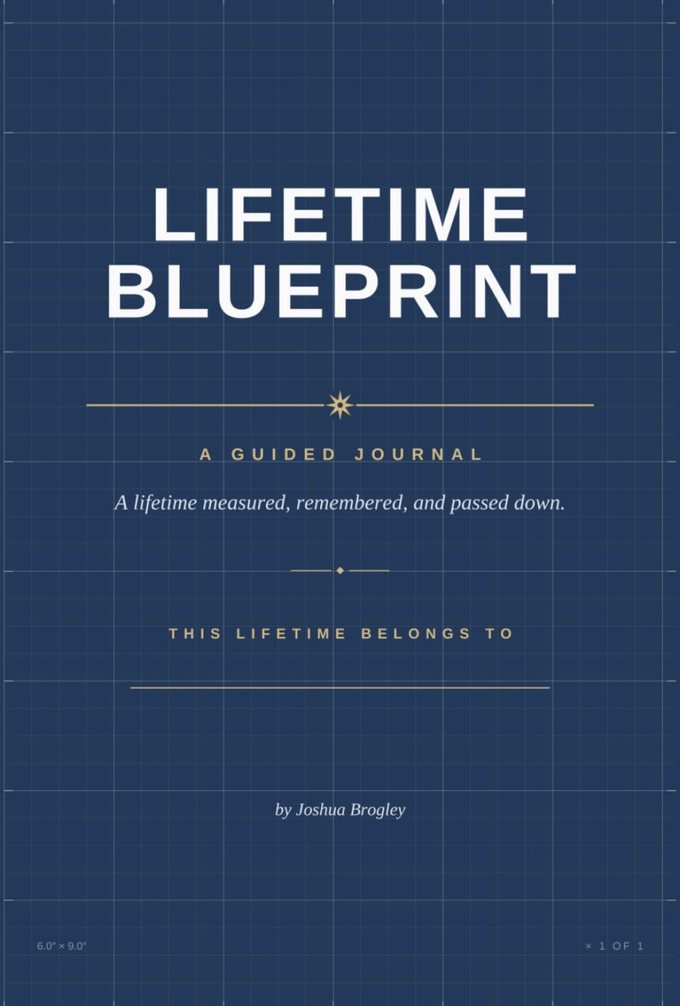
The hardcover built to be inherited: eight life domains scored across decades, thirty life-event templates, and letters written forward, ending in a Final Letter.
What are the benefits of scoring your life?
Three structural ones: the gap between your life and the one you want becomes a finite list instead of dread, the priority order corrects toward the domain that actually needs work, and the next decade gets a plan with dates. Motivation is not one of them and does not need to be.
Does journaling actually change your life?
A daily journal processes; a scored life record measures. Measurement does not make the work easier, it makes it visible and puts it in the right place, which is what changes outcomes over a decade.
More on Lifetime Blueprint
- Your Twenties: The Decade of Compounding Choices
- Your Thirties: The Building Decade, When Time Starts to Feel Finite
- Your Forties Are a Recalibration, Not a Crisis
- Your Fifties: The Distillation Decade, Subtraction Over Addition
- Why Most People Will Never Write Their Life Down
The method behind every book
- Which 365-Day Book Should I Start With? A One-Minute Guide
- What Is a No Zero Day? The Rule That Saves a Bad Week
- What Is a Realistic Morning Routine? Two Minutes, Not Two Hours
All articles about Lifetime Blueprint → · The book page → · All the books →
written by the author, at the kitchen table, after work.