Home / Blog / Lifetime Blueprint
LIFETIME BLUEPRINT
How to Reflect on Your Life by Decade: The Complete Method
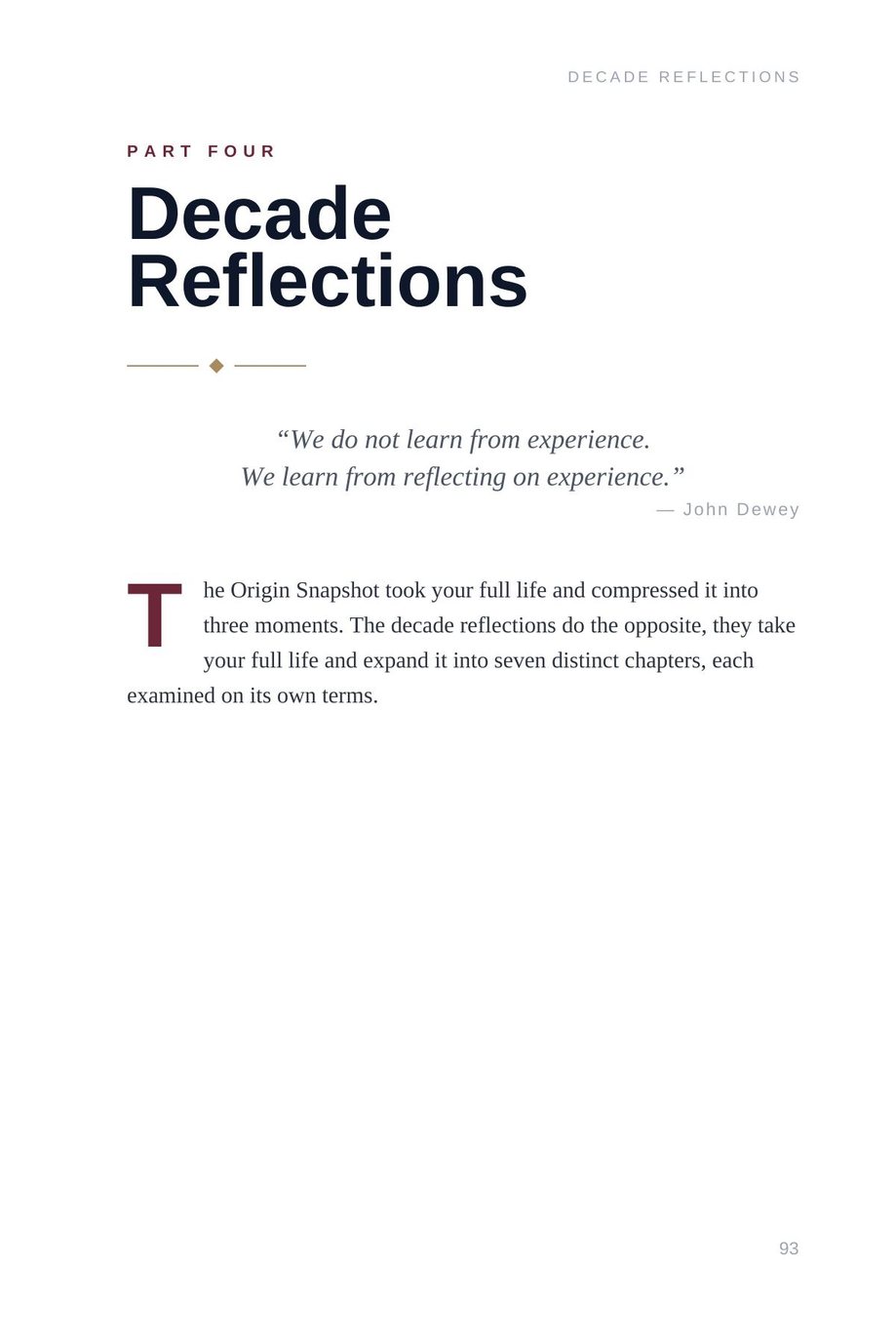
The Origin Snapshot compresses a whole life into three moments. Decade reflections do the opposite: they expand the life into seven distinct chapters, Childhood, Adolescence, the Twenties, Thirties, Forties, Fifties, and the Sixties and After, each examined on its own terms. Every chapter carries the same equipment: a quote and an essay on what the decade is for, a page on what to focus on and what obstacles to expect, a page on what is coming next and how to thrive, prompts, a decade log dating every sitting, a page for indexing photographs, a page for stories worth keeping, and the decade score, written as a pair.
Two scores per decade, never one
A decade scored with a single number lies, because the number cannot say whether the ten years were a slow climb or a slow fall. The method asks for two. During: the decade broken into phases, each phase scored in a domain and weighted by how many years it lasted, then averaged. At the End: the band the decade closed in, which is where you crossed into the next one. A 5 During and a 7 At the End is a hard decade closed strong, a recovery earned; a 7 During and a 5 At the End is a steady decade that ended in decline. Same average, opposite lives. The worked examples show the arithmetic on real shapes.
Backfill the decades lived; live the one you are in; the rest wait
For the decades already passed, the work is recovery: what actually happened, separated from the story you have been telling about it, written in dated layers across many sittings and logged. For the decade you are inside, the chapter turns into an instrument: the focus list, the obstacles, the tips, read at the start and re-read at the midpoint, and the prompts answered while the choices are still being made. For the decades ahead, the pages simply wait; some readers read the next chapter early, the way you might read the guidebook for a country before the flight. Backfilling covers the order and the traps; reflecting on a decade already lived covers hindsight's distortions.
What each decade is for, in the book's framing
Childhood, the decade you did not author, where the inheritance has to be separated from the interpretation. Adolescence, the years of becoming yourself, where decisions felt weightless and were not. The Twenties, the years of compounding choices, which feel slower than they are. The Thirties, the building decade, where time first becomes finite as a felt sense. The Forties, the recalibration, which the cliché calls a crisis and rarely is. The Fifties, the distillation, subtraction rather than addition. The Sixties and After, the legacy decades, written in flashes rather than long sittings. Each has a post: Childhood, Adolescence, Twenties, Thirties, Forties, Fifties, Sixties and After.
Why this needs a permanent home
Decade reflection is not a habit; it is an audit run a handful of times in a life, and its value comes from comparison: the reflection at forty read beside the one from thirty, the childhood written at thirty-five and revised at fifty-eight, the logs showing which decade got written when. None of that survives in a notebook that will be gone by the next decade. The seven chapters, with the logs, the photo index and the story pages, sit at the center of a certain hardcover built to be scored in for the rest of a life and read after it, and the same book asks, at every five-year snapshot, whether the line the decades draw is going where you want. Planning by decades is the forward-looking companion; the cadence explains why once a decade is not too rarely.
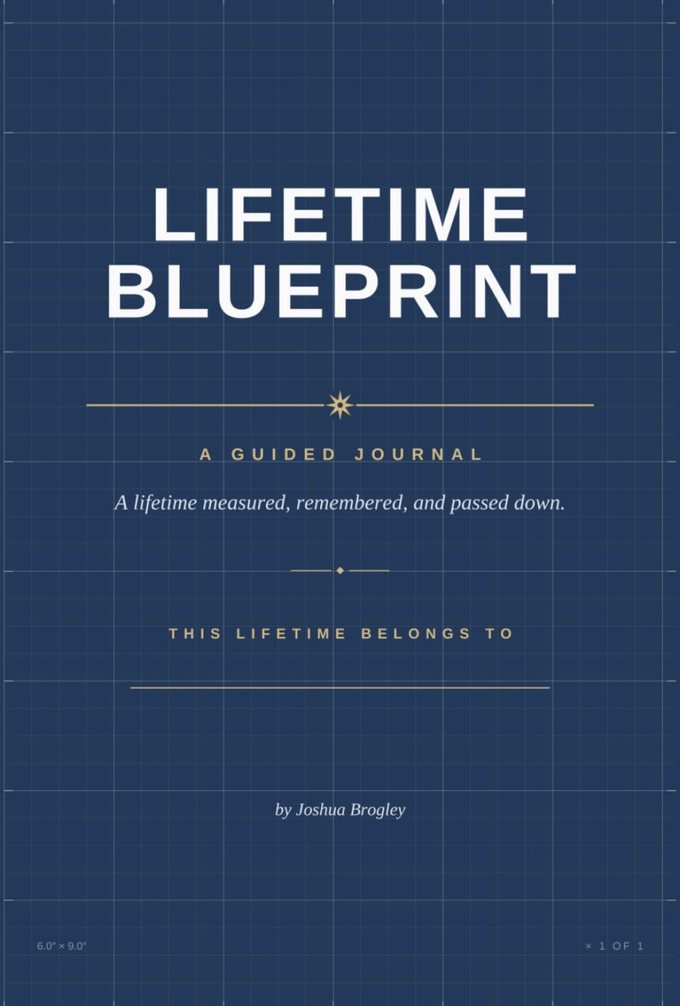
Lifetime Blueprint
The hardcover built to be inherited: eight life domains scored across decades, thirty life-event templates, and letters written forward, ending in a Final Letter.
How do you reflect on each decade of your life?
One chapter per decade: what it was for, what to focus on, what to expect, prompts, a log of every sitting, and two scores, During, weighted by phases, and At the End, the band the decade closed in. The pair tells a story a single number cannot.
What are the stages of life by decade?
In this method: Childhood, the unauthored decade; Adolescence, becoming yourself; the Twenties, compounding choices; the Thirties, building; the Forties, recalibration; the Fifties, distillation; and the Sixties and After, legacy.
More on Lifetime Blueprint
- Your Twenties: The Decade of Compounding Choices
- Your Thirties: The Building Decade, When Time Starts to Feel Finite
- Your Forties Are a Recalibration, Not a Crisis
- Your Fifties: The Distillation Decade, Subtraction Over Addition
- Why Most People Will Never Write Their Life Down
The method behind every book
- Which 365-Day Book Should I Start With? A One-Minute Guide
- What Is a No Zero Day? The Rule That Saves a Bad Week
- What Is a Realistic Morning Routine? Two Minutes, Not Two Hours
All articles about Lifetime Blueprint → · The book page → · All the books →
written by the author, at the kitchen table, after work.