Home / Blog / Lifetime Blueprint
LIFETIME BLUEPRINT
How to Write About Leaving a Job That Defined a Decade
Part of the series The Six Kinds of Life Events Worth Writing Down
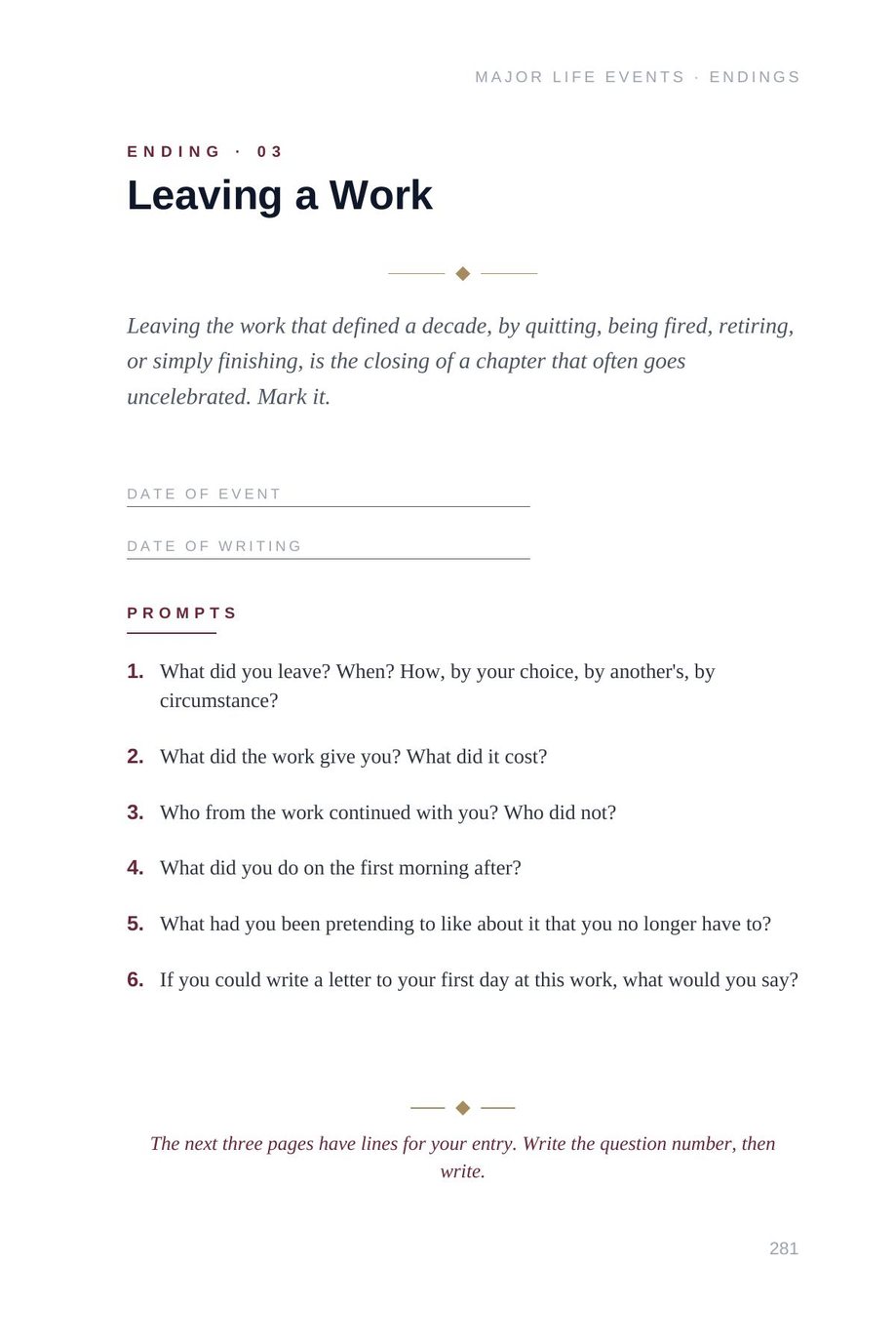
Leaving the work that defined a decade, by quitting, being fired, retiring, or simply finishing, is the closing of a chapter that often carried more identity than anyone admitted, including the person leaving. The last day gets a card and a lunch. The decade gets nothing, unless it is written, and it deserves a real entry: what the work was, what it made of you, what it cost, how it ended, and who you are on the first Monday you do not go.
Name what the work was, and what it made of you
Before writing the leaving, write the work: what you actually did, who you did it with, what you were good at by the end that you were bad at at the start, what it built in you that will outlast the job. People skip this because it feels like a resume, and a resume is exactly what it is not: a resume records positions, and this records the person the positions produced. A decade of work changes a character, and the entry is the only place that change gets acknowledged.
Write the manner of the ending honestly
Fired, quit, retired, finished: four different endings, and the record should say which, without the cover story. A firing written as a resignation is a lie the future you will resent. A resignation written as heroism when it was exhaustion is another. The template asks for the fact of the ending and then the meaning, in that order, and the fact is short: what happened, when, what was said in the room. The meaning is written later, when the first Monday has become the tenth.
The first Monday
One paragraph on the first Monday you did not go, written that day. What you did instead. What it felt like at nine. Who you were without the title. Readers report this is the paragraph they reread most, because it is the only clean measurement of how much of their identity the work had been holding, taken before the new identity arrived to cover the gap.
Where the entry sits
Leaving a Work is the third Endings template, and it pairs with A Career Pivot in Movements when the leaving was a beginning, with The Decision That Changed the Decade when it was a turning, and with the Work domain score, which will show the decade as a pair of numbers, During and At the End. Endings is the category; the career pivot is the neighbor; scoring work is the measurement; the retirement version has its own audience. All of it in a certain hardcover with room for the tenth Monday.
Lifetime Blueprint
The hardcover built to be inherited: eight life domains scored across decades, thirty life-event templates, and letters written forward, ending in a Final Letter.
How do you process leaving a job you had for years?
Write the work before the leaving: what you did, who with, what it made of you. Then the manner of the ending honestly, the fact first and the meaning later, and one paragraph on the first Monday you did not go, written that day.
What should you write when you retire?
The decade, not the last day: what the work built in you, what it cost, how it ended, and who you are on the first Monday. The card covers the lunch; the entry covers the chapter.
More on Lifetime Blueprint
- Your Twenties: The Decade of Compounding Choices
- Your Thirties: The Building Decade, When Time Starts to Feel Finite
- Your Forties Are a Recalibration, Not a Crisis
- Your Fifties: The Distillation Decade, Subtraction Over Addition
- Why Most People Will Never Write Their Life Down
The method behind every book
- Which 365-Day Book Should I Start With? A One-Minute Guide
- What Is a No Zero Day? The Rule That Saves a Bad Week
- What Is a Realistic Morning Routine? Two Minutes, Not Two Hours
All articles about Lifetime Blueprint → · The book page → · All the books →
written by the author, at the kitchen table, after work.