Home / Blog / Lifetime Blueprint
LIFETIME BLUEPRINT
How to Write About Losing Someone You Loved
Part of the series The Six Kinds of Life Events Worth Writing Down
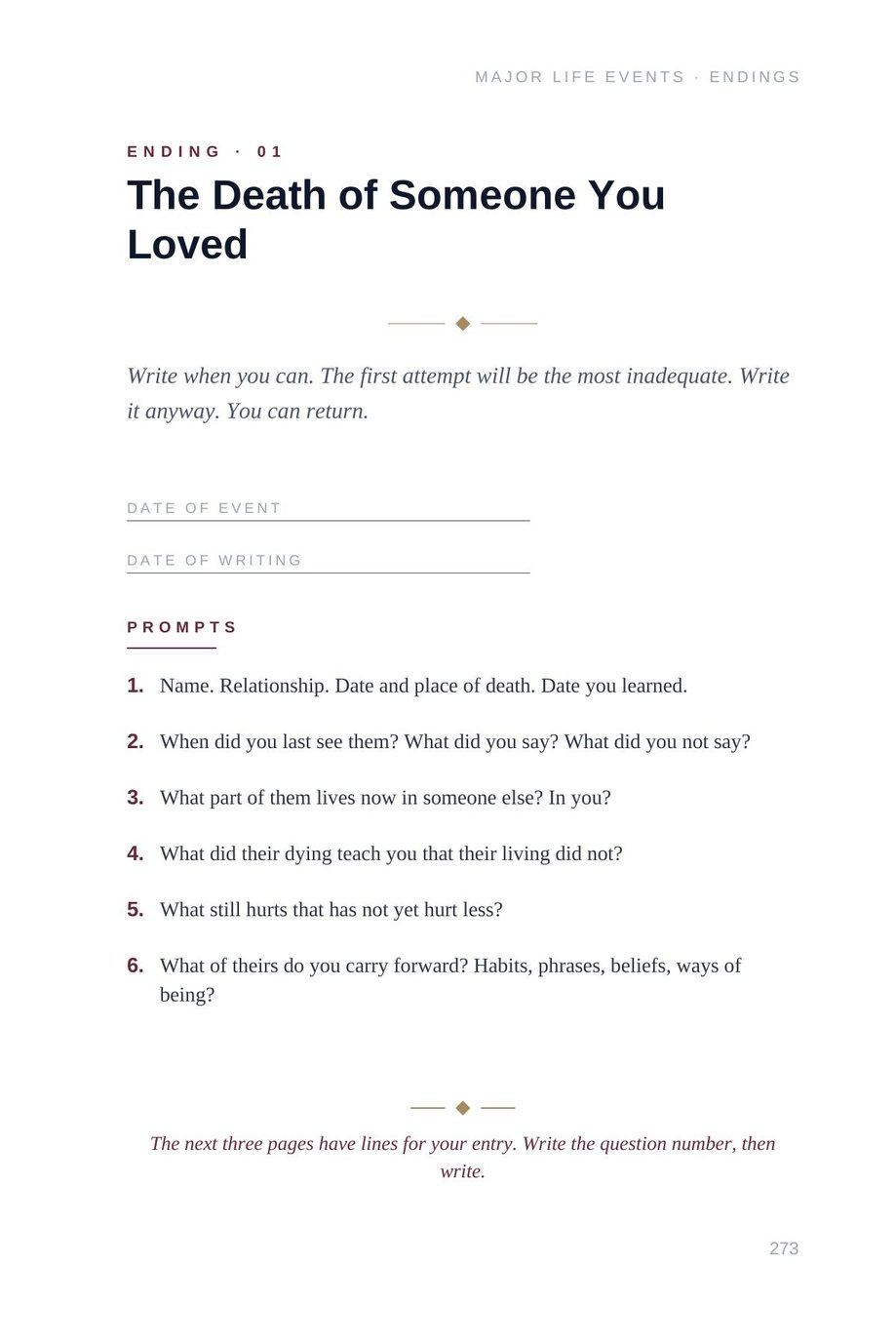
The instruction that actually helps, printed at the top of the best-designed grief template in existence: write when you can. The first attempt will be wrong. Both halves matter. There is no deadline, no correct week, and no version of this that comes out right the first time, because you are writing about something that is still moving. Wrong is not failure here. Wrong is the medium.
Facts first; feelings will not hold still
The first pass that works for most people is almost bureaucratic: who they were, the dates, what happened, the funeral, who stood where. It feels cold and it is load-bearing, because facts consent to being written while feelings are still weather. Griefs recorded as facts first give the later passes something to stand on. Griefs attempted as feelings first mostly produce a blank page and a closed notebook, and the person concludes wrongly that they cannot do this.
The return is the method
One session cannot write a loss, and is not supposed to. The design that works is a page built to be returned to: this year's attempt, dated. Next year's paragraph under it, dated, different, because you will be different. The entry stops being a verdict on the loss and becomes a record of you carrying it, which is the honest shape of grief anyway. This is the deep reason a lifetime book beats a notebook for the big events: the notebook gets finished and shelved, and the events that matter are never finished.
What the page is for, and what it is not
Writing metabolizes; it does not resolve, and it is not treatment. If the loss is fresh and functioning is genuinely hard, writing sits alongside people and, where needed, professional help, never instead of them, and a page that consistently makes things worse is a page to put down for a while without apology. What the written record uniquely does comes later: years on, when memory has sanded the details, the dated page holds what was true, the way they actually talked, the small things you swore you would not forget and would have. It keeps the person specific. Time makes everyone general.
Endings get a category, because they are load-bearing
In the taxonomy of a recorded life, loss is not filed under miscellany; Endings is one of the six kinds of event a life is actually made of, alongside its quieter sibling Healings, which gets written much later and is the entry people are most surprised to find they needed. Both have proper templates, with the merciful instruction at the top, in the same hardcover that holds the scored decades and the letters written forward. Recording the people still here is the companion practice, and it has a clock on it.
Lifetime Blueprint
The hardcover built to be inherited: eight life domains scored across decades, thirty life-event templates, and letters written forward, ending in a Final Letter.
How soon after a loss should I write about it?
When you can, which differs by years between people, and the first attempt will be wrong regardless of timing. Facts first, feelings later, and a dated page you return to beats any single session.
Does writing about grief actually help?
It metabolizes rather than resolves: it keeps the person specific against time's sanding, and gives the carrying a record. It works alongside people and professional support, not as a substitute, and a page that reliably makes things worse should be set down without guilt.
More on Lifetime Blueprint
- Your Twenties: The Decade of Compounding Choices
- Your Thirties: The Building Decade, When Time Starts to Feel Finite
- Your Forties Are a Recalibration, Not a Crisis
- Your Fifties: The Distillation Decade, Subtraction Over Addition
- Why Most People Will Never Write Their Life Down
The method behind every book
- Which 365-Day Book Should I Start With? A One-Minute Guide
- What Is a No Zero Day? The Rule That Saves a Bad Week
- What Is a Realistic Morning Routine? Two Minutes, Not Two Hours
All articles about Lifetime Blueprint → · The book page → · All the books →
written by the author, at the kitchen table, after work.