Home / Blog / Step The F*ck Up
STEP THE F*CK UP
How to Stop Blaming Others: Blame Is a Pacifier
Part of the series Month Five: 30 Days of Taking the Deed to Your Whole Life
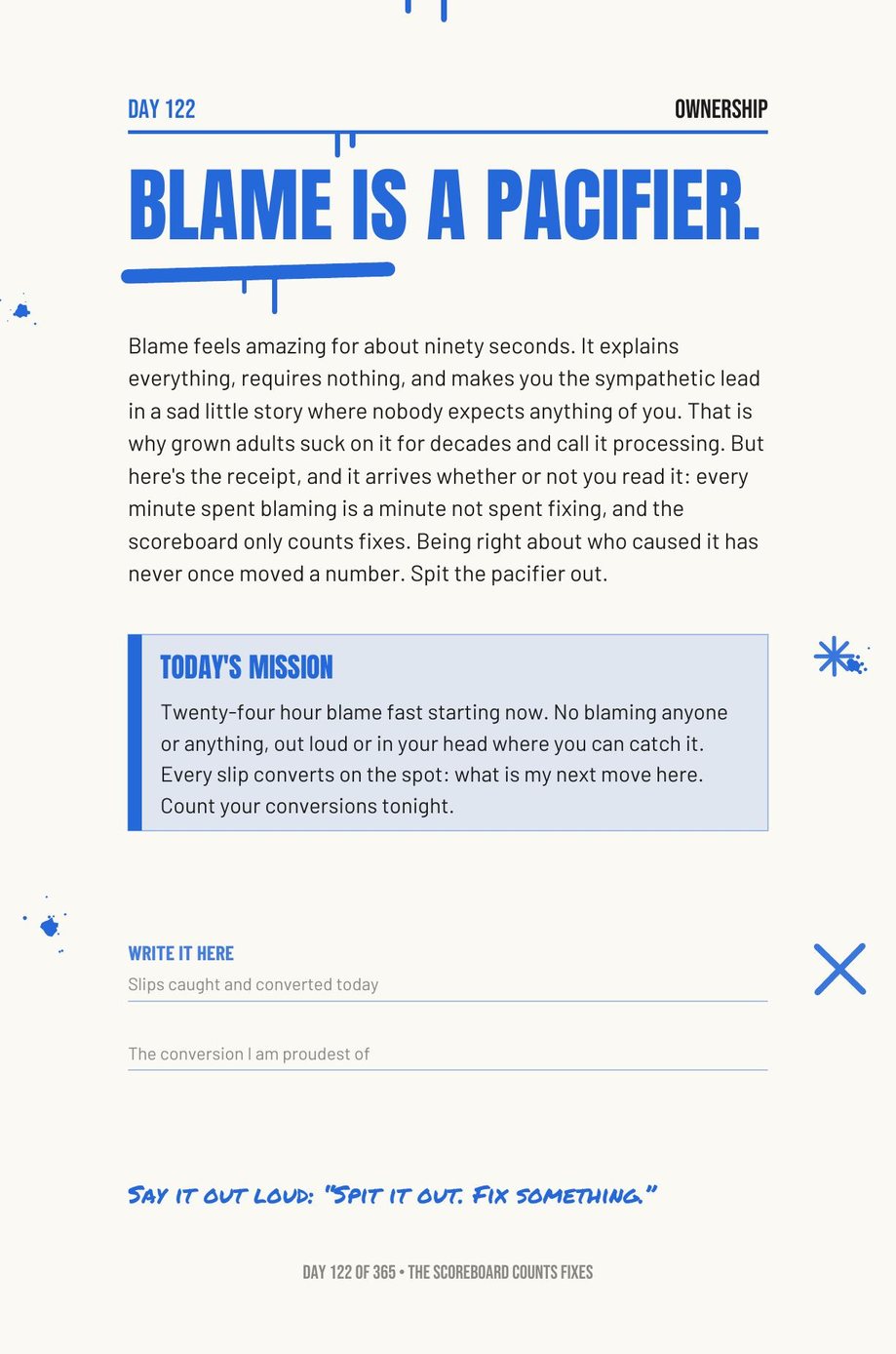
Blame feels amazing for about ninety seconds. It explains everything, requires nothing, and makes you the sympathetic lead in a sad little story where nobody expects anything of you. That, the book's Day 122 page says, is why grown adults suck on it for decades and call it processing. The receipt arrives whether or not you read it: every minute spent blaming is a minute not spent fixing, and the scoreboard only counts fixes. Being right about who caused it has never once moved a number.
Why blame is so hard to put down
Because it works, emotionally, instantly. Blame converts a problem into a story, and in the story you are the victim, and victims are not expected to act. The relief is real. The cost is deferred, which is why it never registers: the number that did not move today looks the same as yesterday's, and the decade of unmoved numbers arrives all at once, later, as a life. Blame is not a character flaw; it is a very good painkiller with a very bad side effect, and the side effect is that nothing changes.
The twenty-four-hour test
The mission is a complaint fast: twenty-four hours without blaming anyone or anything out loud, with a tally of every attempt. Most people are shocked by the count before lunch, because blame does not feel like blame from the inside; it feels like describing the situation accurately. The tally makes it audible. And the second half of the mission is the fix: every time the complaint is caught, one small action on the thing complained about, today. Blame and action cannot occupy the same minute, and the fast proves it.
Being right versus being somewhere
The book's cleanest line on the subject is from Day 121: you can spend a decade proving something was not your fault and be in exactly the same place at the end of it, correct and stuck. Nobody is asking you to be wrong about who caused it. The question is whether you would rather be right or be somewhere else, and the two have turned out to be mutually exclusive for most people most of the time. Ownership is choosing to be somewhere else.
Where this sits
Day 122, the second page of Month Five, Ownership, the first pacifier removed. Taking ownership of your life is the month's anchor post; nobody is coming is the next pacifier; they made me feel is blame in its most respectable grammar. A twenty-four-hour tally, in a certain book that only counts fixes.
Step The F*ck Up
365 days of no-bullsh*t motivation. One page, one mission, two minutes. Miss never twice.
How do you stop blaming other people for your problems?
Run a twenty-four-hour complaint fast with a tally of every attempt, and for each caught complaint take one small action on the thing today. Blame and action cannot occupy the same minute.
Why do people blame others?
Because blame is a painkiller: it explains everything, requires nothing, and casts you as the sympathetic lead who is not expected to act. The relief is instant and the cost is deferred into a decade of unmoved numbers.
More on Step The F*ck Up
- Your Eulogy Is Being Written Now, in Ordinary Hours
- Why You Self-Sabotage Right Before It Works
- Why Strength Is a Life Skill, Not Vanity
- Why Sleep Comes Before Everything: Sleep Is a Performance Drug
- Why Regret Hurts More Than Failure: The Compounding Problem
The method behind every book
- Which 365-Day Book Should I Start With? A One-Minute Guide
- What Is a No Zero Day? The Rule That Saves a Bad Week
- What Is a Realistic Morning Routine? Two Minutes, Not Two Hours
All articles about Step The F*ck Up → · The book page → · All the books →
written by the author, at the kitchen table, after work.