Home / Blog / Step The F*ck Up
STEP THE F*CK UP
I Had No Choice Is Always a Lie: Rewrite It as I Chose To, Because
Part of the series Month Five: 30 Days of Taking the Deed to Your Whole Life
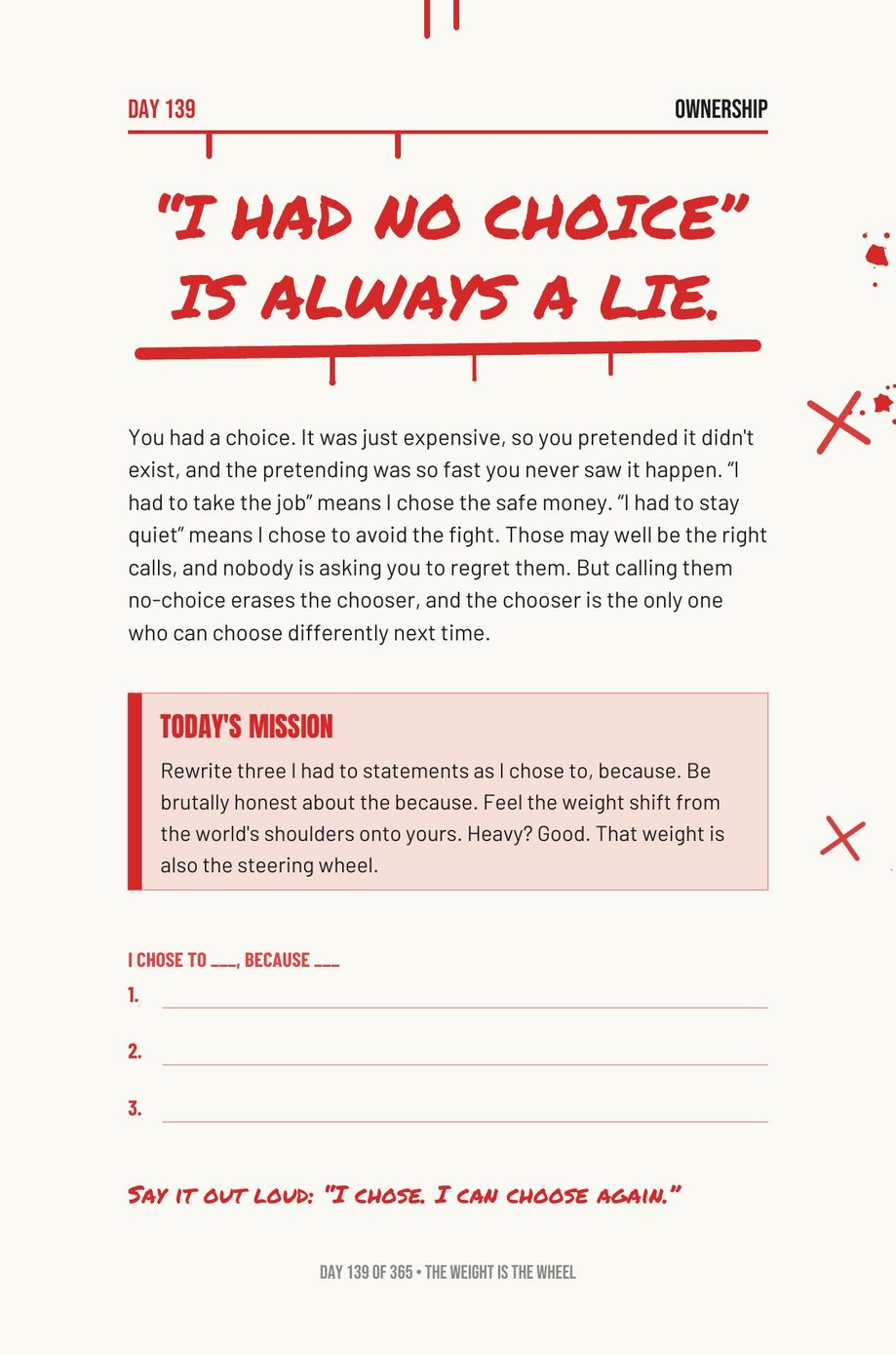
You had a choice. It was just expensive, so you pretended it did not exist, and the pretending was so fast you never saw it happen. That is the book's Day 139 argument, and it comes with translations: I had to take the job means I chose the safe money. I had to stay quiet means I chose to avoid the fight. Those may well have been the right calls, and nobody is asking you to regret them. But calling them no-choice erases the chooser, and the chooser is the only one who can choose differently next time.
Why the lie is so convincing
Because the alternative was genuinely costly. I had no choice is never said about easy decisions; it is said about the ones where the other option meant less money, more conflict, a worse month, disappointing someone. The cost was real. The claim that the cost made the choice disappear is the lie, and it is told mostly to yourself, because it is more comfortable to have been cornered than to have chosen the corner. Comfort is the tell. Every pacifier in this month is comfortable.
The rewrite
Three I had to statements, rewritten as I chose to, because. I had to stay in the job becomes I chose to stay in the job, because the mortgage and the kids and the fear of starting over. Read it back. It is true, and it is uncomfortable, and it does one thing the original could not: it puts a chooser in the sentence. Next time the same decision comes around, the chooser is there to make it, differently or the same, on purpose. The original sentence had nobody in it to consult.
What this does to the next decade
People who believe they had no choice do not plan for choices; they brace for events. People who know they chose, even badly, can see the next choice coming and prepare the option they could not afford last time: the savings, the skill, the conversation had early. The book's ownership month is about exactly this conversion, from a life that happens to you into a life you are demonstrably running, and this page is where the conversion reaches the past.
Where this sits
Day 139 of Month Five, Ownership, late in the month, when the obvious pacifiers are gone and the sophisticated one remains. The can't rewrite from Month One is the same principle applied to the future; this applies it to the past. Taking ownership is the method; bindings, in the slow book, is where the chosen costs get recorded for good. Three rewrites, in a certain book that keeps the chooser in the sentence.
Step The F*ck Up
365 days of no-bullsh*t motivation. One page, one mission, two minutes. Miss never twice.
Is it true that you always have a choice?
In the book's framing, yes, but the other option was usually expensive, and the expense made it feel invisible. I had to means I chose the cheaper option, and naming that keeps the chooser available for next time.
How do you take responsibility for past decisions?
Rewrite three I had to statements as I chose to, because. The rewrite does not require regret; it requires a subject in the sentence, so the next decision has someone present to make it.
More on Step The F*ck Up
- Your Eulogy Is Being Written Now, in Ordinary Hours
- Why You Self-Sabotage Right Before It Works
- Why Strength Is a Life Skill, Not Vanity
- Why Sleep Comes Before Everything: Sleep Is a Performance Drug
- Why Regret Hurts More Than Failure: The Compounding Problem
The method behind every book
- Which 365-Day Book Should I Start With? A One-Minute Guide
- What Is a No Zero Day? The Rule That Saves a Bad Week
- What Is a Realistic Morning Routine? Two Minutes, Not Two Hours
All articles about Step The F*ck Up → · The book page → · All the books →
written by the author, at the kitchen table, after work.