Home / Blog / Step The F*ck Up
STEP THE F*CK UP
Good Enough Is a Ceiling, and the Gap to Excellent Is Ten Minutes
Part of the series Month Eleven: 30 Days of Raising the Bar and Welding It in Place
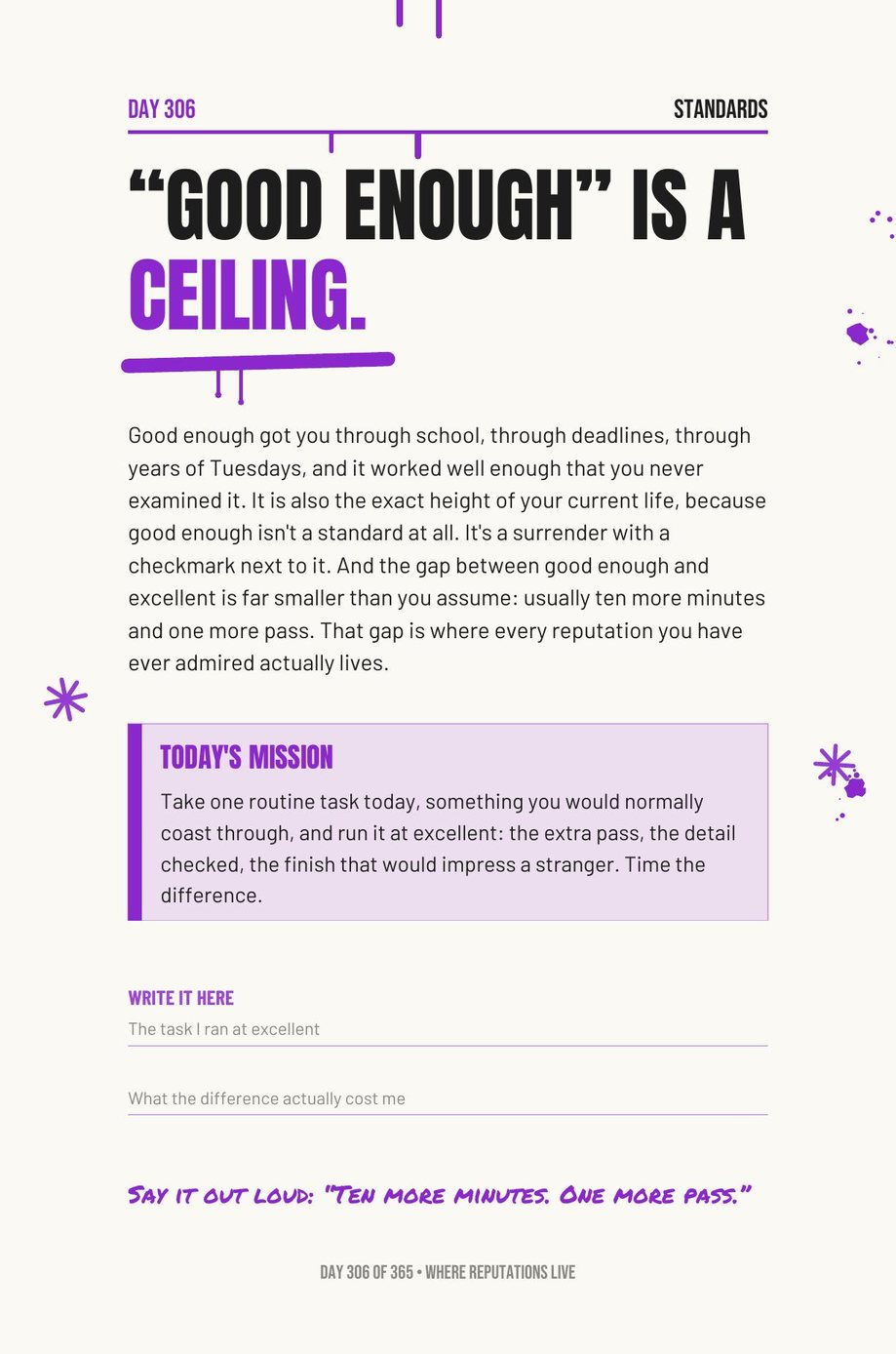
Good enough got you through school, through deadlines, through years of Tuesdays, and the book's Day 306 page says it worked well enough that you never examined it. It is also the exact height of your current life, because good enough is not a standard at all. It is a surrender with a checkmark next to it. And the gap between good enough and excellent is far smaller than you assume: usually ten more minutes and one more pass. That gap is where every reputation you have ever admired actually lives.
Why good enough is a ceiling and not a floor
A floor is the worst you will accept; a ceiling is the best you will attempt. Good enough sounds like a floor, a sensible minimum, and functions as a ceiling, because it is applied at the end of every task as the stopping condition: is this good enough? Yes. Stop. The person who stops at good enough on every task for twenty years has a life that is good enough on every axis, which is exactly what most people have and cannot explain, because at no point did they decide on mediocrity. They decided on a stopping rule, ten thousand times.
The ten minutes and the one more pass
The reframe that makes this actionable is the size of the gap. Excellence is not a different tier of talent. On most tasks it is the last ten percent of effort that almost nobody spends: the reread, the second draft, the extra set, the follow-up message, the detail checked, the thing finished rather than left at ninety. The mission is to take one task today from good enough to excellent with exactly that, ten more minutes and one more pass, and to notice that the ten minutes cost almost nothing and the result is the difference between forgettable and remembered.
Where the gap compounds
Ten minutes on one task is nothing. Ten minutes on every task, as a standard rather than a decision, is a different person within a year, because reputation is built entirely in the last ten percent and everyone else is stopping at ninety. The book's Day 317 page calls excellence quiet for this reason: it is not a performance, it is a stopping rule that was moved, once, in writing, and never renegotiated. That is what the month means by welding.
Where this sits
Day 306, the second page of Month Eleven, Standards, the first bar raised after the tolerance premise. Stopping the negotiation is how the new stopping rule holds; last year's best is the same move applied to peaks; raising your standards is the anchor; the Work rubric in the slow book is where the last ten percent becomes visible mastery. One task, ten more minutes, today, in a certain book that reads good enough as surrender.
Step The F*ck Up
365 days of no-bullsh*t motivation. One page, one mission, two minutes. Miss never twice.
Why is good enough not good enough?
Because it is a stopping rule applied to every task, which makes it a ceiling on the whole life rather than a minimum. Nobody decides on mediocrity; they decide on good enough ten thousand times.
How do you go from good to excellent?
On most tasks, ten more minutes and one more pass: the reread, the second draft, the extra set, the follow-up, the thing finished rather than left at ninety. Reputation lives entirely in that last ten percent.
More on Step The F*ck Up
- Your Eulogy Is Being Written Now, in Ordinary Hours
- Why You Self-Sabotage Right Before It Works
- Why Strength Is a Life Skill, Not Vanity
- Why Sleep Comes Before Everything: Sleep Is a Performance Drug
- Why Regret Hurts More Than Failure: The Compounding Problem
The method behind every book
- Which 365-Day Book Should I Start With? A One-Minute Guide
- What Is a No Zero Day? The Rule That Saves a Bad Week
- What Is a Realistic Morning Routine? Two Minutes, Not Two Hours
All articles about Step The F*ck Up → · The book page → · All the books →
written by the author, at the kitchen table, after work.