Home / Blog / Step The F*ck Up
STEP THE F*CK UP
How to Get Out of Debt: Debt Is a Bully, Punch First
Part of the series Month Nine: 30 Days of Putting the Numbers on the Table
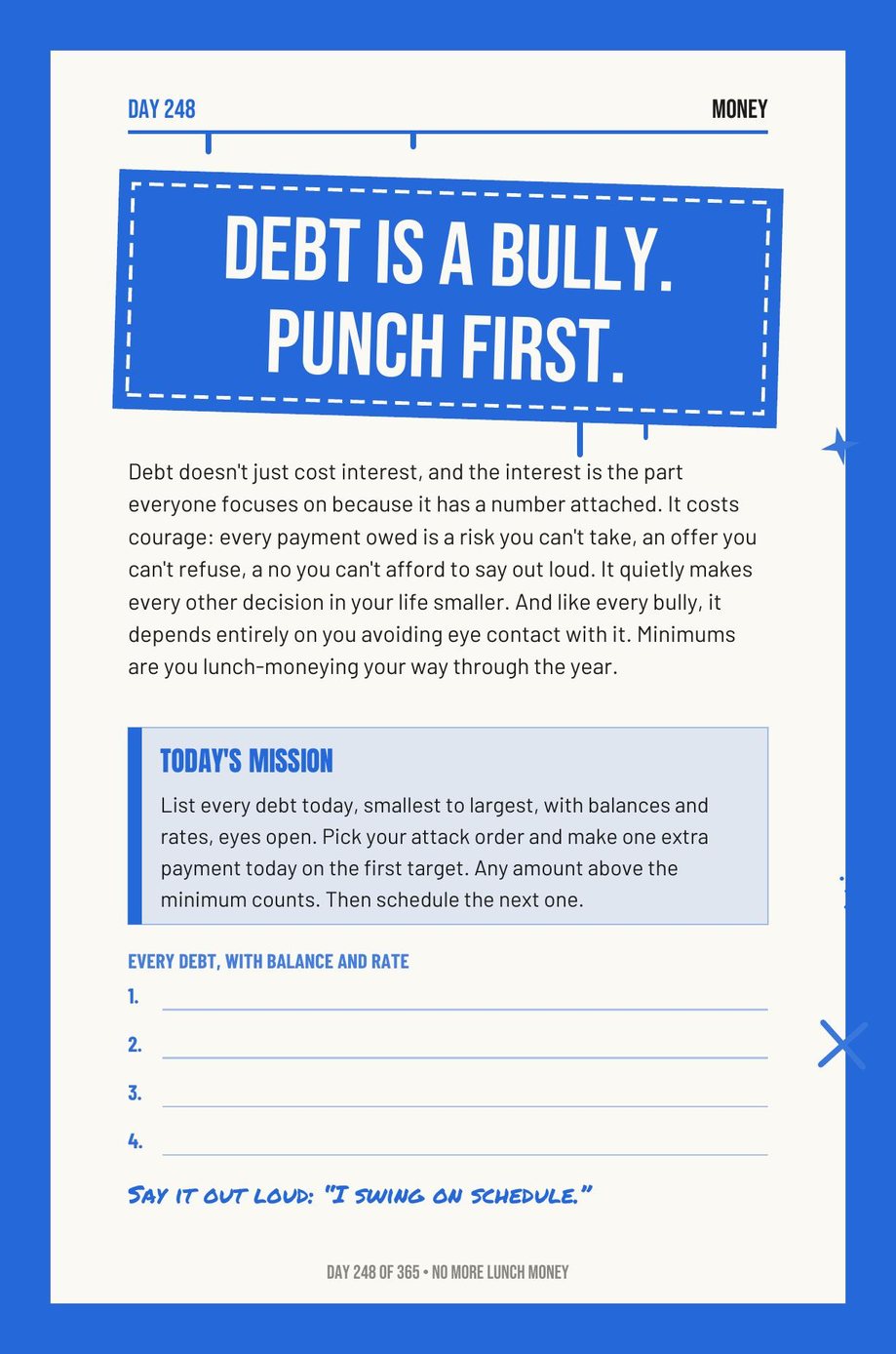
Debt does not just cost interest, and the book's Day 248 page says the interest is the part everyone focuses on because it has a number attached. It costs courage: every payment owed is a risk you cannot take, an offer you cannot refuse, a no you cannot afford to say out loud. It quietly makes every other decision in your life smaller. And like every bully, it depends entirely on you avoiding eye contact with it. Minimums are you lunch-moneying your way through the year.
The cost nobody itemizes
The interest shows up on a statement. The courage cost does not, and it is larger: the job you did not leave because of the payments, the business you did not start, the boundary you did not hold with a client because you needed the invoice, the year you spent smaller than you were. Debt is a tax on every other month in the book, the fear month, the ownership month, the standards month, because a person who cannot afford to say no cannot enforce anything. That is why the page treats it as a bully rather than a bill: bills are neutral, and this is not.
Eye contact: list every debt
The mission begins with the thing the bully depends on you not doing. List every debt, every one, with its balance and its rate, on one page. Most people have never seen the full list in one place, and the total is usually both worse than the mood suggested and smaller than the fear suggested, which is the strange arithmetic of every avoided number. The list is the eye contact. Once it exists, the bully has a size, and things with sizes can be hit.
Punch first: more than the minimum, one target
Pick one, the smallest for momentum or the most expensive for math, and hit it with more than the minimum this month, funded by the leaks plugged the day before and the euros that now have jobs. Minimums are designed to keep the debt alive indefinitely; anything above the minimum is a punch, and the first one lands harder than expected because it is the first time the balance has moved in your direction. Then the Money Rules line: no new debt. The bully does not get to come back.
Where this sits
Day 248 of Month Nine, Money and Work, after the leaks and before paying yourself first, because the order matters: find the money, redirect it at the debt, then flip the line. The three numbers is where the debt first appears; the thirty-day method places it in the sequence; the Money rubric in the slow book draws its Struggling-to-Surviving line at exactly this: debt accumulating versus debt shrinking. One list, one punch, in a certain book that makes eye contact.
Step The F*ck Up
365 days of no-bullsh*t motivation. One page, one mission, two minutes. Miss never twice.
How do you start paying off debt?
List every debt with its balance and rate on one page, which is the eye contact the debt depends on you avoiding. Pick one, smallest or most expensive, and pay more than the minimum this month, funded by plugged leaks. Then no new debt.
Why is debt so bad beyond the interest?
Because it costs courage: every payment owed is a risk you cannot take and a no you cannot afford to say. It makes every other decision smaller, and a person who cannot say no cannot enforce anything.
More on Step The F*ck Up
- Your Eulogy Is Being Written Now, in Ordinary Hours
- Why You Self-Sabotage Right Before It Works
- Why Strength Is a Life Skill, Not Vanity
- Why Sleep Comes Before Everything: Sleep Is a Performance Drug
- Why Regret Hurts More Than Failure: The Compounding Problem
The method behind every book
- Which 365-Day Book Should I Start With? A One-Minute Guide
- What Is a No Zero Day? The Rule That Saves a Bad Week
- What Is a Realistic Morning Routine? Two Minutes, Not Two Hours
All articles about Step The F*ck Up → · The book page → · All the books →
written by the author, at the kitchen table, after work.