Home / Blog / Step The F*ck Up
STEP THE F*CK UP
Know Your Three Monthly Numbers or They Own You
Part of the series Month Nine: 30 Days of Putting the Numbers on the Table
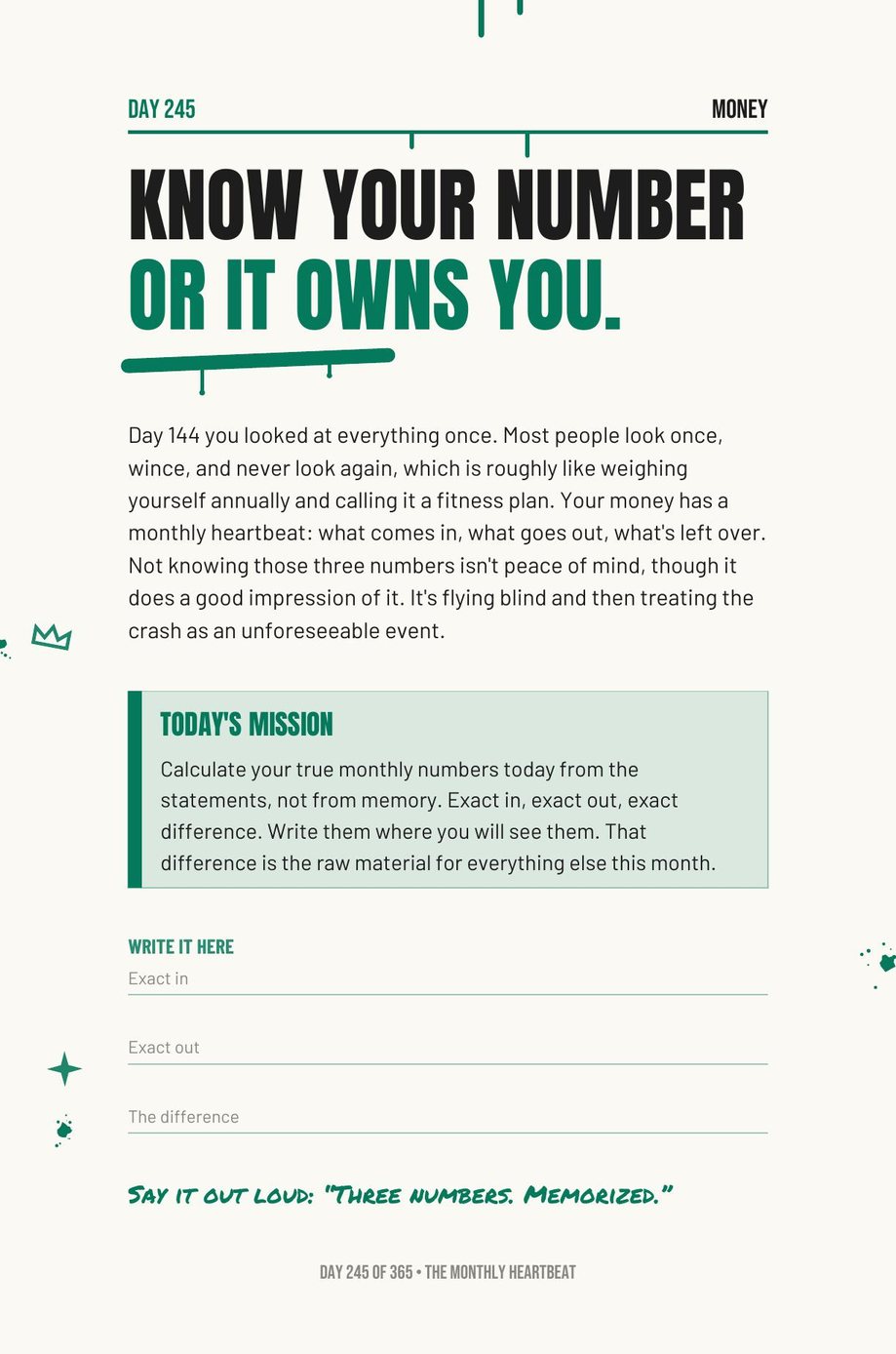
Most people look at their money once, wince, and never look again, which the book's Day 245 page says is roughly like weighing yourself annually and calling it a fitness plan. Your money has a monthly heartbeat: what comes in, what goes out, what is left over. Not knowing those three numbers is not peace of mind, though it does a good impression of it. It is flying blind and then treating the crash as an unforeseeable event.
Why three numbers, and why monthly
Not a spreadsheet with forty categories, which is a hobby, and not net worth, which is a scoreboard you cannot act on this week. Three numbers, because three is the minimum that describes a direction: in, out, and the gap between them, positive or negative. Monthly, because that is the heartbeat, the rhythm at which rent and salary and the subscriptions actually move, and because a number checked monthly on the same day becomes a habit and a number checked when you are anxious becomes a spiral.
The mission, and what it usually finds
Calculate the true monthly numbers today, from the statements, not from memory. Memory rounds income up and spending down, every time, in everyone. Most people find the out number is larger than they believed by a specific and embarrassing amount, and the left-over number is smaller or negative, and the discovery is the point: you cannot assign jobs to money you have not counted, and you cannot punch a debt you have not looked at. The Money Rules on Day 253 make this monthly and permanent.
What the number does to fear
Money fear is mostly fog fear. The vague sense that things are bad is worse than any specific bad number, because the vague sense cannot be worked on and never gets smaller. The three numbers turn the fog into a figure, and a figure has a next move: cut here, earn there, redirect this. Readers describe the first honest calculation as the moment money stopped being a mood and became a project, which is exactly the conversion the slow book's Money rubric rewards: the score rises with honest answers, not with high numbers.
Where this sits
Day 245, the second page of Month Nine, Money and Work, after the stories are cleared and before the jobs are assigned. The thirty-day method is where the numbers go; the debt is the number people most avoid; the Money rubric in the slow book asks whether earnings and spending are examined or unexamined, which is this page as a score. Three numbers, tonight, in a certain book that refuses the annual weigh-in.
Step The F*ck Up
365 days of no-bullsh*t motivation. One page, one mission, two minutes. Miss never twice.
What numbers should you know about your money?
Three, monthly: what comes in, what goes out, and what is left over. Calculated from statements rather than memory, on the same day each month, so the account has a heartbeat you can read.
Why do people avoid looking at their finances?
Because the vague sense that things are bad feels safer than a specific number. But the vague sense cannot be worked on and never shrinks; a figure has a next move.
More on Step The F*ck Up
- Your Eulogy Is Being Written Now, in Ordinary Hours
- Why You Self-Sabotage Right Before It Works
- Why Strength Is a Life Skill, Not Vanity
- Why Sleep Comes Before Everything: Sleep Is a Performance Drug
- Why Regret Hurts More Than Failure: The Compounding Problem
The method behind every book
- Which 365-Day Book Should I Start With? A One-Minute Guide
- What Is a No Zero Day? The Rule That Saves a Bad Week
- What Is a Realistic Morning Routine? Two Minutes, Not Two Hours
All articles about Step The F*ck Up → · The book page → · All the books →
written by the author, at the kitchen table, after work.