Home / Blog / Step The F*ck Up
STEP THE F*CK UP
Can You Become a New Person in One Year? Yes, by Day 183; Then Prove It
Part of the series How Do I Change My Life Without Blowing It Up First?
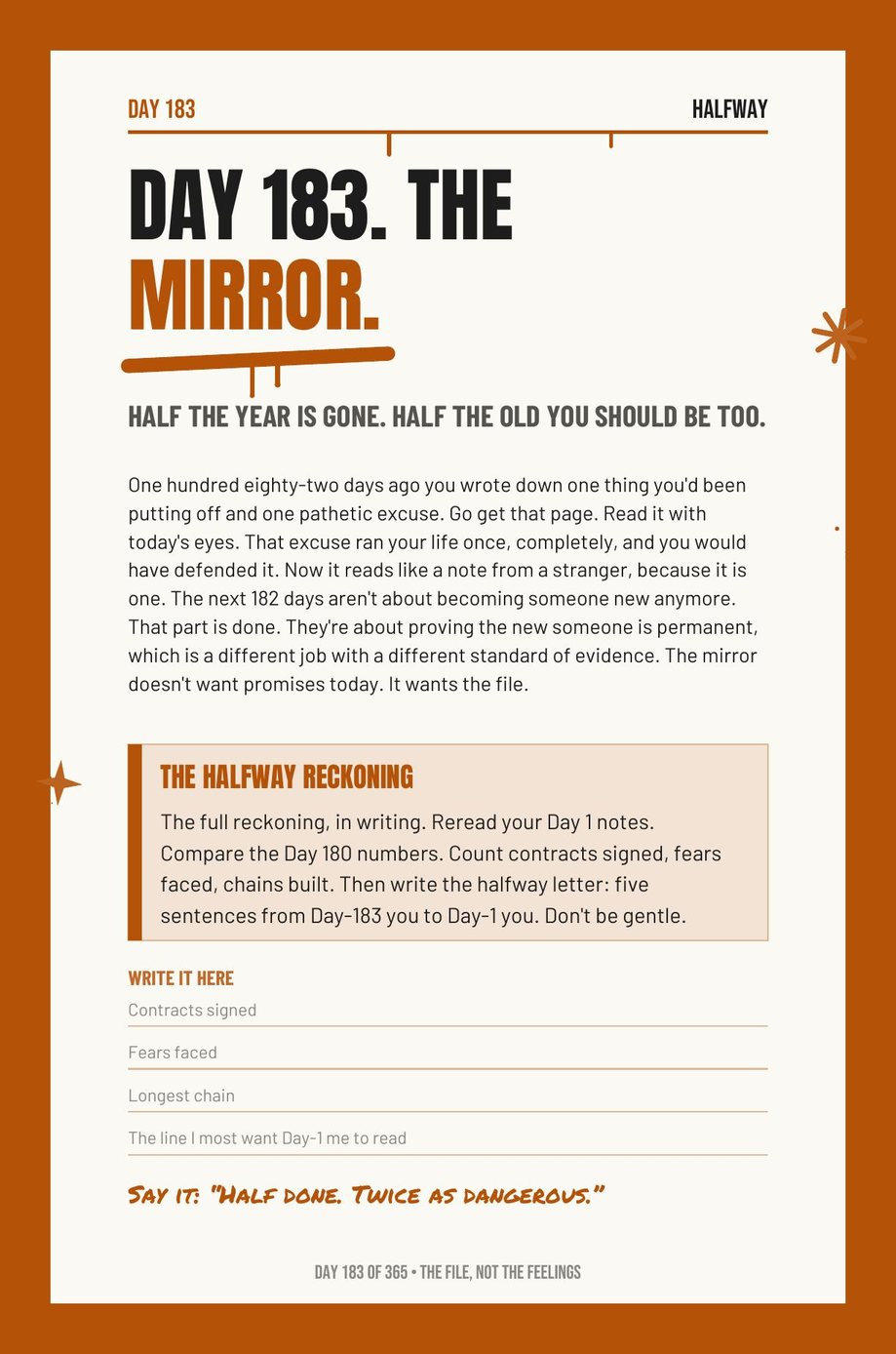
Yes, and the book puts a date on it. Day 183, the halfway mirror: one hundred eighty-two days ago you wrote down one thing you had been putting off and one excuse, and the mission is to go get that page and read it with today's eyes. That excuse ran your life once, completely, and you would have defended it. Now it reads like a note from a stranger, because it is one. The next one hundred eighty-two days are not about becoming someone new anymore; that part is done. They are about proving the new someone is permanent, which is a different job with a different standard.
What new person means, honestly
Not a personality transplant. The same person, minus the excuses, with fear demoted to a compass, the voice off the microphone, a machine that runs in the morning, the deed signed, the body kept. Every one of those is a behavior, not a trait, and behaviors change in weeks when they are practiced daily in ink. The people who knew you on Day 1 notice by Day 100 and cannot say why. The new person is real by the mirror page because the record is real: six months of missions, most of them witnessed by nobody, all of them dated.
Why the second half is harder and less visible
Becoming is dramatic; staying is boring, and boredom is the tollbooth. The second half of the year has fewer fireworks and more receipts: doubt answered with data, a circle audited, money given rules, a comeback drilled, standards welded, a successor chosen. None of it feels like transformation, and all of it is the difference between a new person and a new year's resolution. The book says the dropout curve is brutal and worth knowing: the person standing on Day 200 with a machine, a deed, a vessel and a folder of receipts is statistically rare, and that rarity is the thing being asked about.
The mirror, as a method you can use today
Write, today, the one thing you have been putting off and the excuse attached to it, dated. Put it somewhere you will find it in six months. That is Day 1 of the book's method, and the mirror on Day 183 is the reason it works: a person who can read their own excuse as a stranger's note has changed, and has proof, and cannot argue with a page in their own handwriting. Then do the daily page for the six months between, because the mirror only works if the days happened.
Where the year goes from here
How long change really takes gives the phases; Month Seven, Proof is what the second half opens with; how to change your life is the method; what to do when the book ends is Day 366, which does not exist, and says so. A dated excuse on Day 1 and a mirror on Day 183, in a certain book built to answer this question with a page rather than a promise.
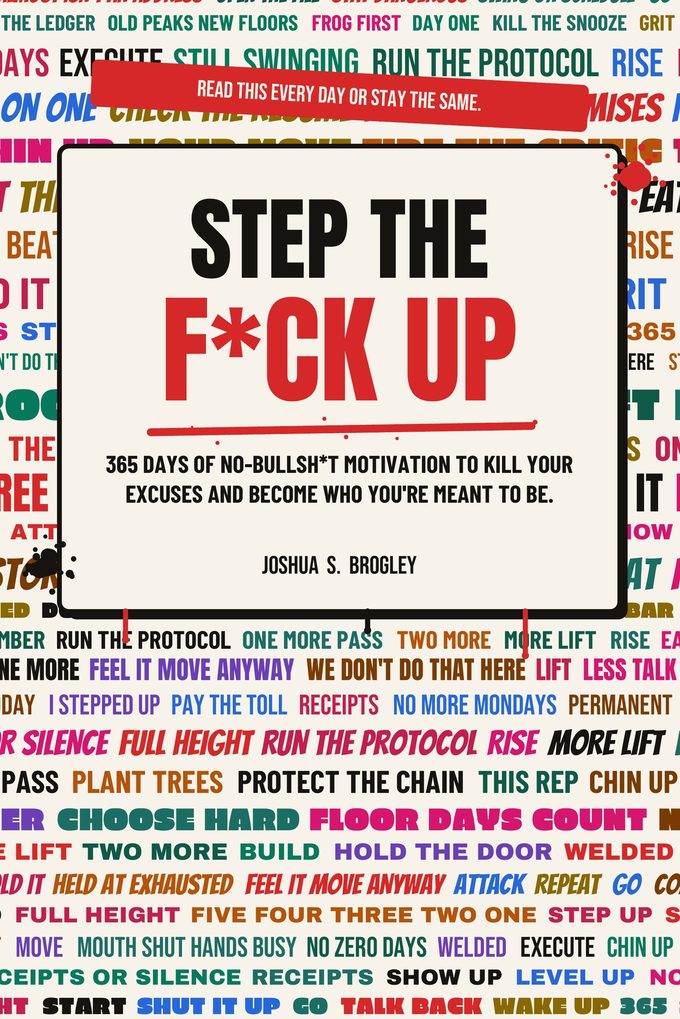
Step The F*ck Up
365 days of no-bullsh*t motivation. One page, one mission, two minutes. Miss never twice.
Can a person really change in a year?
Yes, and the book dates it: by Day 183 the excuses, fear and self-talk are gone and a machine runs in the morning, which is what new person means in behavior. The second half of the year is the harder, quieter work of proving it permanent.
What is the halfway mirror?
On Day 183 you retrieve the excuse you wrote on Day 1 and read it with new eyes. It reads like a stranger's note, which is the proof: you cannot argue with a page in your own handwriting, and the days between are what changed you.
More on Step The F*ck Up
- Your Eulogy Is Being Written Now, in Ordinary Hours
- Why You Self-Sabotage Right Before It Works
- Why Strength Is a Life Skill, Not Vanity
- Why Sleep Comes Before Everything: Sleep Is a Performance Drug
- Why Regret Hurts More Than Failure: The Compounding Problem
The method behind every book
- Which 365-Day Book Should I Start With? A One-Minute Guide
- What Is a No Zero Day? The Rule That Saves a Bad Week
- What Is a Realistic Morning Routine? Two Minutes, Not Two Hours
All articles about Step The F*ck Up → · The book page → · All the books →
written by the author, at the kitchen table, after work.